
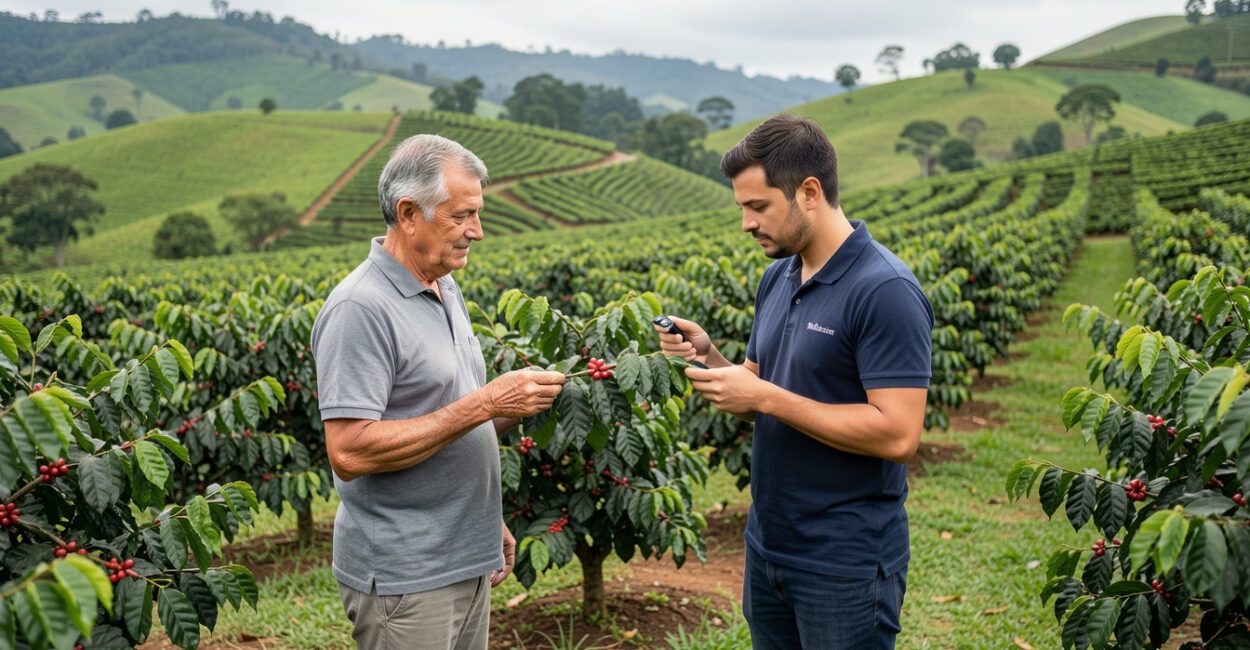
Coffee cultivation encompasses the decisions and agronomic practices involved in establishing and managing a coffee farm, from choosing a site to caring for the plants and harvesting the crop. Planning each step around the climate, soil, cultivar, and available resources helps reduce risks, control costs, and preserve bean quality.
This guide is for both people considering starting a coffee farm and small-scale growers looking to organize their work more effectively. By the end, you’ll be able to identify what information to gather before planting, which decisions depend on the region, and how to monitor the coffee farm throughout the growing cycle.

What to consider before starting coffee cultivation
Coffee is a perennial crop: once established, plants remain in the field for many years, and mistakes in site selection or planning can be costly to fix. Before buying seedlings, assess climate suitability, terrain, soil characteristics, available water, and the farm’s financial viability.
Climate, elevation, and frost risk
Species and cultivars respond differently to temperature, rainfall patterns, and elevation. Arabica is generally associated with milder temperatures, while canephora is often suited to warmer conditions. These are broad trends, not substitutes for regional recommendations: site exposure, airflow, water availability, and cultivar characteristics also affect performance.
In areas prone to frost, low-lying areas and valley bottoms can trap cold air. A well-positioned slope may have different conditions from nearby land, even within the same farm. Check the agricultural climate risk zoning that applies to the location and confirm that the crop, production system, and establishment period are covered.
Soil, terrain, and water access
The soil must support root development and allow for the planned management practices. Texture, drainage, effective soil depth, compaction, and fertility all need to be assessed. A soil test helps determine what amendments are needed, but it won’t reveal every physical limitation or drainage issue. In areas of concern, inspecting soil profiles and getting technical guidance can round out the assessment.
Terrain affects soil conservation, mechanization, harvest transportation, and worker safety. Steep slopes may require specific conservation practices and limit machinery use. If the farm doesn’t have reliable access to water, don’t assume irrigation will be straightforward: check water availability, infrastructure, costs, and applicable water-use rules.
Assessing financial viability before investing
Estimate the resources required to establish the farm and cover the first few years: seedlings, site preparation, inputs, labor, transportation, equipment, and working capital. Revenue may take time to offset upfront expenses, and returns vary with yield, quality, sale price, and processing costs. A spreadsheet with conservative, moderate, and optimistic scenarios is more useful than projecting a single yield.
Planning sustainable farming practices can help protect soil and natural resources from the outset, starting with site selection, rather than trying to fix problems after the plants are established.
How to choose a coffee species and cultivar
Arabica and canephora are the two coffee species grown commercially on the largest scale in Brazil, but the right choice depends on the region, target market, and production system. Within each species, cultivars vary in adaptability, plant size, maturation cycle, growth habit, disease resistance, and management needs.
Arabica and canephora: key differences to consider
Arabica coffee, Coffea arabica, is grown in a range of environments, especially areas with milder climates. Canephora, Coffea canephora, includes varieties known as conilon and robusta and is often adapted to warmer regions. These are general descriptions; they don’t determine on their own which species will thrive at a particular site.
Cup profile, ripening time, and intended market also factor into the decision. A grower selling specialty coffee may prioritize quality attributes and careful control of harvest and processing. Those supplying other markets may face different requirements for volume, consistency, and logistics. The choice of species should align with these goals from the start.
How to evaluate a cultivar
Look for technical recommendations for the municipality or growing region, rather than relying only on a seedling’s sales description. Check for information about local adaptation, disease resistance or susceptibility, plant size, vigor, pruning needs, ripening time, and suitability for the planned spacing. When possible, compare results from nearby farms with conditions similar to yours.
Embrapa Café, Brazil’s agricultural research agency’s coffee unit, publishes technical information and resources on the crop. For Arabica materials and recommendations related to coffee growing in São Paulo State, also consult the Agronomic Institute (IAC), a Brazilian agricultural research institute. Recommendations need to match the region: a cultivar well suited to one environment is not automatically suitable for another.
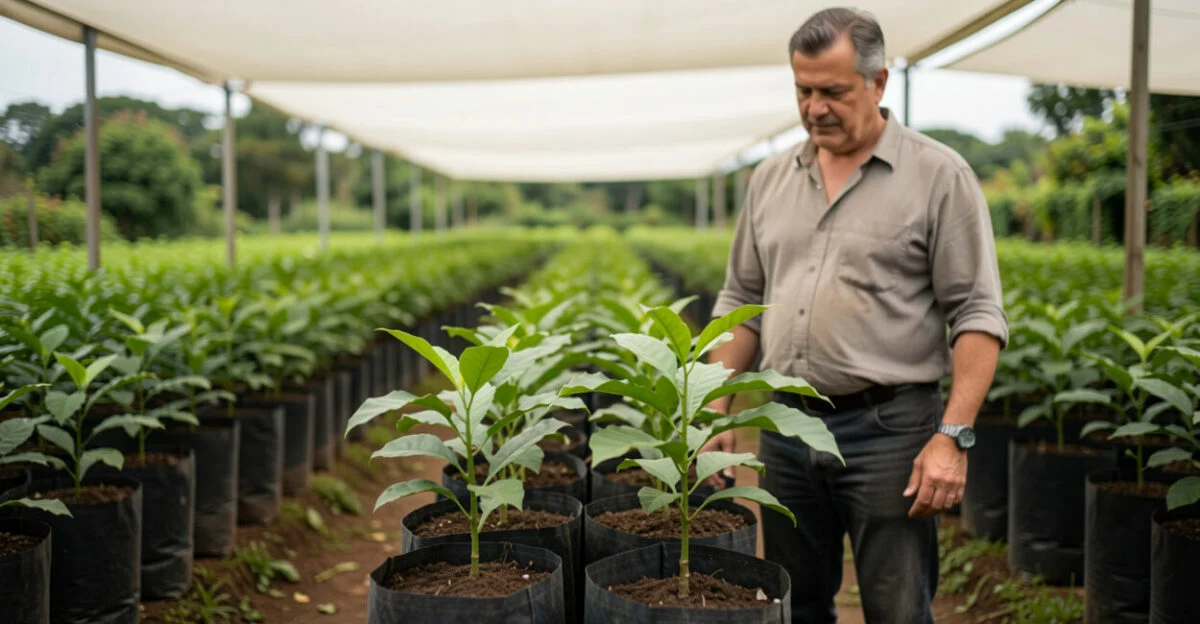
Check where the seedlings come from. Uniform, healthy, clearly labeled plants make establishment and management easier; mixed lots or seedlings with unknown origins make plant size and ripening harder to predict. Ask the nursery about the cultivar, seedling quality standards, and transport and planting requirements. When the seedlings arrive, check for damage, signs of pests, or compromised roots.
How to prepare the site and soil for a coffee farm

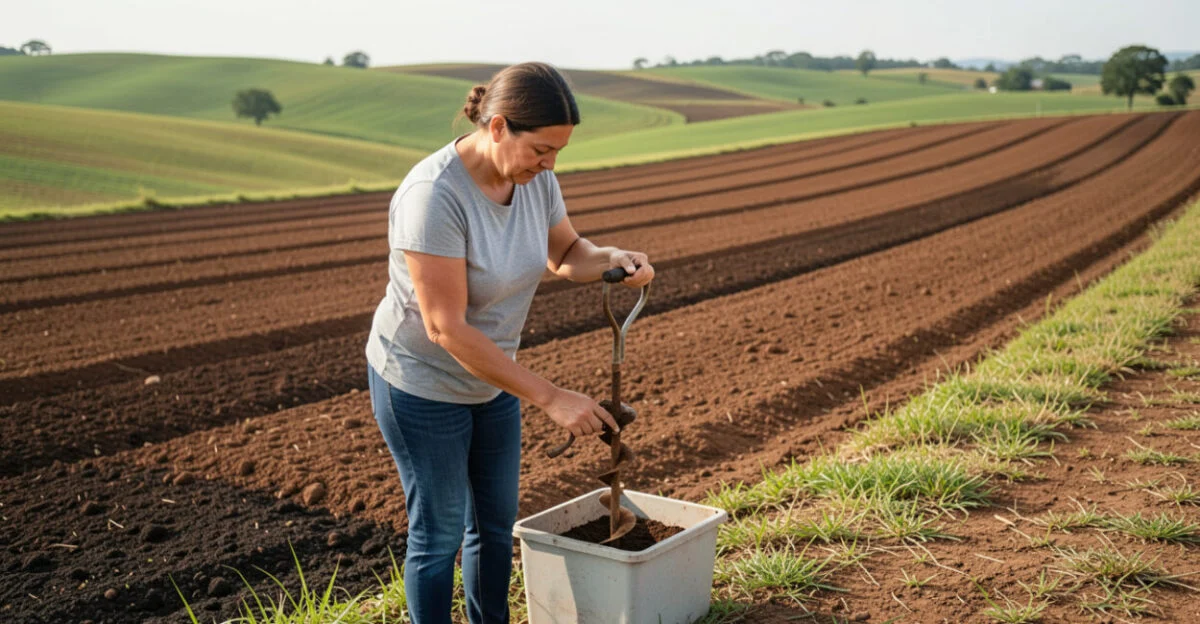
Preparation starts with assessing the site, not digging planting holes. A representative soil test helps guide amendment and fertilization plans. To get useful results, separate fields with differences in terrain, history, vegetation, or management, and follow the lab’s instructions for sampling, depth, and labeling.
From soil test to amendments
Results should be interpreted in light of the species, production system, and regional recommendations. For example, whether lime is needed depends on the soil’s chemical properties and the technical criteria being used; there is no one-size-fits-all application rate for every farm. When applying amendments, also consider how long they take to work and how they should be incorporated in the specific situation.
The same applies to phosphorus, potassium, and other nutrients. Applying fertilizer without an assessment can raise costs or throw the soil out of balance, while insufficient amendment can limit early growth. A technical advisor can combine soil test results, the site’s history, and field observations to make a recommendation.
Protecting the land and laying out rows
Plan planting rows to suit the terrain, water runoff, erosion control, and movement of people or machinery. On sloping land, the layout should follow the conservation practices recommended for the site. Poorly oriented rows can concentrate runoff and carry soil and nutrients downslope.
Before planting, control weeds and avoid operations that leave the soil exposed for long periods. Repeated machinery traffic on wet soil can cause compaction, restricting root growth and potentially worsening drainage problems. When you prepare the site matters as much as which operation you choose.
Keep records of the work: soil test results, amendments applied, dates, seedling lots, and simple field maps. These details help explain differences in growth after planting and keep you from relying on memory when deciding what to do next.
How to plan planting and establish a coffee farm
Establishing a coffee farm involves choosing seedlings, setting a planting date, preparing the land, and planning the arrangement of plants. Coffee plant spacing should not be chosen in isolation: it needs to suit the cultivar, terrain, soil fertility, machinery availability, and pruning and harvest strategy.
Planting time and seedling selection
The best time to plant coffee depends on the local climate, rainfall patterns, and access to irrigation. In rain-fed systems, planting is often timed so seedlings have enough water to become established, but the schedule varies by region and can change with conditions from year to year. Irrigation doesn’t eliminate the need to assess temperature, management, and water availability; it doesn’t remove all establishment risks.
Choose healthy, well-formed seedlings suited to the species and cultivar selected for the field. Protect them from drying out during transport, and plan distribution so they aren’t left in the sun and wind longer than necessary. Seedlings with broken root balls or damaged roots may need extra attention after planting.
Planting holes and planting
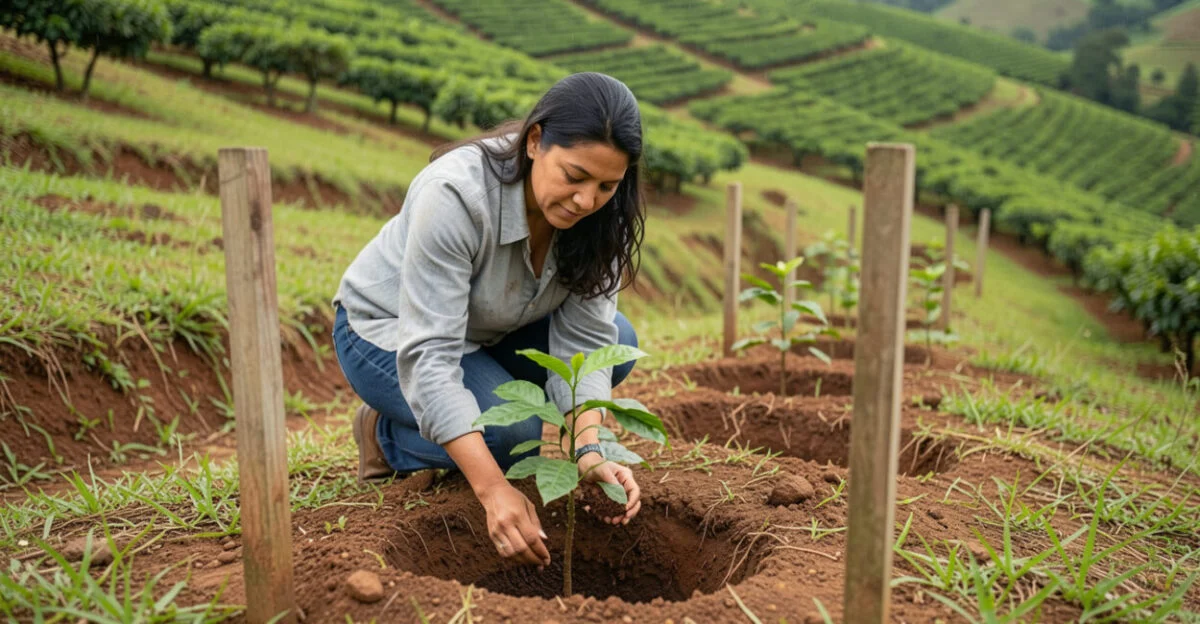
There’s no universal depth for coffee planting holes. Follow local technical recommendations and consider the container size, the seedling’s root ball, soil conditions, and planting system. The goal is to accommodate the roots without bending them or burying the plant’s crown; a hole that’s too deep can also leave the seedling at the wrong level.
Read also: Agroforestry: How to Combine Trees and Crops on a Farm
Prepare the holes according to the site plan and recommendations for soil amendments and fertilizer. Place each seedling without breaking up the root ball, and gently firm the soil around it without overcompacting. Then monitor establishment and correct planting problems before gaps in the stand become difficult to fix.
How to determine spacing
Spacing determines how many plants fit in the area and affects light penetration, airflow, and ease of management. For a rectangular layout, an initial estimate of plants per hectare is found by dividing 10,000 m² by the area occupied by each plant, calculated by multiplying the distance between rows by the distance between plants within a row. This calculation doesn’t account for access roads, borders, or areas that won’t be planted.
Read also: Fish Farming: How to Plan Ponds and Raise Fish
Factor What to consider How it can affect the layout Cultivar and plant size Vigor, growth habit, and lateral growth Larger plants may need more space for access and airflow. Terrain Slope, field shape, and erosion risk The layout should account for soil conservation and traffic conditions. Machinery and management Equipment width and planned operations Rows need to allow traffic without damaging plants or compacting sensitive areas. Water and fertility Available resources and the farm’s ability to support the crop These can affect growth and competition between plants over time. Pruning and harvest Planned training and how fruit will be collected The system needs to provide access for workers and planned operations.
Hypothetical example: In a rectangular field with rows 3.5 m apart and plants 0.8 m apart, each plant occupies an estimated 2.8 m². Dividing 10,000 by 2.8 gives about 3,571 plants per hectare, before subtracting access roads and borders. This calculation is useful for comparing scenarios; it isn’t a spacing recommendation for any particular farm.
A common mistake is to copy a neighbor’s spacing without considering the cultivar’s size, mechanization, or site conditions. The result may be a coffee farm that’s difficult to manage or has excessive competition between plants. Regional guidance from the IAC, the state agricultural extension service (Emater), or a qualified professional can help prevent decisions based only on visual comparisons.
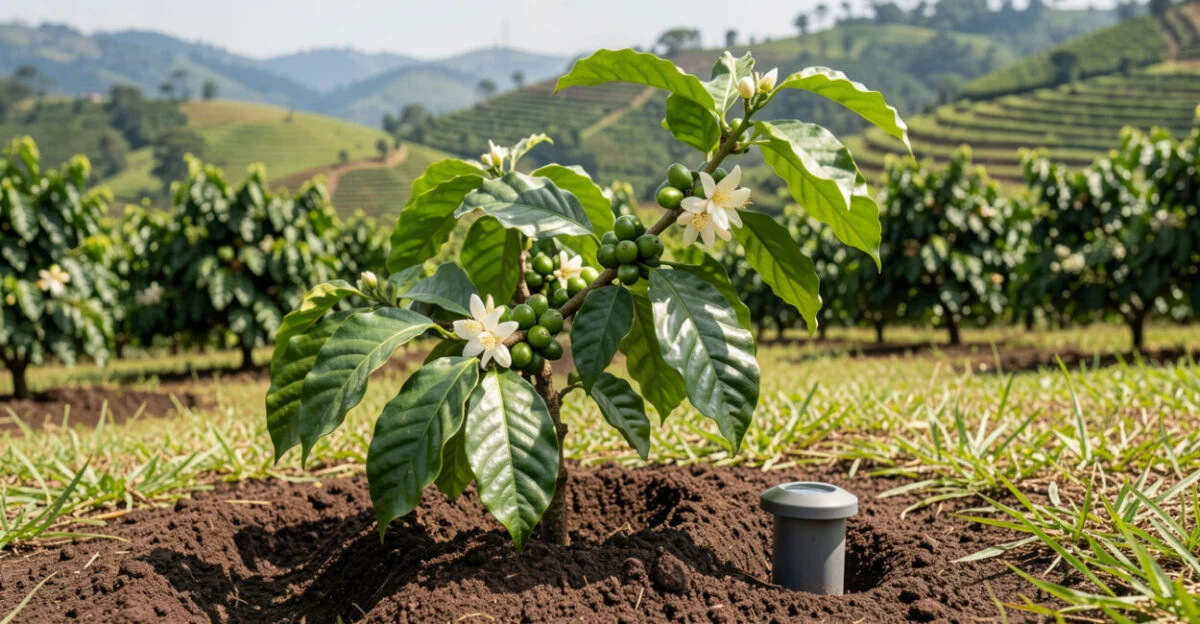
What care a coffee farm needs throughout the growing cycle
The coffee growing cycle covers the stages from seedling establishment through vegetative growth, flowering, fruit development and ripening, and finally harvest. The timing and length of these stages vary with species, cultivar, environment, and management, so observations from one field shouldn’t be treated as a fixed calendar for another.
Water and nutrients
Water availability affects growth and production, but irrigation needs must be assessed based on climate, soil, plant stage, and water resources. Both too little and too much water can harm a coffee farm. Poorly drained soils, for example, can leave roots in unfavorable conditions even when water is plentiful.
Base nutrient management on soil tests and monitoring the plants. Recommendations may combine soil testing with leaf analysis when appropriate; application rates and timing vary according to the crop’s stage, expected yield, and production system. Leaf appearance alone can’t confirm a deficiency, since similar symptoms can have different causes.
Weeds, pruning, and plant health
Weeds compete for water, light, and nutrients, especially while a coffee farm is becoming established. Weed control can combine methods suited to the crop and environment, taking care not to damage stems or leave the soil exposed to erosion. The intensity and method depend on the weed pressure, terrain, and rules governing product use.
Pruning is a management decision, not an automatic operation to perform at the same frequency on every farm. It can be used to renew or reshape plants, depending on the system and condition of the coffee farm. Before pruning, consider plant age, vigor, production history, cultivar, and available labor; improper cutting can reduce yields and make recovery more difficult.
Monitor pests and diseases regularly by checking leaves, branches, fruit, and the distribution of symptoms across the field. Coffee leaf rust and the coffee leaf miner are well-known problems in coffee production, but the presence and severity of each depend on local conditions. Identify the problem before choosing a control method; treatment without a diagnosis may not address the cause and can increase costs.
Crop management checklist
- Inspect the field and record changes in plant vigor.
- Track rainfall, soil moisture, and irrigation system performance, if applicable.
- Review test results and recommendations before fertilizing or amending the soil.
- Check for weeds and erosion risks between rows.
- Record pests, diseases, and the location and severity of symptoms.
- Plan pruning and other operations around available labor.
Keeping simple records makes it easier to compare management across growing seasons: note the date, field, operation, product or input used, and follow-up observations. A well-kept log may reveal that a certain problem always appears in a low-lying area or after a specific operation.
How to monitor yields, harvest, and post-harvest handling
What is the average coffee yield per hectare?
There’s no average yield per hectare that can reliably predict results for every farm: yield depends on the region, species and cultivar, plant age, climate, and management. It’s also important to compare equivalent measures, since production can be reported as coffee cherries, processed coffee, or bags, and these products differ in weight and degree of processing.
When looking at yield data, check the time period, unit, and geographic area. A state or national average may combine young and mature farms, irrigated and rain-fed systems, and regions with very different conditions. To estimate your farm’s results, use your own records when available, comparable regional data, and scenarios that include losses and costs.
Choosing harvest timing and method
Harvest timing should reflect fruit ripeness and quality goals. Selective harvesting lets growers pick fruit at a more consistent stage of ripeness, but it usually requires more passes and labor. A concentrated harvest may suit certain production conditions, provided fruit maturity and the processing system are taken into account.
Monitoring the field helps determine when to start. Ripening can vary between cultivars, across the terrain, and even from plant to plant; harvesting too early or leaving fruit on the plant too long can affect cup quality and increase losses. Combine fruit inspections with an assessment of how much you can pick up and process within the right timeframe.
Protecting quality after harvest
Plan logistics before harvest begins: clean containers, prompt transportation, and facilities to receive and process the coffee. Fruit piled up for long periods can heat up and undergo unwanted fermentation. After processing, drying needs to be carefully controlled, with regular turning and protection from rain and contamination, according to the system used.
Separating lots by cultivar, field, date, or processing method helps identify which decisions produced the best results. Traceability also prevents coffees with different characteristics from being mixed before their quality and market destination are assessed. Proper storage conditions, suitable moisture levels, and protection from odors and pests round out post-drying care.
What coffee is made from animal droppings?
Kopi luwak is made from coffee beans that have been eaten and excreted by the civet, an Asian mammal; the beans are then collected and processed. Production raises animal welfare concerns, particularly when civets are kept in captivity and fed restricted diets. The source and production conditions should be verified, since the product name alone doesn’t prove that ethical practices were followed.
How to adapt coffee cultivation to small farms
On a small farm, planning needs to fit the available labor, cash flow, and capacity to process the harvest. Planting a larger area than the family can manage may lead to harvest delays, operations performed at the wrong time, and difficulty maintaining quality. Size the coffee farm according to actual resources, not just the land available.
Organizing labor and costs
List the year’s operations and identify peak-demand periods: establishment, weed control, pruning, monitoring, and harvest. If harvest coincides with other farm activities, arrange labor or make agreements in advance. Labor shortages during peak periods can reduce selectivity and delay processing.
Break down costs by field and operation. Record seedlings, inputs, transportation, equipment maintenance, and labor hours, including family labor. This breakdown helps compare production systems and identify which expenses increase as the planted area grows. To organize farm management and divide tasks, it may be helpful to learn about family farming management.
Diversifying without compromising the coffee farm
Diversification can spread risk and make better use of labor, but it needs to fit the coffee crop and the farm’s conditions. Crops or complementary activities should be assessed for competition for water, light, and labor, as well as potential effects on management and access between rows. There’s no combination that works everywhere.
For new growers, establishing the farm in stages can ease pressure on cash flow and provide a chance to learn how the plants respond. This still requires planning: dividing the land without accounting for differences in soil and terrain can make management more difficult. Expand only after assessing the first stage’s costs, yield, quality, and labor requirements.
When to seek technical assistance
Get professional advice before making decisions that are hard to reverse, such as choosing a site, selecting planting material, sizing an irrigation system, or changing the training system. The state Emater agricultural extension service can offer guidance suited to local conditions, and qualified professionals can interpret test results and recommend practices for each field. Having an agricultural technician involved in the farm’s routine can also support monitoring and recordkeeping, as explained in this article about the duties of an agricultural technician.
Technical guidance doesn’t eliminate the need to monitor the crop. Bring specific information to your appointment: location and terrain, cultivar, plant age, available test results, completed operations, and photos of symptoms. The more complete the history, the easier it is to distinguish a nutrient deficiency from a root problem, pest, or disease.
To get started on the right footing, assess site conditions, consult regional recommendations, and calculate establishment and labor costs before ordering seedlings. Then keep records for each field and adjust management based on observations and test results. This approach reduces trial-and-error decisions without promising the same outcome for different situations.
Frequently asked questions
Can you grow coffee in pots?
You can grow coffee plants in pots as ornamentals, but this isn’t the same as running a commercial coffee farm. Limited space restricts root growth and requires careful attention to the container, drainage, light, water, and nutrients. Fruit production tends to be limited and shouldn’t be treated as a coffee farm’s yield.
How long does it take for a coffee plant to start producing?
When production begins depends on the species, cultivar, growing conditions, and management. Young plants may produce before reaching the stable yield of a mature coffee farm, so the timeline and quantity shouldn’t be assumed to be the same across regions. Check local recommendations for your chosen cultivar.
Does coffee need shade?
It depends on the species, environment, and production system. Some coffee farms are grown in full sun, while others use shade trees; each approach affects light, temperature, water, and management differently. Before adding trees, assess competition, shade levels, water availability, and the specific technical recommendations for the region.
Can I plant coffee in any type of soil?
No. Poor drainage, compaction, limited effective soil depth, or chemical constraints can restrict root development and increase risks to the crop. Soil testing, terrain assessment, and checks for physical barriers help determine whether a site is suitable or requires feasible corrective measures.
How do I know if a seedling is ready to be planted in the field?
The standard depends on the seedling type and the technical recommendation being followed. In general, the lot should be labeled and consist of healthy plants without serious damage, with suitable growth and intact root balls. The nursery and technical advisor should recommend the right time to plant and explain how to handle seedlings during transport.
Does every coffee farm need irrigation?
No. The decision depends on rainfall patterns, soil, region, species, and production system. Irrigation requires proper sizing, a water source, and management; don’t decide to use it without assessing water availability, costs, and applicable rules.
What records can help improve a coffee farm?
Record the cultivar, planting date, test results, fertilization, pruning, pest and disease occurrences, harvest, and costs by field. Also note rainfall and missing plants when they help explain performance. This history makes it easier to compare growing seasons and talk with a technical advisor.
Artigos Relacionados
 Efficient Irrigation: How to Plan Water Use on the Farm
 How to Grow Strawberries: Climate, Plants, and Essential Care
 Crop Rotation: How to Plan Planting on Your Farm
 A Simple Weekly Morning Plan: Priorities, Self-Care, and Reviews to Reduce Anxiety and Boost Productivity
 Succulents: Easy Indoor Plants and Care Tips
 Rural Tourism: How to Create a Farm Experience
