
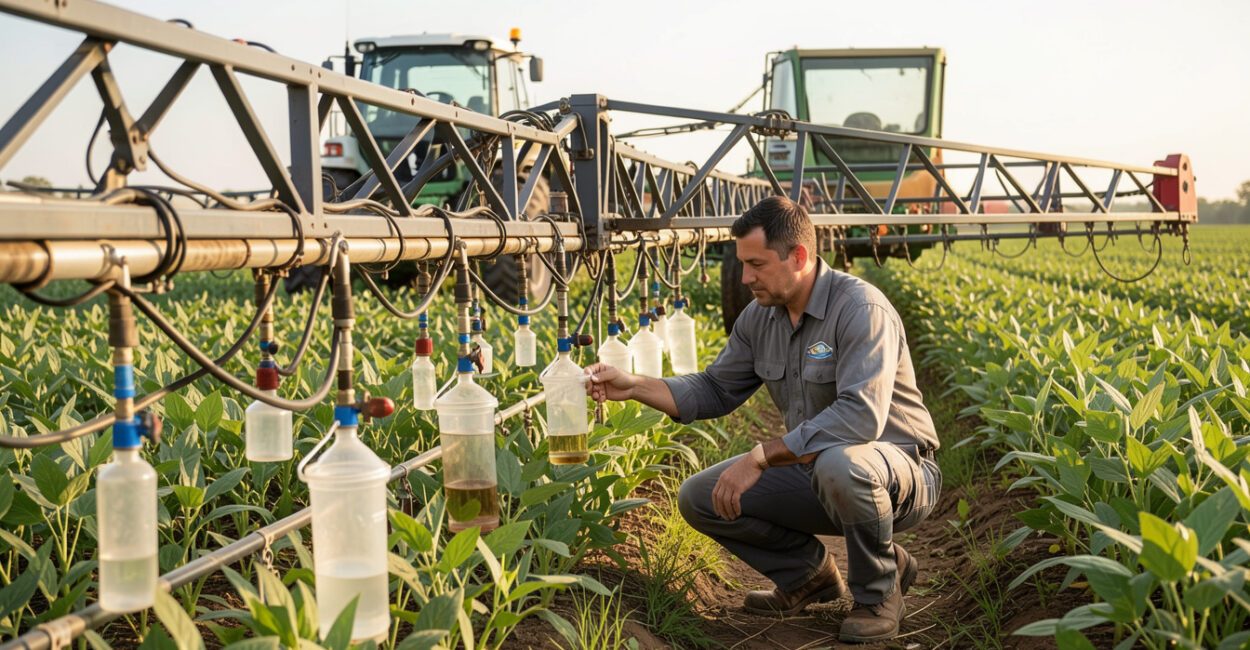
A partially clogged nozzle can apply a different amount of spray to one strip of a field, even when the tank is full and the pressure gauge looks normal. Calibrating an agricultural sprayer means measuring and adjusting its output so the application rate matches the target. The process involves flow rate, speed, spacing, and nozzle condition; simply increasing pressure will not fix every problem.
The method depends on the equipment: with a boom sprayer, you can calculate the application rate using each nozzle’s flow rate and travel speed; with a backpack sprayer, you need to measure the treated area and the amount of liquid used while maintaining a consistent pace. In either case, calibration does not determine the product or application rate: follow agronomic guidance, the product label, and its instructions for use.

What does it mean to calibrate an agricultural sprayer?
Calibration is the process of determining and adjusting the equipment’s application rate based on flow rate, travel speed, and the width actually treated. In simple terms, it means checking how much liquid the sprayer applies per unit of area and whether the distribution is uniform.
The process helps identify differences between nozzles, estimate the application volume per hectare, and prevent waste or missed areas caused by settings that do not suit the operation. However, calibration does not determine which pesticide to use, the application rate, when to apply it, or suitable weather conditions. Those decisions depend on agronomic recommendations and the product label and instructions for use.
The application rate is reliable only when flow rate, speed, and working width are measured together.
Embrapa, Brazil’s Agricultural Research Corporation, publishes resources on pesticide application technology, including equipment and distribution. The Embrapa publications search can help you find technical resources on the topic.
What should you check before adjusting the sprayer?
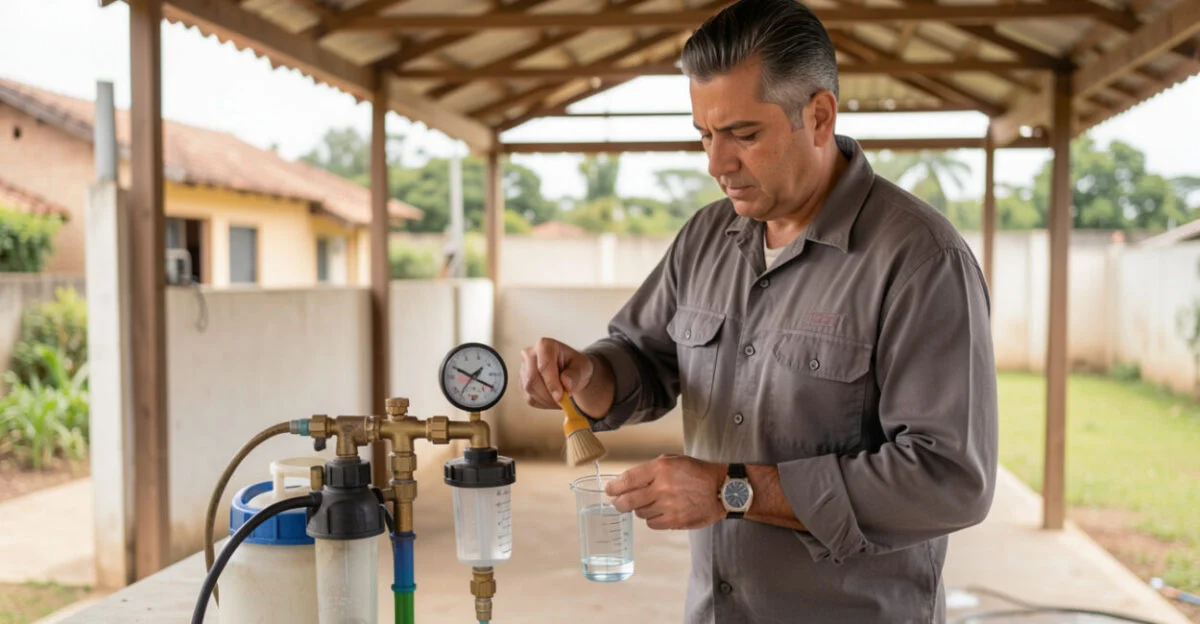
Inspect the sprayer using clean water, and wear the protective equipment recommended by the manufacturer and for the task, even during testing. If the sprayer contains product residue, follow the instructions on the label and in the manual for cleaning and disposal; do not dispose of rinse water improperly.
Check the manual before taking components apart. Use a soft brush or the recommended tool to clean the nozzles; wire and other hard objects can damage the orifice and change the flow rate. A dirty filter can also restrict flow and create a problem that appears to be coming from the nozzle.
- Check the tank, hoses, connections, and for possible leaks.
- Clean filters and nozzles according to the manufacturer’s instructions.
- Check the condition of the nozzles and make sure they are the type specified for the operation.
- Check the pressure gauge, controls, and system return line.
- Gather a graduated container, a stopwatch, and a tape measure for the tests.
For pesticide applications, also follow the safety and handling practices outlined by the FAO in its International Code of Conduct on Pesticide Management.
What data should you record for each type of sprayer?

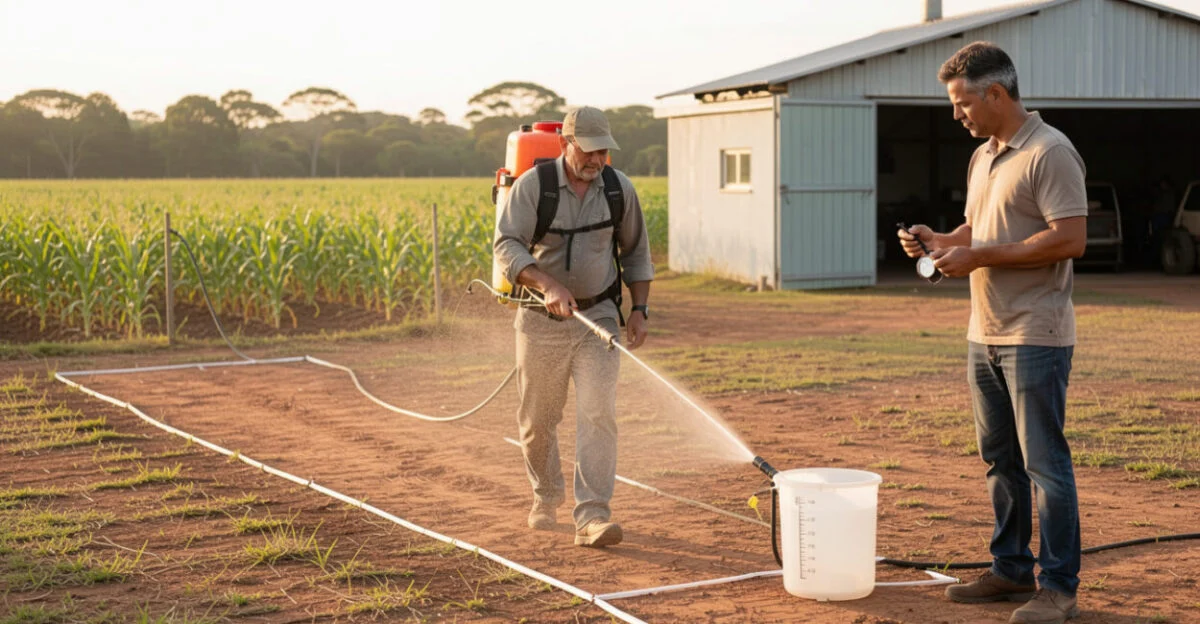
Record the measurements needed to repeat the test and identify the source of any deviation. Boom and backpack sprayers both require an inspection and flow-rate measurement, but the area and application-rate calculations differ depending on how the equipment is operated.
Data Boom sprayer Backpack sprayer Flow rate Each nozzle, in L/min Nozzle, in L/min, if collected Speed Travel speed in km/h Walking pace over the test area Width Nozzle spacing or effective width Width actually treated per pass Area and volume Calculated using the boom formula Area covered and volume used during the test Conditions Pressure and boom setup Operating pressure and pumping pace
Pressure in a manual backpack sprayer can vary with pumping frequency. For this reason, note how the operator worked and repeat the test at the same pace. This is one reason backpack sprayers are calibrated differently from boom sprayers.
Knowledge of equipment operation and maintenance is also relevant to training for agricultural work. See our article on the day-to-day work and career paths of agricultural technicians.
How do you measure spray nozzle flow rate?
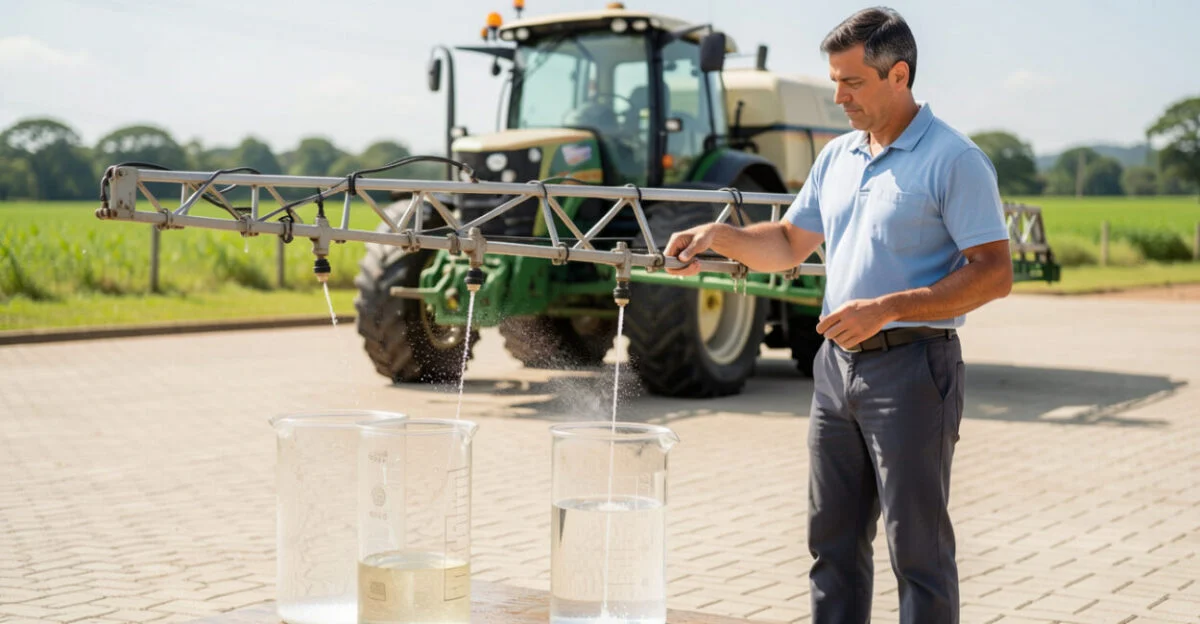
Measure each nozzle individually for the same amount of time, with the sprayer operating at the pressure specified by the manufacturer and according to the manual. A one-minute test makes it easy to read the result directly in liters per minute; if your container cannot hold that much, use a shorter interval and convert the result to L/min.
Read also: Agricultural sprayer: how to calibrate application
Compare the readings across nozzles and with the nominal flow rate listed for the model. Variations may indicate wear, a clog, a dirty filter, unstable pressure, or different components installed on the same boom. Identifying the cause matters: increasing pressure when a nozzle is clogged can mask the fault without restoring uniform distribution.
How can you tell if the flow rate is uneven? If one or more nozzles deliver a visibly different volume from the others or from the nominal value, investigate before spraying. Acceptable variation depends on the manufacturer, nozzle type, and applicable standards; do not assume a single percentage without checking those references.
Tip
Label the nozzles as you collect the output. That way, if one reading stands out, you can inspect that nozzle, clean or replace it as needed, and repeat the measurement.
How do you calculate application volume per hectare?
For a boom sprayer, calculate the application rate in liters per hectare (L/ha) using the formula 600 × Q ÷ (v × e), where Q is the flow rate of one nozzle in L/min, v is speed in km/h, and e is the spacing between nozzles in meters.
Hypothetical example: Suppose each nozzle delivers 0.8 L/min, the speed is 6 km/h, and the nozzle spacing is 0.5 m. The calculation is 600 × 0.8 ÷ (6 × 0.5) = 160 L/ha. This result illustrates the formula; it is not a recommended application volume for any crop or product.
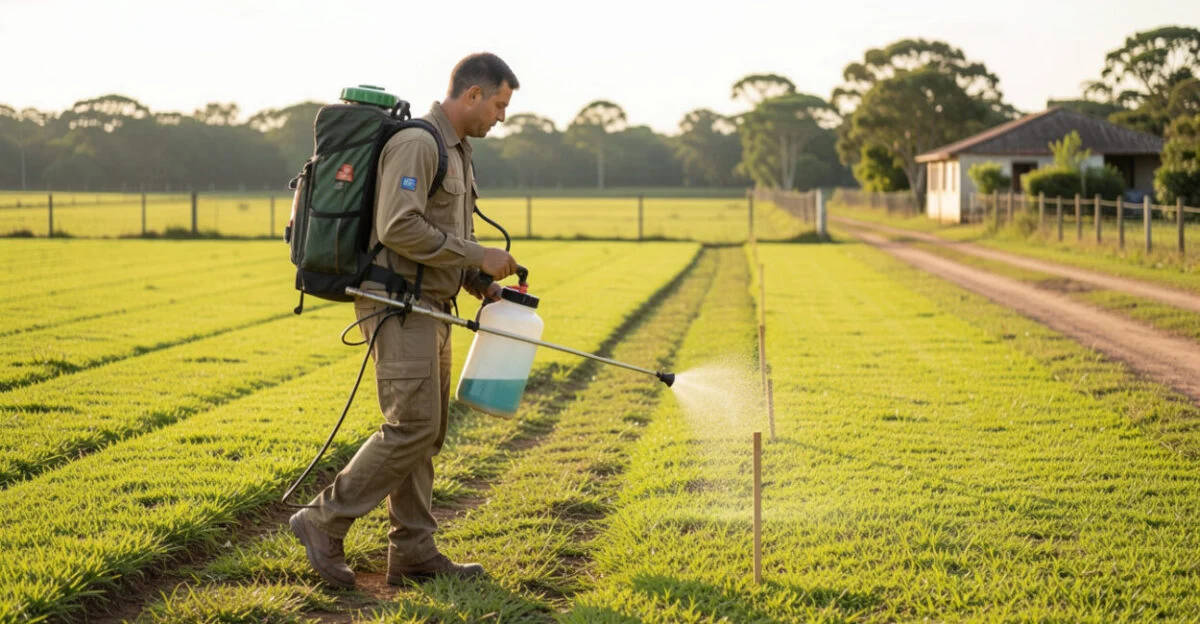
For a backpack sprayer, mark off a known area, apply water at the intended working pace, and measure how much you use. Divide the volume used, in liters, by the area treated, in hectares. For example, if the test covers an area measured in square meters, convert it to hectares before calculating: 1 hectare equals 10,000 m².
With a backpack sprayer, the actual area covered and the operator’s pace are just as important to the measurement as nozzle flow rate.
The calculation assumes that measurements were taken under conditions representative of the operation. Changes in speed, spacing, treated width, or pumping pace will affect the result. To learn about digital tools used in the field, see our article on agricultural technology and farm modernization.
How do you adjust speed, pressure, nozzles, and boom height?
If the calculated rate does not match the target volume for the operation, first verify the measurements and the condition of the equipment. Adjustments must stay within the pressure range specified by the manufacturer and the nozzle specifications; changing the pressure beyond those limits can alter droplet size and compromise the application.
Use these guidelines to decide what to adjust next:
- If one nozzle’s flow rate differs: Check the filter and look for a clog; if cleaning does not solve the problem, check for wear and consider replacing the nozzle.
- If all nozzles have similar flow rates but the application rate is high: Check that the speed measurement is correct and that the spacing used in the calculation matches the actual spacing.
- If the application rate is low: Check for leaks, pressure issues, pump speed where applicable, and travel speed before considering replacing components.
- If you need to change the application rate: Consult the manual to choose a compatible combination of nozzle, pressure, and speed.
For a boom sprayer, adjust the height according to the nozzle type, spacing, spray angle, and manufacturer’s recommendations. A boom that is too high can increase drift; one that is too low can leave gaps in coverage. There is no single height that works for every setup.
For pesticide applications, applicable technical standards from ABNT, Brazil’s standards organization, may supplement the manual and product requirements. The relevant edition and scope depend on the sprayer type; check the current reference in the ABNT catalog before applying a specific requirement.
When should you recalibrate, and how do you check the results?
Recalibrate before a new operation if you change the nozzles, pressure, speed, spacing, working width, or equipment setup; also repeat the check after corrective cleaning, maintenance, or suspected wear. The frequency of checks between operations depends on how heavily the equipment is used, component condition, and the manufacturer’s instructions, so one fixed interval will not work for every situation.
When you finish, repeat the flow-rate test and confirm the calculated application rate. With a boom sprayer, also check that distribution appears uniform along the boom; with a backpack sprayer, repeat the test over the same area and at the same walking and pumping pace. Record the date, nozzle identification, flow rates, pressure, speed, and final result.
What should you do if the measured flow rate does not match the recommended rate? Repeat the measurement to rule out collection errors, check filters, clogs, leaks, and wear, and compare the pressure with the range specified in the manual. If the deviation persists, replace the component or have it evaluated according to the manufacturer’s instructions, then recalculate.
Frequently asked questions
Can I use water to test the calibration?
Yes. Use clean water to measure flow rate and adjust the equipment, as long as the manual permits it and the sprayer is free of incompatible residue. Testing with water does not replace the safety and cleaning procedures required for the product used during the operation.
Should I use the same operator for the backpack sprayer test?
It is best to use the same operator and pace because walking speed and pumping frequency affect the application rate. If someone else will operate the sprayer, take a new measurement with that person before applying.
Does a working pressure gauge guarantee uniform application?
No. The pressure gauge shows the pressure at the point where it is measured, but it does not by itself confirm the flow rate of each nozzle, the speed, or distribution along the boom. To check uniformity, you need to assess all these factors together.
Can I clean a nozzle with a thin wire?
Avoid it. Wire can deform the orifice and change the flow rate; use the method and tools recommended by the manufacturer.
Does the calculated volume determine the pesticide application rate?
No. The calculation gives the volume of spray mixture applied per unit of area. The product rate and conditions of use must follow agronomic guidance and the product label and instructions for use, in accordance with applicable requirements.
Start by inspecting the equipment and measuring each nozzle individually with water. Then use the formula appropriate for the equipment, check the result against the manual, and record your adjustments; those records make it easier to identify what changed during the next operation.
Artigos Relacionados
 Agricultural Pest Control: How to Monitor Your Fields
 Agricultural Input Inventory Management: Best Practices for Farms
 Soil Liming: When to Apply and How to Guide Application
 Agricultural Machinery: How to Choose and Finance Equipment
 Agricultural Traceability: 5 Innovations for 2025
 Agricultural Technical Training: Boost Productivity and Stand Out in the Field
