

Your materials are open, but you’ve already checked your phone, tidied your desk, and put off the first exercise. Procrastination while studying often looks like this: faced with a large or vague task, you replace the work with something that offers immediate relief.
To break the cycle, turn the material into a small, observable action, such as reading two pages and writing down one question.

Procrastinating doesn’t prove that you’re lazy or don’t care about the exam. Putting things off may be related to anxiety, fear of making mistakes, fatigue, or not knowing what to do.
The strategy needs to address the cause: a timer can help you get started, but it won’t solve, by itself, a routine with too little sleep or material you haven’t understood yet.
Before You Start
- Choose one subject and a specific resource.
- Set a short time for your first attempt, such as ten minutes.
- Keep your phone out of reach or turn on Focus mode.
- Decide what you’ll do next if you finish what you planned.
Why Procrastination While Studying Starts with Vague Tasks
To get moving, replace a broad goal like “study biology” with a specific, brief task, such as “read the summary on cells and answer three questions.” Procrastination is the voluntary delay of a planned task, even when you know that putting it off may have consequences.
In everyday terms, you know you need to study, but you avoid getting started because the work feels difficult, uncertain, or uncomfortable.
A vague instruction leaves you to decide where to start, how much to do, and how to tell whether you’ve made progress. Each decision adds friction at the outset. There’s another common pitfall: preparing to study can become a way to put it off. Spending half an hour organizing materials may feel productive, but if your goal was to work through problems, you still haven’t taken the first step.
The American Psychological Association discusses procrastination as a behavior related to self-regulation and difficulty dealing with aversive tasks. This helps explain why simply pressuring yourself often doesn’t work: it adds stress without making the next step any clearer.
When a task has a clear starting point, studying no longer depends on a vague decision.
Tell the Difference Between Needing Rest and Putting Things Off
Before pushing yourself, pay attention to what’s going on. Physical fatigue, not getting enough sleep, or ongoing difficulty concentrating may call for a break or a change in schedule. Resistance that fades after you open your materials and answer a question may point to difficulty getting started, though both situations can occur at the same time.
Do a quick check-in: are you exhausted, or just uncomfortable with the task? If you’re sleepy and keep rereading the same line without understanding it, sleeping or resting may be more useful than extending an unproductive study session. If you have energy but keep avoiding the choice of a first topic, make the task smaller and try studying for ten minutes.
There’s no ideal break length that works for everyone. It depends on sleep, health, workload, and the type of activity. If low energy or difficulty concentrating persists and affects other areas of your life, consider seeking guidance from a health care professional.

Start with an Action That Takes Less Than Ten Minutes

The first step is to choose a concrete action you can start right now. Open the assigned chapter, write the date in your notebook, and read the first paragraph. If you’re studying math, copy a problem and identify the information it gives you. The initial goal is to engage with the material, not finish it.
When you’re not feeling motivated, try pairing this action with a ten-minute timer. When it goes off, you can keep going or stop and check in with yourself. Often, getting started reduces resistance; sometimes, the discomfort remains. If that happens, look for the obstacle: you may need some background explanation, the environment may be noisy, or the task may still be too big.
This short time limit doesn’t have to become a rigid rule. If ten minutes feels like too much, try five; if you’re already engaged, you don’t need to interrupt a good flow just because the timer went off. The technique is meant to make getting started easier, not to measure your worth or ability.
Complete guide: Study Discipline: How to Stay Focused at Home
Break the Material into Steps You Can Check Off
A large subject becomes more manageable when each step has a visible result. “Study for the exam” can become: check what’s covered, review one concept, answer questions, and write down what you still don’t understand. When you’re done, you know what you accomplished and can choose the next step.
- Set the scope: write down the exam or assignment topics.
- Choose one topic: avoid trying to cover the entire syllabus in one session.
- Define an outcome: for example, summarize a concept in your own words or solve four problems.
- Check your progress: mark what you finished and note any questions you still have.
For example, for a history exam on the Old Republic, one session could focus on reading the section about coronelismo, a system of local political control by powerful landowners, and answering three review questions. If a question reveals a gap in your understanding, write it down to look up later instead of interrupting your study block to research whatever comes to mind.
Also read: Study Environment: Simple Changes to Help You Focus at Home

Set Up Your Environment and Choose a Way to Get Started
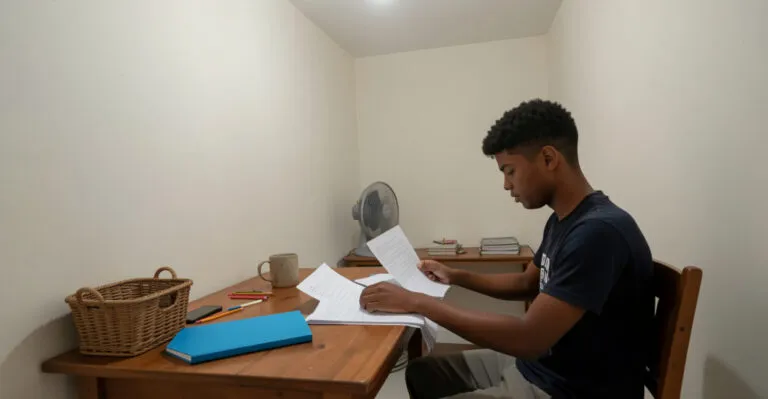
Your environment doesn’t need to be perfect; it just needs to make the first action easy. Keep only the materials for the task, water, and something to write with on your desk. Put your phone in another room or use Focus mode. If interruptions make it hard to study at home, a library or another quiet space may work better.
The Pomodoro method, which alternates focused work periods with breaks, can provide structure if you lose track of time without a set limit. One option is to study for 25 minutes and rest for five, but that interval isn’t required or right for everyone. If you’re having trouble getting started, ten minutes may feel more realistic; for an activity that requires sustained concentration, switching tasks midway may get in the way.
If your main challenge is setting aside an uninterrupted time, time blocking to organize your study time can help protect that period. Also plan what you’ll do during the block: “review Chapter 2 and answer questions 1 through 5” is more useful than simply writing “study.”
Get Back into a Rhythm Without Trying to Repay Study Debt
After missing a few days, take a quick inventory: which topics are most urgent, what’s overdue, and how much time do you actually have? Choose one priority for your next session. Trying to make up for everything with a marathon study session often increases fatigue and makes it even harder to get started next time.
If your first session after a break doesn’t go very well, that doesn’t mean you’ve failed to get back on track. Lower your goal, but set a time to return. You could review one page or answer two questions. One way to track small wins is to write down what you finished and what you’ll do next; that way, you won’t have to start from scratch by deciding everything all over again in your next session.
When you keep falling behind, look for the cause before tightening your schedule. The material may be too difficult to study without support, your plan may not fit your routine, or your goal may depend on time you don’t have. Adjusting your workload is more sustainable than trying to make up for every lost hour all at once.
Getting back into a rhythm starts with a goal that fits the time and energy you have today.
Build a Routine That Decides Your Next Starting Point
A study routine reduces last-minute decisions. Choose times you can repeat throughout the week and pair each block with a subject or a specific outcome. Include breaks and leave some room for the unexpected, because a schedule with no flexibility tends to fall apart at the first delay.
Before ending each session, write down the first task for the next one. For example: “Tomorrow at 6 p.m., review my chemistry notes and solve problems 6 and 7.” To structure your study periods, you can also check out this guide to weekly planning with priorities and adapt the plan to your actual schedule.
The University of North Carolina at Chapel Hill’s Learning Center offers guidance on study habits and academic organization. Use resources like these as a starting point, not as a one-size-fits-all formula: subjects, study conditions, and personal needs call for different adjustments.
Today, choose a subject, write down a task you can do in ten minutes, and start before reorganizing the rest of your week. When you’re done, note the next step. That way, your next session begins with a clear action, not another round of negotiating with yourself.
Frequently Asked Questions About Putting Off Studying
How Can I Stop Procrastinating When an Exam Is Coming Up?
List the topics covered and prioritize those that count the most or that you haven’t mastered yet. Use short blocks to review and answer questions, without spending all your time creating a perfect study schedule.
What Should I Do If I Sit Down to Study and Still Get Distracted?
Move your phone away and reduce the task to one checkable action, such as reading one page and writing a question about it. If you’re still distracted, check whether your environment, fatigue, or difficulty with the material is making it hard to concentrate.
Can I Study Only When I Feel Like It?
For some tasks, motivation comes after you get started; waiting for it can make your study time depend on your mood that day. A set time and a small task can help you begin, though your routine should take sleep, health, and other responsibilities into account.
How Long Should I Study Each Day to Build a Routine?
There’s no universal number. Start with a period that fits your week and lets you give the material your full attention, then adjust based on your course load and your ability to stick with the plan. A short, consistent session may be a better start than a lengthy goal you end up abandoning.
When Should I Seek Professional Help for Difficulty Studying?
Consider talking with a health care professional if your difficulty is accompanied by intense distress, ongoing low energy, or problems in several areas of your life. Procrastination alone doesn’t mean you have a disorder, and productivity strategies can’t replace an individual assessment.
Artigos Relacionados
 Phones and Studying: How to Reduce Interruptions at Home
 High-Performance Habits: 7 Practices to Start Today
 Transformative Habits: 5 Routines to Start Today
 Slow Reading in Elementary School: When to Seek an Evaluation
 12 Promising Healthcare Careers That Start With M
 Most In-Demand Careers That Start With M: 25 Options and Salaries
