
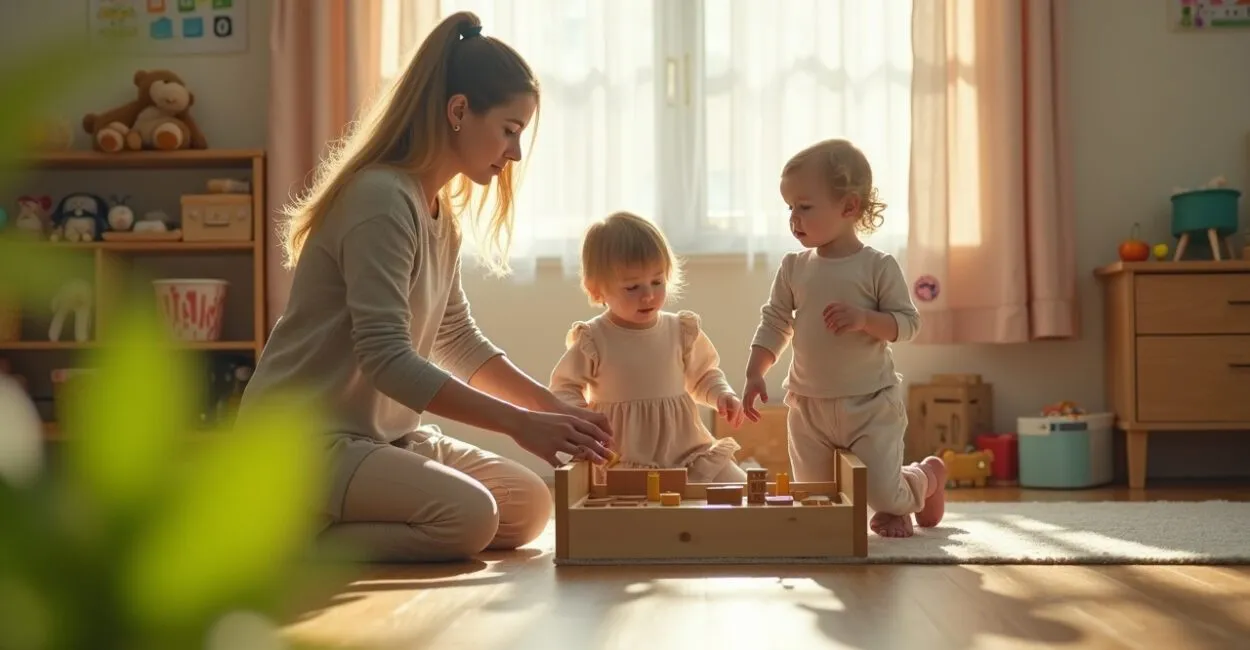
A young child’s inattention is almost never a matter of “not wanting to”; most of the time, their brain is still learning to filter stimuli, sustain focus, and inhibit impulses. That’s why neuroscience and attention in early childhood should be understood in terms of development, not used as a behavioral label.

Understanding this process can change everyday decisions: the length of an activity, the rhythm of the routine, how an adult guides a task, and even the kind of environment where a child plays. Below, you’ll learn what science says about children’s attention and what parents, educators, and caregivers can do to encourage engagement, self-regulation, and learning.
The Essentials
- Attention in early childhood depends on the development of brain networks that are still taking shape, especially those involved in executive function.
- Young children are easily distracted because their brains respond more strongly to things that are new, intense, and emotional than to things that are lengthy and abstract.
- Predictable routines, secure relationships, and adult guidance reduce cognitive load and make it more likely that children will sustain focus for longer.
- Short, concrete activities with a clear beginning, middle, and end work better than lengthy, open-ended, or overly verbal tasks.
- Inattention is a cause for concern only when it is more pronounced than expected for the child’s age, occurs across multiple settings, and has a real impact on development.
What neuroscience tells us about the brain and attention in early childhood
Attention is the ability to select relevant information and inhibit distractions in order to stay focused on a goal. In early childhood, this system is still developing because the brain is undergoing intense organization of synaptic connections, myelination, and refinement of the networks responsible for attentional control, self-regulation, and planning.
In practice, this means a child can’t turn focus on and off like an adult. Their interests shift easily, they need external cues to get organized, and they learn a great deal through repetition, predictability, and relationships.
The development of children’s attention depends both on neurological maturation and on the quality of their interactions and environment.
This topic is well documented by institutions such as the Center on the Developing Child at Harvard University, which highlights the role of executive function in child development. The key point is clear: attention isn’t innate and fully formed; it develops over time.
A technical definition, in plain language
In the field of child neuroscience, attention isn’t simply “sitting still and looking.” It involves sustained, selective, and joint attention, as well as inhibitory control and cognitive flexibility.
Put simply: sustained attention means staying focused; selective attention means filtering out distractions; joint attention means following another person’s gaze and intention.
In early childhood, focus doesn’t falter because of disobedience; it fluctuates because the circuits for self-regulation are still developing.
How the young brain develops focus, self-regulation, and inhibitory control
Focus in young children improves gradually, not in a straight line. Between ages 2 and 6, executive function develops significantly, particularly inhibition, working memory, and control of impulsive responses. This maturation happens through repeated experiences of waiting, making choices, tolerating frustration, and returning to tasks.
The role of the prefrontal cortex
The prefrontal cortex is one of the regions most closely associated with planning, self-control, and organizing behavior. It matures over many years, so expecting a young child to sustain attention as well as an older school-age child is a matter of perspective, not discipline.
The role of joint attention
Joint attention occurs when an adult and child focus on the same object, event, or activity with a shared purpose. This process is central to language development, learning, and bonding. When an adult names what’s happening, points, waits for the child to respond, and continues the interaction, they help the young brain organize information and purpose.
One point is often overlooked: attention and emotion go hand in hand. Children are more likely to sustain focus when they feel safe, understood, and able to anticipate what comes next. In situations involving stress, poor sleep, or too much stimulation, the attentional system becomes less efficient.
The CDC in the United States emphasizes that child development involves expected milestones, but varies with context. This variation is real and matters: comparing children without considering age and environment almost always leads to inaccurate conclusions.
Why young children get distracted: age, development, and environment

Young children get distracted because their brains are more sensitive to novelty, movement, and immediate rewards. This isn’t a character flaw; it’s a feature of neurodevelopment. Their attentional systems are still learning to filter the flood of information coming from both inside and outside the body.
Age changes what kind of attention to expect
A baby explores for short periods. A 2-year-old quickly shifts from one interest to another. By ages 3 and 4, children can stay engaged longer in hands-on activities, especially with guidance. Even so, attention during the preschool years remains highly dependent on context, the type of task, and how tired the child is.
Overstimulating environments get in the way
Environments with constant noise, multiple screens, frequent changes, and too many toys make it harder to select stimuli. The young brain needs contrast to organize attention; when everything competes at once, nothing stands out consistently.
I’ve seen this often in everyday situations: a child would start a puzzle, but a sound from the TV in the background, a buzzing phone, or another flashing toy was enough to make them abandon the task. The problem wasn’t a “lack of interest.” The environment was taking up attentional resources that were still limited.
The environment teaches attention not only through what it offers, but also through what it removes.
Individual differences matter
Some children have a more observant temperament; others are more active. Some need more movement to get their bodies organized before they can focus. Others engage better through talking, rhythm, or hands-on activities. What works for one child may tire another.
What really helps attention: routines, predictability, relationships, and guidance
If the goal is to improve children’s attention, the most reliable approach isn’t to pressure them to “pay more attention.” It’s to reduce noise, organize the setting, and help them get started. Attention improves when the brain receives clear signals of safety, sequence, and purpose.
Predictable routines reduce mental effort
When children know what comes next, they spend less energy trying to guess the next step. That frees up resources for the task itself. Visual schedules, simple agreements, and advance notice of transitions can make a real difference in early childhood education.
Connection comes before instruction
Without emotional regulation, good attention is hard to achieve. An adult who offers comfort, names feelings, and helps a child return to an activity acts as an external regulator until that ability is internalized. This is central to self-regulation in childhood.
Guidance is different from control
Adult guidance doesn’t mean doing things for the child or repeating commands in a loud voice. It means modeling, breaking the task into steps, showing where it starts and ends, reducing distractions, and offering the right level of help. When adults step in only to correct, children lose autonomy; when they step in to organize, children learn to organize themselves.
| Strategy | Why it helps focus | Practical example |
|---|---|---|
| Visual routine | Reduces uncertainty and abrupt transitions | Picture sequence: “put toys away → snack → story” |
| Short activity | Matches the attention span expected for the child’s age | A 5- to 10-minute building activity with a clear goal |
| Limited choice | Increases engagement without overwhelming the child | “Do you want to start with the blocks or the crayons?” |
| Fewer distractions | Protects selective attention | Turn off the TV during guided play |
In practice, early childhood and brain development are almost inseparable: every repeated routine, well-guided pause, and return to a task helps strengthen self-control circuits. That matters more than harsh corrective strategies.
How to adapt activities, screen time, space, and tasks to increase engagement
Anyone who works with young children knows that the same activity can work well one day and fall flat the next. The difference often comes down to duration, clarity, time of day, and level of guidance. To increase engagement, the activity needs to match the child’s stage of development.
Short, hands-on activities work better
Activities with hands-on materials, simple instructions, and a clear endpoint sustain attention for longer. Instead of saying, “Do this activity for 20 minutes,” try shorter blocks with quick feedback. Young children learn through their bodies, through action, and through repetition.
Screen time requires thoughtful choices
Screen time isn’t a moral issue; it’s a neurobehavioral one. Fast-paced, highly colorful, highly reactive content trains children to switch stimuli quickly, not to sustain focus. That doesn’t mean screens must always be prohibited, but it does mean setting limits, watching together, and choosing slower-paced, age-appropriate content.
The American Academy of Pediatrics recommends careful media use in childhood, with attention to content quality, context, and adult involvement. The right question isn’t just “How much time?” but also “What content, when, and with what guidance?”
The space also shapes attention
Organized environments with fewer visual stimuli at a time tend to support engagement. Too many posters, noise, and scattered objects can increase distraction. Sometimes, improving children’s attention has less to do with teaching the child and more to do with simplifying the space around them.
Warning signs: when to take a closer look at attentional development
Not every distraction is a sign of a problem, and keeping this in mind helps avoid rushed diagnoses. What deserves attention is a persistent, intense pattern that appears in different settings and clearly interferes with daily routines, learning, play, or relationships.
When to take a closer look
- The child almost never completes age-appropriate activities, even with support.
- Impulsivity is far beyond what’s expected, with frequent risk-taking and persistent difficulty waiting or stopping behaviors.
- The signs appear at home, at school, and in other settings, not just in one specific situation.
- There is a significant impact on language, sleep, social interaction, or learning.
It’s also worth remembering that insufficient sleep, anemia, hearing problems, excessive family stress, and neurodevelopmental differences can look like “inattention.” That’s why careful evaluation matters more than a quick label. When in doubt, observing patterns over time is more reliable than relying on a single impression.
Organizations such as NIH/NICHD offer useful information about child development and expected milestones. Good practice means considering behavior alongside age, context, and day-to-day functioning, rather than looking at a single symptom in isolation.
What schools and families can do together
When schools and families send similar messages, children gain predictability and spend less effort figuring out what’s expected of them. This partnership is one of the most effective ways to support attention and learning in early childhood education because it keeps different settings from pulling the child in opposite directions.
What to coordinate between home and school
- Sleep and meal times, and transitions to important activities.
- The same keywords for short reminders, such as “look,” “wait,” and “put away.”
- Similar guidelines for screen use, especially before tasks that require focus.
- Ways to calm down and return to an activity after frustration or fatigue.
A common scenario helps illustrate this: at school, the teacher organizes circle time with soft music, a cushion, and objects for the child to hold. At home, an adult tries to get the child’s attention by calling out instructions from across the room, with the TV on and a phone nearby. The result is predictable: the child responds better where the environment does more to help their brain get organized.
The best agreement isn’t about being rigid; it’s about being consistent. Children learn more quickly when they see that adult cues are repeated and make sense in both places.
Frequently asked questions about neuroscience and attention in early childhood
When does attention start developing in early childhood?
Attention starts developing very early, even in the first months of life, when babies begin to hold their gaze, respond to sounds, and shift their interest. Between ages 2 and 6, attention gains more control and stability. Progress is gradual and depends on brain maturation and environmental experiences.
What level of attention is expected at different ages?
Expectations vary widely depending on age and the type of task. In general, younger children focus for shorter periods and need more outside support; older children can stay engaged longer, especially with hands-on, meaningful activities. Comparing a 2-year-old with a 5-year-old without considering context leads to inaccurate conclusions.
How does neuroscience explain distraction in young children?
It points to the immaturity of attentional control networks, the strong pull of new stimuli, and the influence of emotional state. The young brain is still learning to filter what matters and block out competing demands for attention. Frequent distraction is therefore part of development, not necessarily a problem.
What can parents and teachers do to improve focus without pressuring a child?
The most effective approach is to organize the environment, reduce distractions, maintain a predictable routine, and break tasks into short steps. It also helps to explain what will happen, offer limited choices, and stay with the child as they begin an activity. Pressure often makes things worse; guidance helps children learn.
When can inattention be a warning sign?
When it persists, appears in multiple settings, and has a real impact on daily routines, learning, or relationships. If difficulties are far beyond what’s expected for the child’s age and are accompanied by intense impulsivity, delays in other areas, or significant physical or emotional symptoms, a professional evaluation may be appropriate. The key is to look for a pattern, not a single incident.
%%AGPTRH6%%
What to do now
If your goal is to support attention in early childhood, the best approach is to stop treating focus as a test of obedience and start treating it as a skill that is still developing. Adjust routines, reduce competing stimuli, shorten activities, and observe how the child responds when the environment is working in their favor.
The smartest next step is to choose one specific part of the day—snack time, circle time, bath time, reading, or play—and try one change at a time. When an intervention is simple, consistent, and easy to observe, it’s much easier to see what actually supports the development of children’s attention.
Artigos Relacionados
 Neuroscience in Early Childhood Education: How Children’s Brains Learn and How to Apply This Knowledge to Maximize Learning
 Letter Activities in Early Childhood Education
 Activities for Early Childhood Education: Practical Ideas
 Activities About Jobs in Early Childhood Education
 Mother’s Day in Early Childhood Education: 7 Memorable Activities
 Technology for Young Children: Finding the Right Balance
