

It is a set of practices, structures, and technologies that reshape the teaching and learning process to improve relevance, equity, and measurable outcomes. At its core, it involves rethinking curriculum, assessment, teacher training, and school management to prioritize 21st-century skills, active learning, and evidence-based personalization. Here, I define innovative education as a systemic shift that connects educational purpose with operational mechanisms and clear impact measures.
Key Takeaways
- Innovative education combines active learning, formative assessment, and personalization to improve knowledge retention and application.
- Effective implementation combines pedagogical change with institutional support: ongoing teacher training, real-time data, and local governance.
- Digital tools are catalysts, not solutions on their own; instructional design and teacher training are the critical factors.
- Measuring impact requires a range of indicators: curriculum proficiency, soft skills, engagement, and post-school pathways.
Why Active Pedagogies Define the Success of Innovative Education
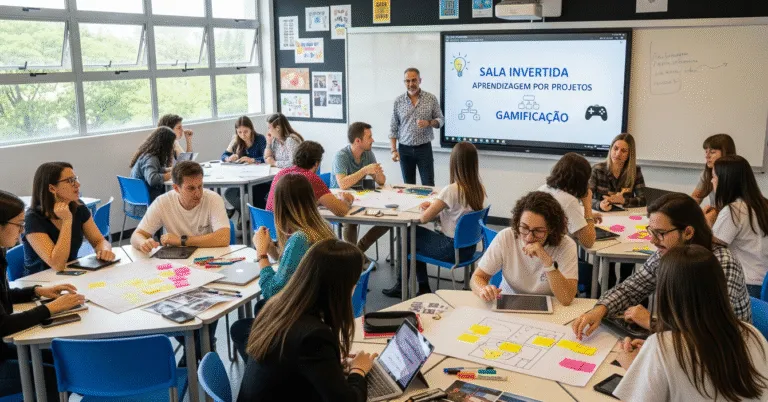
The systematic adoption of active pedagogies distinguishes programs that transform learning from those that merely look modern. Active pedagogies put students at the center, using projects, inquiry, and simulations to create authentic contexts. This makes knowledge more transferable and fosters critical thinking. OECD data show an average gain of 0.3 standard deviations when instruction focuses on real-world problems. In practice, this means teacher training must focus on facilitation, authentic task design, and rubrics that assess processes as well as correct answers.

How Active Pedagogies Change the Teacher’s Role
Teachers move from being transmitters of information to facilitators and designers of learning experiences. This requires skills in facilitation, formative feedback, and project management. Teachers need to understand learning cycles and how to adapt tasks for different levels. In the classroom, effective practice combines brief direct instruction with guided collaborative activities, ensuring students have a conceptual foundation before applying what they learn. This balance reduces conceptual gaps and helps students become independent learners sooner.
Concrete Examples and Evidence
Schools that implemented interdisciplinary projects reported improvements in students’ problem-solving skills and motivation. An MIT study found gains in creativity and persistence when courses included long-term projects. In public school districts, interventions combining ongoing training and coaching reduced dropout rates by up to 15% over three years. These results confirm that active pedagogy can be scaled when supported by institutions.
Why Data and Formative Assessment Are Central to Innovative Education
Formative assessment informs day-to-day teaching decisions and personalizes learning pathways. Unlike summative tests, formative assessment provides immediate feedback and prompts corrective action. Systems that combine performance and engagement data with error patterns make it possible to intervene at the right time. For data to be useful, it must be actionable: clear dashboards, regular analysis routines, and response protocols must be in place. Without these elements, data collection becomes an added burden with no real impact.
Indicators That Matter
Relevant indicators include proficiency by skill, individual growth rates, engagement patterns in activities, and observed social-emotional skills. Looking only at test scores misses important nuances. For example, tracking persistence on complex tasks can help identify a need for support with metacognition. Bringing these indicators into regular instructional team meetings turns data into personalized teaching plans.
Tools and Data Governance
When properly configured, learning analytics platforms provide alerts and reports by class and student. But technology requires privacy policies, training, and teachers who can interpret the data. School districts that clearly define the roles of data analysts and instructional coordinators can translate indicators into concrete decisions, improving the effectiveness of interventions and resource allocation.

How Technology Enhances but Does Not Replace Teaching Practice

When used effectively, technology expands access and personalization. Adaptive resources, simulations, and collaboration platforms make it possible to tailor assignments without overburdening teachers. However, poorly aligned technology can fragment the curriculum and create dependence on vendors. Choices should prioritize interoperability, evidence of effectiveness, and support for teaching practice. In short, technology is a lever; instructional design and human capital remain at the center.
Criteria for Selecting Digital Solutions
Prioritize tools backed by evidence of learning, compatible with the local curriculum, easy to use, and protective of student data. Look for technology stacks that integrate with the school management system and allow data exports. Technical support and initial and ongoing teacher training are essential for effective adoption.
Effective Technology Integration Models
Hybrid models that combine in-person sessions with asynchronous digital activities have shown consistent results. In rotation models, for example, students move between direct instruction, digital labs, and projects. This approach creates more opportunities for practice and formative assessment without increasing teachers’ workloads.
Practice-Oriented Teacher Training to Sustain Innovative Education
Transformation depends on the professionals in the classroom. Training limited to one-off courses falls short. Teachers need active learning, classroom coaching, and professional learning communities. Effective programs include peer observation, structured feedback, and concrete goals for change. Training investments should include time, resources, and professional recognition to sustain adoption.
Components of an Effective Training Program
A strong program includes brief theoretical modules, guided practice in real-world settings, feedback cycles, and impact assessment. According to international studies, individualized coaching increases the likelihood of a change in practice by 50%. In addition, systems that compensate teachers for learning time and offer competency-based career paths can retain talent.
Barriers and How to Overcome Them
Resistance to change, heavy workloads, and a lack of committed leadership are common obstacles. Overcoming them requires distributed leadership, realistic goals, and progress indicators. Early wins in pilot classrooms and sharing local evidence help build trust and scale successful practices.
Funding, Policy, and the Scalability of Innovative Education
Scaling innovation requires alignment among public policy, funding, and local capacity. Blended funding models—public, private, and philanthropic—have made controlled experiments possible. For these efforts to be sustainable, however, recurring costs must be built into public budgets and accountability measures defined. Effective policies encourage controlled experimentation, the spread of proven practices, and ongoing technical support.
Evidence-Based Scaling Models
Programs that scaled successfully combined rigorous pilots with phased funding and clear goals. School districts that required independent assessments and tied increased funding to meeting milestones were able to maintain quality during expansion. Transparent data and outcome-based contracts accelerate continuous improvement.
Risks of Uncontrolled Scaling
Scaling too quickly without evaluation leads to inconsistent quality and wasted resources. Requiring minimum standards, training local administrators, and creating rapid response mechanisms can reduce risks. Policies should provide for adaptation phases and legal safeguards to protect students’ rights and privacy.
Measuring Impact: How to Evaluate Innovative Education Programs
Evaluating impact requires an experimental or quasi-experimental design that measures learning, social-emotional skills, and educational pathways. Short-term indicators include gains in proficiency by skill and engagement; long-term indicators include employability and continued education. Evaluations should combine standardized tests, portfolios, and observations. Without triangulating methods, conclusions are weak. Investing in implementation research makes it possible to adjust interventions in real time.
Recommended Methods
Randomized controlled trials (RCTs) are ideal when feasible, but quasi-experimental studies, regression discontinuity, and matching offer robust alternatives in school settings. Combining quantitative and qualitative methods helps explain not only whether something works, but why it works and under what conditions.
Sample Indicator Dashboard
| Dimension | Indicator | Data Source |
|---|---|---|
| Learning | Growth by skill (standard deviations) | Standardized diagnostic assessment |
| Process | Percentage of active learning practices per class | Rubric-based observation |
| Pathway | Graduation rate and college enrollment | Administrative records |
Next Steps for Implementation
To get started, define clear goals and practical indicators. Pilot practices in diverse settings, establish evaluation cycles, and provide ongoing training with coaching. Prioritize tools backed by evidence of effectiveness and establish data governance. Ensure recurring funding and involve the school community in the design process. These decisions reduce risk and increase the likelihood of real impact. Successful implementation transforms structures rather than simply adding isolated programs.
Immediate Practical Recommendations
Map local capacity, choose 1–2 priority practices, define simple metrics, and launch pilots with intensive training. Document processes and results to support replication. Use local evidence to refine and scale gradually.
A Vision for the Future
Investing in innovative education means aligning schools with sustainable human development and the knowledge economy. With strong governance, data, and human capital, it is possible to reduce inequities and prepare young people for complex challenges.
Frequently Asked Questions
What Exactly Is Innovative Education, and How Does It Differ from Traditional Teaching?
Innovative education is a set of practices that changes goals, processes, and assessment to prioritize active learning, personalization, and life skills. It differs from traditional teaching by shifting the focus from the teacher to the student, using ongoing formative assessments, and integrating technology as a support, not an end in itself. While traditional teaching prioritizes memorization and summative assessment, innovative education aims to transfer knowledge to real-world contexts, measure progress by skill, and adjust instruction based on data.
What Evidence Supports Using Active Pedagogies at Scale?
International studies, including meta-analyses, show average gains of 0.2 to 0.4 standard deviations in academic performance when active pedagogies are implemented effectively. Research from MIT and the OECD documents improvements in creativity, persistence, and problem-solving. The critical factor is implementation fidelity: gains appear only with teacher training, institutional support, and assessment. Controlled pilots that included coaching and real-time data recorded significant increases in engagement and retention.
How Do You Choose Education Technology That Has a Real Impact on Learning?
Choose tools backed by evidence of effectiveness, aligned with the curriculum, and designed to support teachers’ work. Evaluate usability, interoperability, and data protection. Prioritize solutions that provide formative feedback and actionable data, along with training and technical support. Before scaling, run controlled pilots and measure impact using clear indicators, including changes in teaching practices and proficiency gains by skill.
What Is the Average Cost of Implementing an Innovative Education Program Across a Municipal School District?
Costs vary by scale and context. School pilots cost between 50,000 and 200,000 Brazilian reais per municipality for training, basic technology, and coaching in the first year. Scaling across an entire district requires recurring budget allocations, estimated at 2% to 8% of annual per-student spending, depending on the program’s intensity. Blended funding models and partnerships can lower upfront costs. Most importantly, set aside funding for ongoing training and maintenance, not just technology purchases.
How Do You Measure the Success of an Innovative Intervention in 12 Months?
Over 12 months, use a set of short-term indicators: gains on diagnostic assessments by skill, attendance and engagement in active learning activities, rubric-based observations, and teacher satisfaction. Combine these with qualitative data from student and teacher interviews to understand barriers. Set realistic goals and review progress quarterly. Consistent improvement in proficiency and instructional practices suggests the intervention is having an impact and may merit expansion.
Recommended sources and further reading: OECD Education, IBGE (Brazilian Institute of Geography and Statistics), and studies from the MIT Teaching Systems Lab. These resources provide context for the evidence and practices discussed here.
Artigos Relacionados
 Active Learning Methods for Practical Entrepreneurship Education
 Active Learning Methods: 7 Practices That Are Transforming Education
 Active Learning Methodologies in Teacher Education: How to Apply Them
 Innovative Pedagogy in Higher Education: New Methodologies
 Active Learning Methodologies in Today’s Quality Higher Education
 Elementary Education: Strategies for Active Learning
