
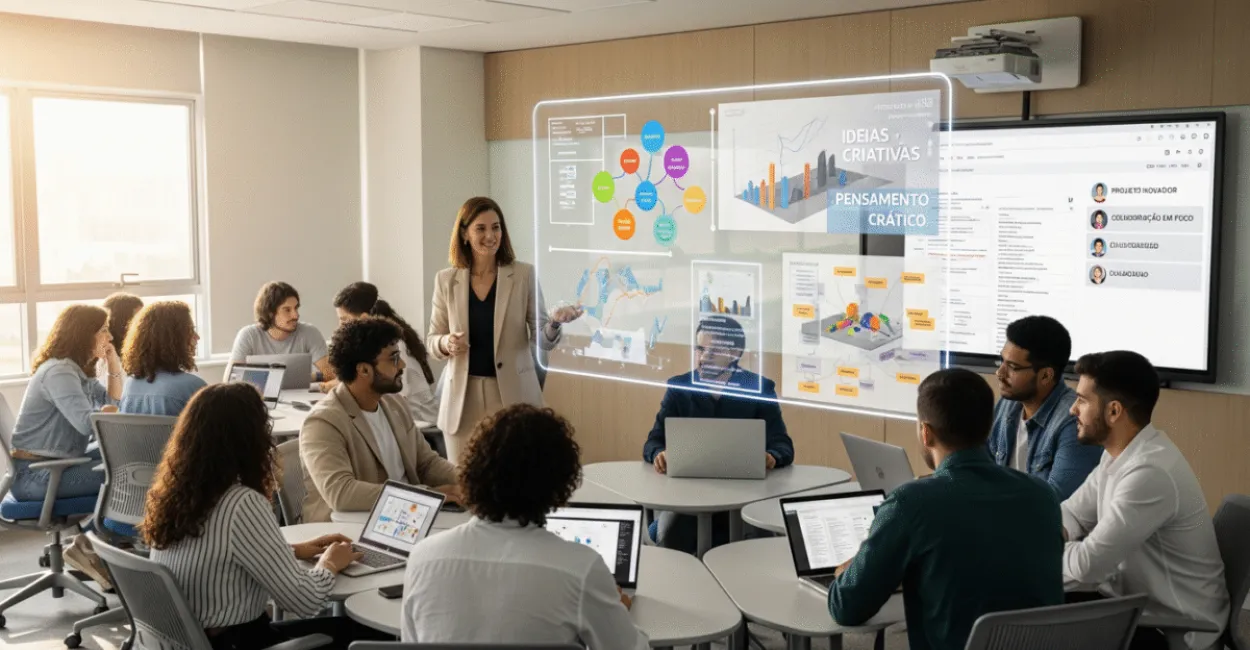
A class can use tablets throughout a lesson and still learn passively. Innovative pedagogy starts with deciding what students need to learn and how they will demonstrate that learning; methods, materials, and technology come afterward.
In higher education, this means planning experiences that build knowledge, independence, and skills related to students’ fields of study.

This approach also appears in early childhood education and K–12 education, but strategies need to reflect the students’ age, curriculum goals, and classroom conditions. Examples can help distinguish a meaningful pedagogical change from a different activity that does not change what students do or learn.
Key takeaways
- An innovative practice addresses a clear learning objective; using an app alone is not enough.
- Active learning, projects, and problem-based discussions work best when students receive guidance and feedback throughout the process.
- Strategy selection should account for students’ prior knowledge, class size, accessibility, and available resources.
- Assessment should look for evidence of learning, not just participation or submission of a final product.
What innovative pedagogy means in higher education
Innovative pedagogy is an approach to teaching that aligns objectives, activities, and assessment to increase student participation in building knowledge, while taking context and differences among students into account. Simply put, instructors plan situations in which students need to apply, discuss, or produce knowledge rather than just receive information.
It helps align instruction with the skills a degree program requires, such as analyzing evidence, solving problems, and communicating decisions. Pedagogy provides a foundation for understanding how objectives, content, teaching relationships, and assessment connect; innovation means revisiting these choices intentionally and evaluating their effects.
This does not mean abandoning lectures, reading, or individual exercises. A short explanation can prepare students for a discussion; a lecture may also be appropriate when a new concept calls for a structured introduction. Innovation lies in the alignment between what you intend to teach and the work assigned to students.
A teaching strategy deserves to be called innovative only when it strengthens the connection between objectives, participation, and evidence of learning.
Examples of teaching practices across educational levels
Innovative teaching practices are planned activities that let students explore ideas, make decisions, and produce evidence of learning. The format varies by age and curriculum: a playful investigation in early childhood education should not be assessed like an undergraduate research project.
In early childhood education, an activity might begin with observing plants around the school. Children draw what they see, compare changes over several days, and discuss their hypotheses, with guidance suited to their age. The focus is on exploration, language, and curiosity—not on turning the activity into a formal science lesson.
In K–12 education, innovative classroom practices might include investigating a local issue, producing a podcast, or analyzing sources about a historical topic. Brazil’s Base Nacional Comum Curricular (BNCC), the national common core curriculum, guides the development of skills and competencies at each educational level. Lesson planning should consult the Base Nacional Comum Curricular rather than choosing an activity just because it seems appealing.
In higher education, a nursing class might analyze a simulated clinical case and justify care priorities based on what students have learned. In communications courses, groups might create a campaign for a specific audience and defend their choices. These classroom practice examples connect course content to decisions in each field without replacing the necessary conceptual study.
Teaching methods used in schools include interactive lectures, demonstrations, individual study, discussions, projects, and problem-solving. Active learning is one part of this toolkit: it engages students intellectually, but it does not eliminate explanations, instructor support, or opportunities to synthesize ideas. The choice depends on the objective, not a fixed preference for a single method.
How to implement the approach and estimate costs

Implementing these practices requires defining learning outcomes, organizing the curriculum, and preparing instructors to lead activities that involve meaningful student participation. Costs depend on existing infrastructure, class size, training time, and required materials; there is no single figure that applies to every institution.
- Define the objective: Describe what students should explain, do, or decide by the end of the unit.
- Get to know the class: Check students’ prior knowledge, class size, accessibility needs, and access to devices or the internet.
- Choose a strategy: Use a project, case discussion, flipped classroom, or another method based on the type of learning you want to achieve.
- Plan evidence and support: Decide how to assess the process and outcome, and what guidance to provide during the activity.
- Start with a manageable pilot: Try the approach in one unit or course, collect data, and make adjustments before expanding it.
To estimate the budget, separate implementation and ongoing costs: training and planning hours, software licenses or equipment, technical support, and material adaptations. An activity based on cases and accessible texts may take more preparation time but require little technology investment; a lab or immersive resource may call for infrastructure and maintenance. Build the estimate around the chosen strategy, not a list of trendy tools.
Read also: Challenges in Higher Education: A Complete Guide to Overcoming Early Difficulties 2025
Brazil’s National Curriculum Guidelines for initial teacher preparation, established by the Conselho Nacional de Educação (National Education Council), are also a reference for teacher education and teaching practice. Institutions should check which current rules apply to their programs and contexts, since curriculum requirements can vary by field and may be updated.
Purposeful and accessible educational technology
A learning management system (LMS) can organize materials, activities, and feedback; multimedia resources can make hard-to-observe processes visible; and simulation software can let students practice decision-making in controlled conditions. Augmented reality can help students visualize structures or spaces when it supports a task that would be difficult to complete in other formats.
Before adopting any resource, answer four questions: What objective does it support? Who can access it? What alternative is available to those without an internet connection or device? How will learning be assessed? For example, if students need to compare arguments, a discussion board can help document contributions. Without participation and synthesis criteria, however, the platform may simply fill up with posts without deepening the discussion.
Artificial intelligence can support activities such as revising writing or comparing responses, but it requires rules about authorship, fact-checking, and privacy. One useful guideline is to ask students to document how they used the tool, verify its responses, and explain their decisions. Digital resources should also offer options compatible with screen readers, captions, and different ways to participate.
Innovative teaching methods can combine in-person and digital resources, but technology alone cannot fix problems with instructional design. Instructions also need to be communicated clearly: clear objectives, deadlines, and criteria help prevent an activity from seeming confusing or unfair.
Benefits, limitations, and challenges of implementation
Activities that require decision-making and original work can increase engagement by giving students a concrete intellectual task. They also create opportunities to practice professional skills, such as making evidence-based arguments or collaborating on a team. These effects depend on the quality of guidance and alignment with course content; an activity without a clear purpose can consume time without deepening learning.
A common mistake is to confuse participation with learning: talking a lot in a discussion does not prove that a student understands a concept. Instructors need to check what each student can explain or apply, including those who participate less in public. Individual quizzes, brief written reflections, and tasks that apply learning to a new case can reveal gaps that group work may conceal.
Other challenges include resistance to change, instructor workload, large classes, and unequal access to digital tools. In a large group, for example, a project can leave some students without clearly defined responsibilities; assigning roles, requiring individual deliverables, and setting aside time for check-ins can reduce this risk. Not every strategy suits every subject: some learning requires repeated practice or direct instruction before open-ended activities.
In Reimagining Our Futures Together: A New Social Contract for Education, UNESCO describes education as a collective effort requiring cooperation and a commitment to inclusion. This perspective reinforces that pedagogical innovation also depends on institutional conditions, not just the initiative of an individual instructor.
How to assess learning and adjust strategies
Diagnostic assessment identifies what students already know before a unit begins; formative assessment tracks progress and informs next steps. Both complement summative assessment. The assessment tool should match the objective: if the goal is to make an argument, a memorization test does not provide sufficient evidence.
Learning objective Strategy Expected evidence Assessment method Explain a concept Case discussion with advance reading Connection between the concept and elements of the case Individual response using explicit criteria Solve a professional problem Group simulation Justified decisions and a record of the process Rubric covering reasoning, execution, and reflection Communicate a proposal Project with a presentation A product suited to the audience and a rationale for the choices made Assessment of the product, presentation, and individual contributions
Feedback should explain what is working, what needs revision, and what concrete action could improve the work. Comments like “needs more depth” provide little guidance; identifying an unsupported claim and suggesting a relevant source makes the feedback actionable. A new attempt after feedback shows whether the student was able to apply it.
Best practices for sustaining pedagogical innovation
Institutions can sustain change by providing planning time, discipline-specific training, and opportunities to share materials and challenges. Faculty development works best when it addresses a real classroom situation: how to divide students into groups, track contributions, and assess individual work within a group project.
Students can also help improve activities. A brief survey after a unit, combined with an analysis of student work and assessment results, can reveal obstacles an instructor might otherwise miss. Student feedback is one piece of evidence among many, not a substitute for checking what students have learned.
To get started, choose a course and a specific objective, identify observable evidence, and test a strategy that fits the available resources. Then compare student work before and after feedback, identify who lacked access or participation, and adjust the design. This cycle helps you move forward without turning innovation into a technology purchase or an improvised curriculum overhaul.
Frequently asked questions
Can artificial intelligence be used in graded activities?
Yes, as long as the assignment makes clear what students need to produce and how to disclose their use of the tool. Assessment should include verification, justification, or application of the content so that a generated response is not mistaken for mastery of the subject.
How can an activity be adapted for students with different needs?
Provide accessible instructions, alternative ways to participate, and more than one way to demonstrate learning when doing so does not change the objective being assessed. Planning these options in advance is usually more effective than improvising after a barrier appears.
Can you innovate without buying equipment?
Yes. Case studies, discussions with assigned roles, text analysis, and projects using available materials can change participation and assessment without requiring new devices. The main investment may be time for planning and training.
Artigos Relacionados
 Educational Technology and Its Impact on Higher Education
 Higher Education and Career Entry: An In-Depth, Up-to-Date Analysis
 Active Learning Pedagogy in Extracurricular Activities: Engagement and Learning
 Soft Skills in Teacher Education: More Than Technical Knowledge
 How to Include Students with Disabilities in the General Education Classroom
 The Importance of Literacy in Adult and Youth Education
