
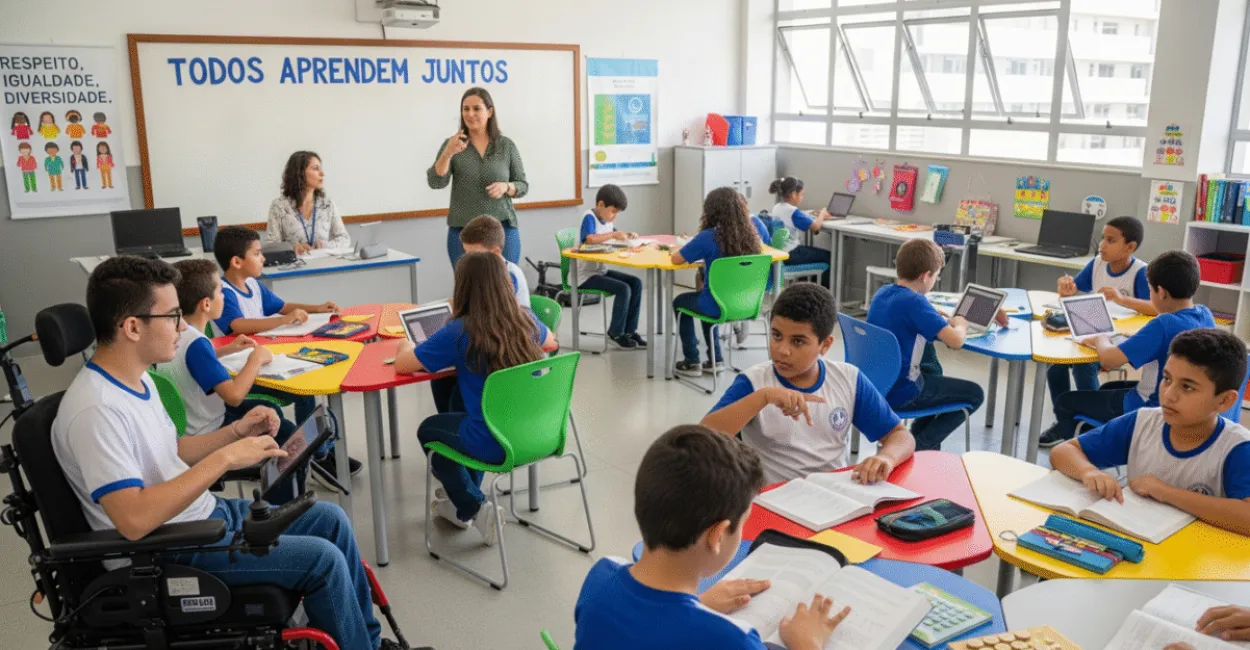
A school can have ramps, technology, and good intentions—and still exclude a student. This happens when inclusion exists only in words. For students with disabilities, the difference between being present and participating comes down to what the school does every day: how it teaches, assesses, organizes routines, and welcomes diversity.
True inclusion isn’t about creating a “separate track” for a few students. It means adapting the environment, curriculum, and teaching practices so every student can learn with dignity. This guide explains what changes in the general education classroom, which accommodations work, where obstacles tend to arise, and how to make inclusion a consistent part of teaching practice.

What You Need to Know
- School inclusion isn’t just about enrollment; it means access, participation, and learning with appropriate support.
- Physical, instructional, and attitudinal barriers are the main reasons a student’s presence doesn’t lead to meaningful inclusion.
- Inclusive lesson planning starts before class: learning objectives, resources, assessment, and instructional support all need to be planned flexibly.
- Curricular adaptations don’t mean “making the content easier”; they change how it’s taught without abandoning essential learning goals.
- Collaboration among the classroom teacher, specialized educational services (AEE), family, and school staff reduces guesswork and makes strategies more consistent.
How to Welcome Students with Disabilities into the General Education Classroom Without Lowering Curriculum Standards
Technically speaking, inclusive education is the process of ensuring that students have access, participation, and learning in general education, with the necessary support in place. Put simply: being in the classroom isn’t enough; students need to be able to follow along, interact, and show what they’ve learned.
This may seem obvious, but in practice, many schools confuse inclusion with integration. Integration expects students to adapt to an existing system. Inclusion adapts the system to the student, within realistic instructional limits. That difference changes everything.
What Schools Need to Provide
- physical access to the school;
- materials in formats the student can use;
- participation in class activities;
- assessment options suited to how the student can express what they know;
- specialized support when needed.
UNESCO’s position on inclusive education emphasizes that education systems should reduce barriers, not select students who “fit” the traditional model. This applies to students with physical, intellectual, visual, or hearing disabilities, autism spectrum disorder, and other conditions requiring specific supports.
In practice, inclusion works when schools remove barriers and organize support; it fails when it depends on one teacher improvising alone.
The Barriers That Most Often Limit Participation in Everyday School Life
Anyone who works in this area knows the problem rarely comes down to a single factor. Exclusion usually results from a combination of barriers. A noisy classroom, overly long instructions, a standardized test, and a lack of support can be enough to shut a student out.
Three Common Barriers
- Physical barriers: stairs, unsuitable desks, inaccessible restrooms, and difficult navigation.
- Instructional barriers: nonstop lectures, little variation in how information is presented, and one assessment format for everyone.
- Attitudinal barriers: low expectations, overprotection, or treating the student like a child.
The last type is often the hardest to notice. The class may accept a student, but the teacher may unknowingly lower expectations too much or stop offering meaningful challenges. The result is harmful: the student may seem “included” but learns less than they could.
Data from IBGE’s Continuous National Household Sample Survey (PNAD Contínua) are a reminder that people with disabilities aren’t a small or marginal group in society. Schools of all sizes need to plan for these students rather than improvise.
Instructional Planning That Really Works

Inclusive planning starts with a simple question: what needs to stay the same, and what can be adjusted? Not all content needs to be presented in the same way, and students don’t have to demonstrate every skill in the same way. The curriculum is the guide; the route can change.
What Can Be Adapted Without Losing the Core Learning Goals
- time allowed to complete activities;
- response format: spoken, written, visual, or through assistive technology;
- number of exercises, without losing sight of the objective;
- how the content is presented;
- the type of support provided while completing the work.
A fourth-grade teacher noticed that a student with an intellectual disability struggled with long lists of questions. She kept the same topic but reduced the number of items, replaced two questions with visual choices, and allowed the student to answer orally. The student wasn’t given an “easier” task; they gained meaningful access to the lesson. The whole class began using different ways to show understanding, which improved participation across the board.
Adapting doesn’t mean lowering expectations; it means changing the path to learning so the expectation remains learning.
When an Accommodation Doesn’t Work
Not every accommodation solves every problem. If the main issue is communication, for example, reducing the number of exercises won’t be enough. For students with hearing disabilities, using Libras (Brazilian Sign Language), captions, supportive lip-reading conditions, and visual cues can make a much bigger difference than adjusting the time allowed. The right strategy depends on the student’s functional needs, not just their diagnosis.
Read also: Classroom management: positive strategies
Resources, Assistive Technology, and Support That Make a Difference
An inclusive environment uses resources to increase independence. Assistive technology includes any tool, strategy, or service that helps people with disabilities take part in activities more independently. It can be anything from an adapted pencil to screen-reading software.
In general education classrooms, the most effective resources are often the simplest, as long as they’re integrated into daily routines. Equipment sitting unused in a resource room won’t help if it isn’t part of general classroom lesson plans.
Practical Examples of Support
- Braille slates, sorobans, and tactile materials for students who are blind;
- visual contrast, large-print text, and appropriate seating for students with low vision;
- Libras interpreters and visual supports for students who are deaf;
- augmentative and alternative communication and symbol boards for students with speech difficulties;
- noise-reducing headphones, predictable routines, and clear expectations for some students with autism spectrum disorder (ASD).
The work of the Ministry of Education and Brazil’s Specialized Educational Services (AEE) policy is relevant because it reinforces that specialized support supplements—but does not replace—enrollment and participation in the general education classroom. In other words, students don’t attend AEE instead of regular classes; AEE helps them access general education more effectively.
Fair Assessment Without Lowering the Bar
Inclusive assessment doesn’t abandon standards. It adjusts the format to measure what really matters. If the goal is to understand a concept, for example, students may demonstrate their understanding in different ways without compromising the rigor of the assessment.
The most common mistake is to confuse accommodation with leniency. This disrespects the student and creates confusion for the team. Students with disabilities need meaningful assessment, not a symbolic grade.
Criteria for More Reliable Assessment
- clear learning objectives;
- a variety of ways to demonstrate knowledge;
- extra time when needed;
- accessible language in instructions;
- ongoing progress tracking, not just a final test.
INEP, Brazil’s National Institute for Educational Studies and Research, publishes useful guidance on assessment and education indicators. The key idea here is simple: accurate assessment requires respecting students’ access to the content. When assessment ignores that, it measures barriers more than learning.
The Role of Families, School Staff, and AEE
Sustainable inclusion doesn’t depend on individual heroics. It depends on a support network. The classroom teacher, instructional leadership, school support staff, family, and AEE need to work together with clear communication, shared expectations, and regular follow-up.
In practice, misunderstandings often arise because each person has different expectations. The family wants progress; the school wants routines; AEE provides guidance; and the teacher has to manage the whole class. When no one aligns on goals, the child is the first to feel the effects of the disorganization.
What Each Person Needs to Do
- Classroom teacher: plan flexible lessons and observe the student’s actual responses.
- AEE: support access to the curriculum and recommend resources without isolating the student from the class.
- Family: share useful information about the student’s needs and abilities, not just diagnostic reports.
- School leadership: monitor accommodations and make sure inclusion doesn’t depend on individual goodwill.
What Changes When a School’s Culture Is Truly Inclusive
When a school takes inclusion seriously, the change shows up in the classroom atmosphere, student independence, and the way classmates learn to live with differences without treating them as a problem. This benefits not only students with disabilities; it improves the quality of instruction for everyone.
An inclusive culture doesn’t come from a poster in the hallway. It shows up when staff question exclusionary routines, look at learning data, and make the changes that are needed. This kind of school stops asking, “How do we fit this student in?” and starts asking, “What’s making it harder for this student to learn?”
What separates enrollment from inclusion isn’t a student’s presence at school—it’s the institution’s ability to turn participation into learning.
Next Steps
If the goal is to move from intention to action, the best approach is to start with the basics: identify barriers, choose one accommodation at a time, and observe its actual effect in the classroom. Inclusion for students with disabilities improves when schools replace improvisation with consistent teaching practices, and those practices with ongoing follow-up.
The smartest next step is to review one lesson from this week and ask: Who is being left out, why, and what can we adjust without losing the instructional objective? When this question becomes part of lesson planning, inclusion stops being an exception and starts becoming a method.
Frequently Asked Questions
What’s the Difference Between Inclusion and Integration in Schools?
Integration means the student has to adapt to the existing model. Inclusion means the school adapts its practices, resources, and environment to ensure participation and learning. Inclusive education focuses on removing barriers.
Does the Entire Curriculum Need to Change to Teach Students with Disabilities?
No. The curriculum can remain the point of reference, while access, timing, resources, and assessment methods are adjusted. The goal is equitable learning, not lower quality.
Does AEE Replace the General Education Classroom?
No. Specialized Educational Services supplement schooling and help students access the general curriculum more effectively. They don’t replace attendance or participation in the general education classroom.
How Can Teachers Tell if an Accommodation Is Working?
The best indicator is participation alongside learning: the student understands the task, can respond, and makes observable progress. If an accommodation only makes an activity “easier” without improving access to the content, it needs to be reconsidered.
Does Every Student with a Disability Need the Same Type of Support?
No. A disability alone doesn’t determine what support a student needs; their functional needs and context matter a great deal. Two students with the same diagnosis may need completely different strategies.
Can a School Deny Enrollment Because It Doesn’t Have the Ideal Facilities?
It shouldn’t. Enrollment is a right, and the school needs to find ways to ensure access and participation, with support from the education system when necessary. A lack of facilities can’t be used to justify exclusion.
Artigos Relacionados
 How to Motivate Adult Education Students to Keep Studying
 The Classroom of the Future: Emerging Technologies Transforming Education
 Inclusive Education in Schools: Transformative Paths for Every Student
 The Importance of Literacy in Adult and Youth Education
 How to Introduce Literacy in Early Childhood Education
 Brazil’s LGPD in Schools: Protecting Student, Family, and Staff Data
