
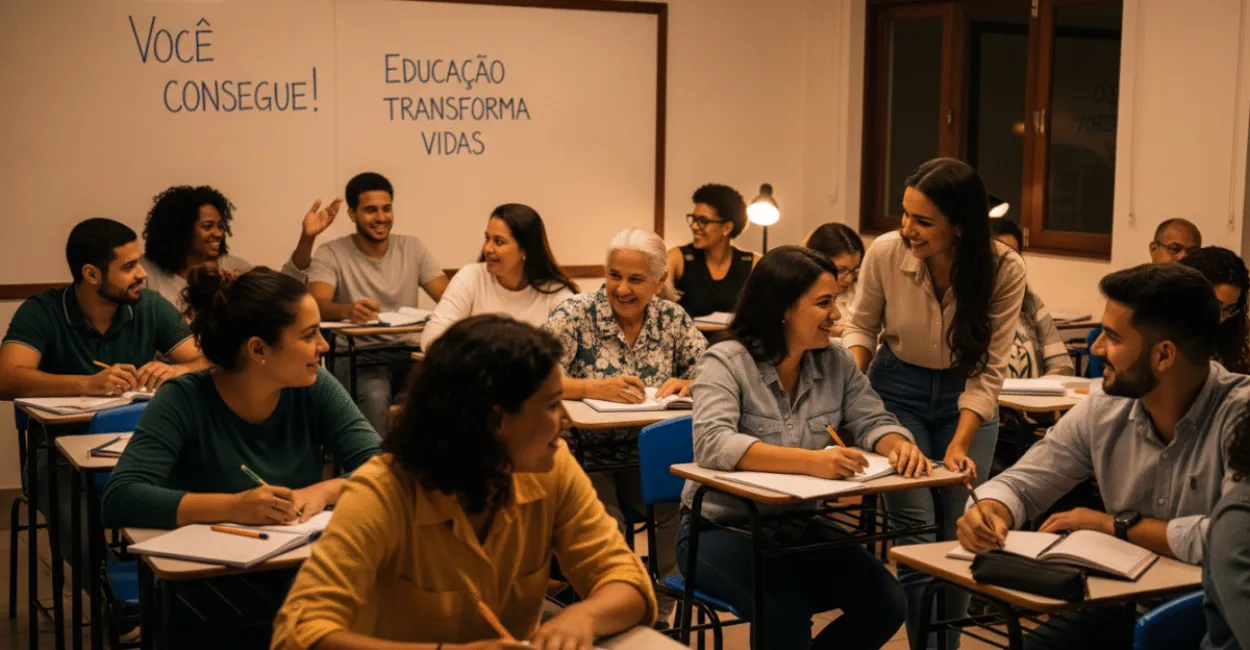
Someone may want to finish school and still miss class because the bus never came, their work shift changed, or a family member needed care. Motivating adult education students means finding out what’s behind an absence and working with each student on a practical response, rather than interpreting the absence as a lack of interest. Brazil’s Educação de Jovens e Adultos (EJA), or Youth and Adult Education program, serves people with diverse backgrounds and responsibilities. That’s why schools need to connect course material to students’ lives and track attendance, participation, and learning as indicators that can help guide instruction.
A good place to start is with a conversation, an achievable goal, and a check-in after a few weeks. This cycle makes motivation a shared responsibility among the student, teacher, and school staff.

How can schools motivate adult education students with strong relationships and achievable goals?
To motivate adult education students, schools should welcome each student, identify the biggest barrier to attendance, and work with them to set a realistic study goal. Next, they need to offer a strategy that fits the student’s routine and check whether it helped, without blaming the student for barriers involving transportation, work, or family care. Trust is built through concrete gestures: using the student’s name, explaining how to make up an assignment, and checking in after an absence. The goal should also be specific. “Get better at math” can become “solve percentage problems using examples from shopping and budgeting,” then be adjusted as the student progresses.
- Ask what brought the student back to school and what might make it difficult to stay.
- Agree on a short-term goal and a clear way to track progress.
- Choose one action to address the reported barrier and set a date to review it.
This approach aligns with the right to education established by Brazil’s Lei de Diretrizes e Bases da Educação Nacional (National Education Guidelines and Framework Law, Law No. 9,394/1996). The law provides for EJA for people who did not have access to education or the opportunity to continue their studies at the appropriate age. How it is organized in practice depends on the rules of local education systems and local conditions.
How can schools identify barriers to attendance and learning?
A brief, one-on-one conversation without a judgmental tone often reveals more than assuming a student lacks interest. Ask what made it hardest to get to class or study recently, and agree on whether a staff member can follow up later.
An accessible needs assessment can take the form of a semi-structured interview or a short questionnaire. It can cover work schedules, caregiving responsibilities, access to transportation and the internet, learning needs, and personal goals, such as earning a diploma, expanding job opportunities, or improving reading and writing skills. Health information should be handled privately; the goal is to understand what support a student needs, not to collect clinical information without a clear purpose.
It’s also helpful to map local resources, including health services, public transportation, community organizations, childcare centers, and social programs. Staff can keep contact information and eligibility requirements in an internal spreadsheet, taking care not to share personal information without permission.
If several students report the same barrier, the response shouldn’t be limited to one-on-one conversations. The school can consider changing class times, coordinating with local services, or offering ways to make up assignments. Available support varies by community, so schools shouldn’t promise solutions they can’t control.
What teaching practices connect course material to everyday life?

Projects, real-world problems, and student choice help show the purpose of what students learn. Making connections should still preserve curriculum goals: building on students’ experiences doesn’t mean limiting instruction to what they already know.
Project topics for EJA classes can include workplace rights, consumer choices, nutrition, urban transportation, neighborhood history, and digital communication. For example, a project on household budgeting could bring together percentages and math operations, reading advertisements, writing an argumentative essay, and discussing spending decisions. A ready-made EJA project should be adapted to students’ questions and learning levels before being used with the class.
In language arts, a complaint letter or personal narrative can give writing a clear purpose. To support writing, students can review an explanation of essay writing and discuss how to organize ideas for a specific audience and purpose. A conversation about listening, argumentation, and communication can also inform presentations and discussions, without treating persuasion as the right approach in every situation.
Technology should remove barriers, not create new ones. If some students have unreliable internet access, don’t make a platform or video the only way to engage with the material. Printed resources, small files, and activities students can revisit in class provide more options.
How do welcome and a sense of belonging affect student retention?
A welcoming environment supports student retention when it recognizes students’ experiences without putting them on the spot or treating them like children. A class may include people of different ages, backgrounds, and educational levels. Assigning the same tasks without support can conceal these differences rather than address them.
One useful practice is to offer choices in how students respond, such as writing an answer, explaining it aloud, or creating something as a group, while keeping learning criteria clear. Family involvement can help when the student wants it and when it fits their routine. It shouldn’t be treated as a requirement for an adult to study.
There are different frameworks for describing the “three pillars” of EJA. Here, the term refers to three areas of focus, not a single official list: recognizing students and their rights; ensuring access to knowledge and learning; and creating conditions for participation and continued education. Consult the Operational Guidelines for EJA issued by Brazil’s National Education Council and materials from the Ministry of Education to guide instructional planning in accordance with current rules.
A sense of belonging grows when students take part in decisions that affect their learning and ability to stay in school.
How can students balance school, work, and caregiving responsibilities?
A study plan needs to fit a person’s real routine and account for changes to that routine. A short weekly plan with essential tasks and options for catching up is more practical than a long list that assumes students have free time every day.
A teacher can work with students to create a weekly plan with a few study sessions and one priority at a time. If students have access to a cell phone, a message with the assignment and due date can help; otherwise, a printed sheet or a note in a notebook serves the same purpose. A PDF activity workbook for EJA or a 2026 EJA workbook is useful only if students can access it and its content aligns with the curriculum and their reading levels.
Consider a common scenario: a student misses class when her work shift changes and falls behind on an activity. Staff ask whether the class schedule or assignment made it harder to return, identify the essential material, and arrange a brief catch-up session. The following week, they check whether she was able to participate and adjust the plan if her shift changed again.
Peer tutoring can help students catch up, as long as one student isn’t made responsible for teaching all the material. For career guidance, resources from the Brazilian Government Portal can be a starting point for finding information about public-sector careers; staff should check that the content fits the lesson’s goals and audience.
How can schools tell whether strategies are working?
Compare the plan with observable signs of participation, attendance, and learning, and adjust the approach when those signs don’t change. A single absence doesn’t prove a student is unmotivated; patterns over time can help schools determine when it’s time to check in again.
Indicator How to check and what to adjust Attendance Track attendance and absences over several weeks; ask whether scheduling, transportation, or caregiving is getting in the way. Participation Look at assignment completion and classroom contributions; offer another way to participate if the current approach creates a barrier. Learning Use exercises, student work, or oral explanations; revisit the material if the student hasn’t yet demonstrated the expected skill. Agreed-upon goal Review with the student what has improved and what hasn’t been feasible; scale back or rework the goal without losing sight of the learning objective.
Formative assessment collects evidence throughout the learning process to guide next steps, rather than relying only on a final grade. A brief note after each check-in can record the reported barrier, the agreed-upon action, and the observed result. Keep only what’s necessary and limit access to the staff responsible.
Not every strategy will work the same way for everyone. For example, flexible deadlines may help students dealing with shift changes, but they won’t solve reading difficulties or lack of access to materials on their own. When an intervention doesn’t work, staff should revisit their assumptions and talk with the student before trying the same approach again.
What messages and activities help students engage?
A motivational message for adult education students works best when it acknowledges a specific challenge and suggests a practical next step. Rather than telling someone “don’t give up,” staff can say, “If work kept you from class this week, let’s identify the most important material and make a plan to catch up.”
Motivational activities for EJA classes can make room for goals, different perspectives, and collaboration without requiring anyone to share personal details. Here are a few options:
- Goal map: Each student writes down a learning goal and one action they can take to make progress; students who prefer can share only the action.
- Everyday problem: Small groups solve a scenario related to the class project and explain their approach.
- Progress note: At the end of class, each person writes down something they understood and a question they’d like to revisit.
An inspirational video for students can start a conversation, but it doesn’t replace an activity connected to the class’s goals. The same goes for reflective readings for students who seem unmotivated: reading should open up a dialogue, not turn into a lecture about individual effort.
Summary: Which action should you choose?
Question One-line answer Where should we start? Talk about the most urgent barrier and agree on an achievable goal. How should we plan lessons? Connect the curriculum to relevant situations without compromising learning goals. How can we support student retention? Adapt study routines and coordinate resources from the school and community. How can we measure progress? Track attendance, participation, learning, and agreed-upon goals, then review the approach.
The next step is to choose a class or small group, record the most commonly reported barrier, and work with students to plan an intervention the school can provide. Set a date to review attendance and learning indicators; if the barrier persists, talk with students again before concluding that the strategy or the student has failed.
Frequently asked questions
How can we conduct an initial needs assessment without overburdening staff?
Start with three questions: What does the student want to achieve? What might make it difficult to attend? What support would make the goal more achievable? Use the answers to take immediate action, and gather more information only when needed.
Can a ready-made EJA project be used without changes?
Usually, it needs to be adapted. Check whether the topic interests the class, whether the activities align with curriculum goals, and whether the materials are accessible to everyone.
What should we consider before recommending a PDF resource?
Check its readability on a cell phone, file size, language, and fit with the skills being taught. If some students can’t access the document, offer a printed version or do the activity in class.
How can we discuss an absence without embarrassing the student?
Talk privately and ask whether there’s anything the school can adjust. Don’t ask for personal explanations in front of the class or assume that an absence means the student isn’t interested.
When should we involve the student’s family?
When the student thinks it would help and gives permission to contact them. The decision should respect the student’s privacy and autonomy as an adult.
Artigos Relacionados
 Inclusive Education in Schools: Transformative Paths for Every Student
 Youth and Adult Education in Brazil: Better Preparation for a Successful Future
 The Classroom of the Future: Emerging Technologies Transforming Education
 How to Introduce Literacy in Early Childhood Education
 Brazil’s LGPD in Schools: Protecting Student, Family, and Staff Data
 Education and the Protestant Reformation: Historical Changes and Lasting Impact
