
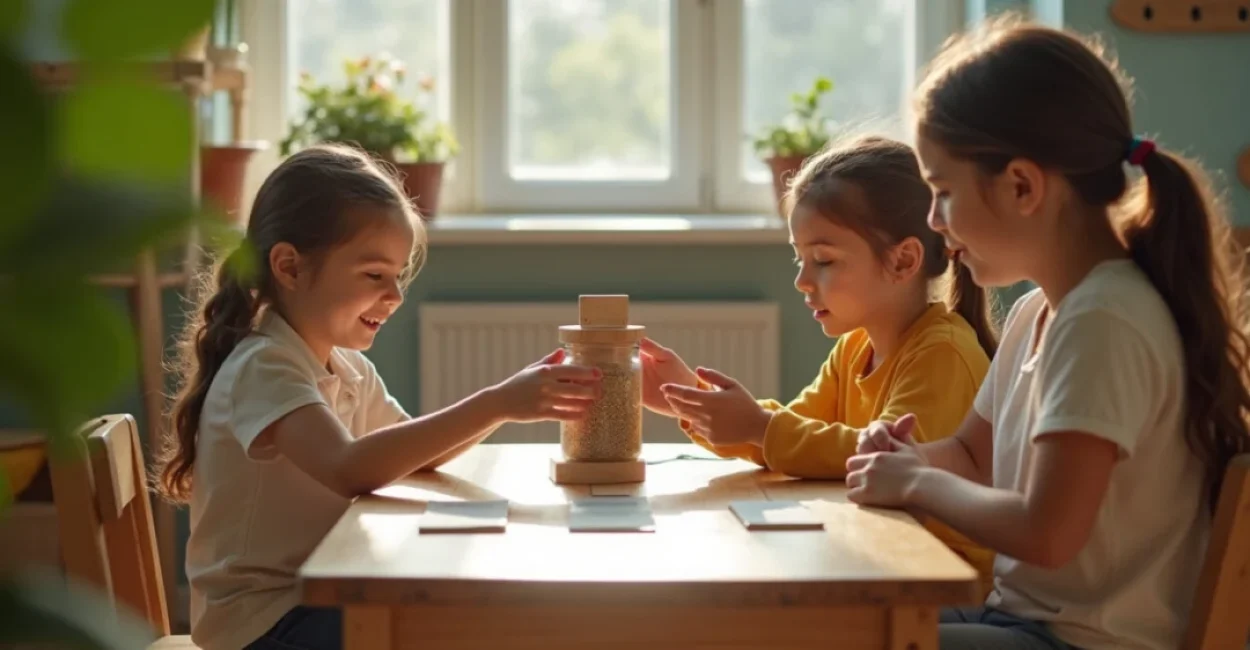
Emotional competence isn’t a personality “gift”—it comes from training, observation, and repeated practice. When we talk about social-emotional skills, we mean the abilities that help people recognize what they feel, understand how it affects others, and navigate relationships more effectively at school, at work, and at home.

This matters because effective learning, healthy relationships, and consistent leadership all depend on a solid emotional foundation. In practice, it’s simple: people who develop these skills tend to handle frustration, conflict, pressure, and collaboration better.
Below, you’ll find a clear definition, the main components of this skill set, and 10 practical activities for developing these skills in concrete ways.
The Essentials
- Social-emotional skills are observable abilities that combine self-awareness, self-control, empathy, communication, and collaboration.
- These skills aren’t just about “behaving well”: they affect academic performance, mental health, team dynamics, and decision-making.
- Development starts early but continues throughout life—and guided practice is more effective than generic advice.
- Short, frequent, relevant activities work better than isolated, abstract exercises.
- Progress shows up in concrete actions: listening without interrupting, naming emotions, asking for help, negotiating boundaries, and repairing conflicts.
Social-emotional skills and 10 practical activities to develop them
Technically speaking, social-emotional skills are a set of abilities related to recognizing, regulating, and using emotions in social situations. In plain language, they’re the ability to understand yourself, understand others, and respond constructively, even when things get tough.
This field connects with widely used models in education and psychology, such as social-emotional learning, emotional regulation theory, and the development of social-emotional skills promoted by organizations such as the OECD, the Organisation for Economic Co-operation and Development. UNICEF, the United Nations Children’s Fund, also highlights the relationship between holistic development, well-being, and learning. The key point is simple: emotion doesn’t interfere with intelligence; it’s part of it.
10 practical activities that really work
- Daily emotion check-in: Ask someone to identify what they’re feeling and why, avoiding vague labels like “bad” or “stressed.”
- Discussion circle with simple ground rules: Speak, listen, summarize what the other person said, and only then respond.
- Perspective-taking game: Analyze a situation and answer, “What did I feel?”, “What might the other person have felt?” and “What would be fair to do?”
- Trigger journal: Write down situations that bring up irritation, fear, embarrassment, or the urge to give up to identify patterns.
- Pause and breathe: Take 30 to 60 seconds before reacting in tense situations.
- Read and discuss: Use stories, movies, or real-life cases to talk about choices, consequences, and empathy.
- Teamwork challenge: Assign a task to a pair or group, with defined roles and a shared goal.
- Assertive communication practice: Practice phrases like “I need,” “I disagree,” “I didn’t like that,” and “Let’s agree on a plan.”
- Repair after conflict: Teach people to acknowledge mistakes, apologize clearly, and suggest a concrete way to make things right.
- Weekly self-assessment: Review what improved, what got in the way, and which skill needs attention next week.
Social-emotional development advances when people practice observable behaviors, not just when they “understand the theory.”
This is the part many people overlook. Knowing the name of an emotion doesn’t mean you can regulate it; understanding empathy doesn’t mean you practice it. Anyone who works in this field knows that change happens when a skill becomes part of a routine through repetition and feedback—not when it’s reduced to a motivational speech.
What each skill really means in everyday life
Not all social-emotional skills are the same. Some involve recognizing what’s happening inside you; others involve managing the impact it has on your relationships. When everything gets lumped together, the result is usually lofty talk and little follow-through.
Self-awareness, self-control, and empathy
Self-awareness means recognizing your internal states, preferences, boundaries, and typical reactions. Self-control means responding in a more constructive way than your initial impulse might suggest. Empathy means recognizing another person’s emotional state without disregarding your own perspective.
These three skills often go together, but they aren’t the same. Someone can be empathetic and still blow up under pressure. Someone else can have self-control but little social awareness. That’s why a serious assessment of social-emotional skills needs to look at behavior, not just what people say.
Collaboration and communication
Collaboration doesn’t mean agreeing with everyone; it means being able to build something with others without turning every difference into a fight. Communication involves clarity, listening, and adapting your language to the situation.
In schools and workplaces, a lot of confusion starts here: someone may have good intentions but not know how to make a case, ask for help, or disagree without attacking. That strains teams, damages relationships, and reduces productivity.
The difference between mature communication and constant noise isn’t talking more—it’s speaking clearly, listening closely, and correcting course without putting anyone down.
Why these skills affect learning, mental health, and work

The impact is broader than it may seem. For children and teens, these skills support engagement, persistence, and positive interactions. For adults, they help people make decisions under pressure, handle frustration, and maintain healthy relationships.
Reports from the OECD’s social-emotional skills program show that traits such as persistence, sociability, and emotional control are associated with better educational and life outcomes. Research from organizations such as CASEL, the Collaborative for Academic, Social, and Emotional Learning, also reinforces that consistent social-emotional learning improves school climate and engagement. The message isn’t “show more emotion”; it’s “teach the skills that support healthy relationships more effectively.”
Where these skills make the biggest difference
- At school: They support focus, participation, and frustration tolerance.
- At home: They reduce escalating conflicts and improve communication across generations.
- At work: They support feedback, collaboration, leadership, and problem-solving.
- Mental health: They support emotional regulation and help prevent prolonged impulsive reactions.
There’s an important limit to keep in mind: social-emotional skills alone can’t resolve disorders, trauma, or violent situations. They can help, but they don’t replace mental health care, social support, or a reasonably stable environment. This distinction matters because it avoids exaggerated promises and blaming the person.
How to teach these skills at home, at school, and on teams
The best approach is the simplest: less abstract instruction, more guided practice. Children learn a lot by watching adults name emotions, respect boundaries, and own their mistakes without making a scene. Adults learn the same way—they just call it “culture,” “leadership,” or “maturity.”
At home
Replace generic questions with specific ones. Instead of “How was your day?”, ask “What annoyed you today?”, “Who helped you?” or “When did you lose your patience?” This expands emotional vocabulary and helps people better understand situations.
At school
Short activities work better than disconnected projects. Five minutes of self-assessment, a listening exercise, or a discussion with ground rules for respectful conversation is more valuable than a long lecture with no follow-up.
At work
Teams that hold alignment meetings, give specific feedback, and establish clear agreements reduce communication problems and emotional friction. A common mistake is thinking this “gets in the way of productivity.” In practice, the opposite is true: resolving fewer conflicts poorly frees up energy for what matters.
Here’s a simple example: two seventh-grade students argued every week because they kept interrupting each other during group work. Their teacher replaced repeated scolding with three ground rules: take turns speaking, summarize the previous person’s point before responding, and write down the final decision. Within a few weeks, the same pair still disagreed, but they stopped blowing up at each other. The problem wasn’t a lack of intelligence; it was a lack of structure for communicating with others.
How to assess progress without relying on subjective impressions
Assessing these skills isn’t about deciding “who’s nice.” It’s about observing behavior in real or simulated situations. The criteria need to be concrete; otherwise, the assessment becomes a matter of personal opinion.
| Skill | Observable behavior | Practical indicator |
|---|---|---|
| Self-control | Pauses before responding | Fewer impulsive reactions during conflict |
| Empathy | Recognizes another person’s point of view | Fewer interruptions and less jumping to conclusions |
| Communication | Speaks clearly and asks for clarification | Fewer misunderstandings and less rework |
| Collaboration | Shares tasks and follows through on agreements | More consistent group results |
This kind of assessment can also draw on scales and tools used in research and education, but not every setting calls for a formal test. In many cases, simple rubrics and ongoing observation provide enough information to guide next steps.
Common mistakes that stall development
The first mistake is treating social-emotional skills as fixed personality traits. They aren’t. People change when they have the right environment, training, and repetition. The second mistake is thinking that simply “talking about feelings” is enough, without changing routines, rules, or the example set by adults.
Another common mistake is confusing sensitivity with permissiveness. Teaching empathy doesn’t mean avoiding boundaries. In fact, setting clear boundaries is often one of the most direct ways to show care.
What often goes wrong
- Expecting children to show self-control without modeling it for them.
- Talking about empathy without making room for people to really listen.
- Stepping in only after a crisis instead of working on prevention.
- Measuring progress only by “calm behavior,” while ignoring critical thinking and assertiveness.
What to do now to get started and stay consistent
If you want to move from talk to action, start small: choose one skill at a time, define an observable behavior, and repeat the activity for a few weeks. A short, consistent practice is better than a long list abandoned at the first difficulty.
The smartest next step is to try a simple routine in your own setting—at home, in the classroom, or on your team—and observe what changes in the quality of conversations, reactions under pressure, and follow-through on agreements. When the practice is concrete, social-emotional skills stop being a nice-sounding concept and start producing visible results.
Frequently asked questions
Can social-emotional skills be taught at any age?
Yes. They can be developed in childhood, adolescence, and adulthood, though the approach varies by age. Children learn more through modeling and routine; adults respond better to guided reflection, feedback, and hands-on practice.
What’s the difference between social-emotional competence and emotional intelligence?
Emotional intelligence usually focuses more on recognizing and managing emotions. Social-emotional skills are broader: they include empathy, communication, collaboration, self-control, and responsible decision-making. In practice, the terms overlap, but they aren’t identical.
Do these skills replace mental health care?
No. They can make a big difference in prevention, relationships, and day-to-day regulation, but they don’t replace therapy, psychiatry, or other care when someone is experiencing severe distress, trauma, or a mental health disorder. In those cases, professional support is essential.
How long does it take to see progress?
It depends on how often the skills are practiced and on the context. Small changes usually show up first in observable behavior: fewer interruptions, better listening, and a better response to frustration. More lasting changes take weeks or months of repetition.
Which practical activity gets results fastest?
Emotion check-ins, pausing before reacting, and assertive communication practice tend to work fastest. They can have an immediate effect because they improve how people respond during conflicts. Even so, they work best as part of a routine, not as a one-time activity.
%%AGPTRH6%%
Artigos Relacionados
 Extracurricular Activities for Social-Emotional Development at School
 Preschool Activities That Build Social Skills Every Day
 Social-Emotional Skills: Effective Practices in Whole-Child Education Today
 Parents and Social-Emotional Development: How to Support Children
 Early Childhood Activities: A Daily Routine for Emotional Development
