
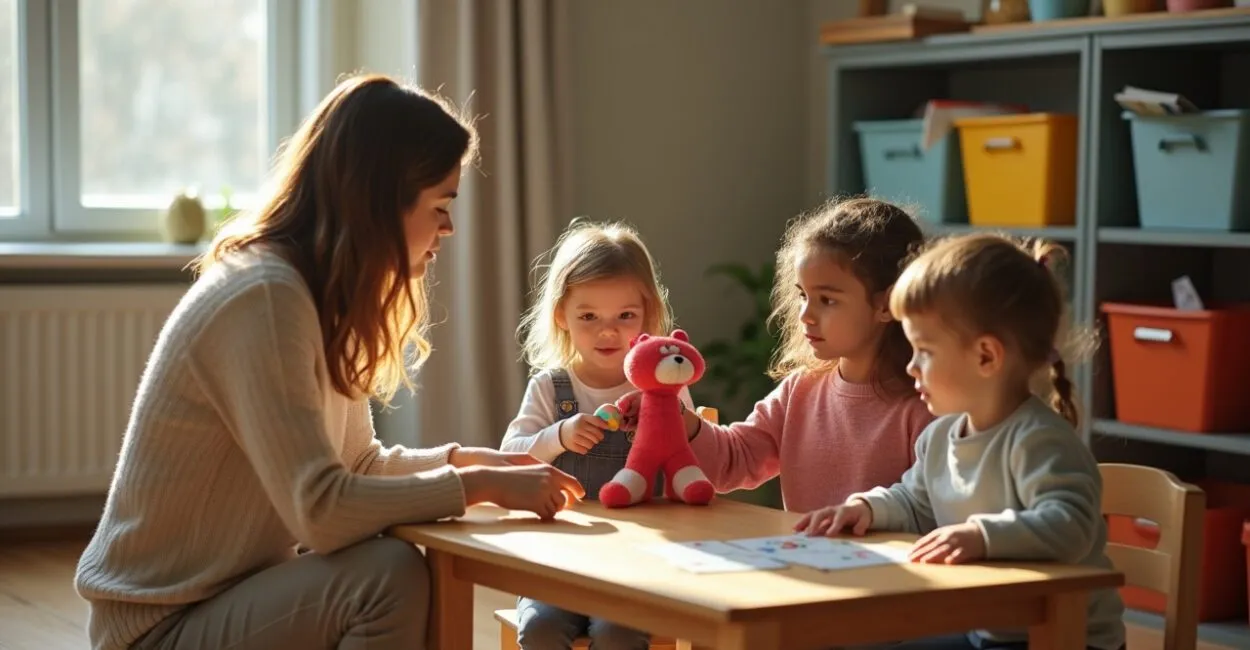
These are playful games and activities intentionally designed to teach young children to recognize, express, and regulate emotions. They’re more than entertainment: they’re educational interventions that combine elements of developmental psychology, attachment theory, and social-emotional learning practices. These games use routines, simple materials, and intentional adult guidance to create safe experiences where children can practice adaptive emotional responses.
Interest in social-emotional practices in early childhood has grown in response to concerns about mental health and school readiness. Child care professionals work with mixed-age groups, limited time, and scarce resources. Well-designed emotional play offers significant benefits: fewer tantrums, improved self-regulation, and greater cooperation. This article presents 12 practical games, along with goals, materials, age-based variations, and guidance to help caregivers create safe, welcoming experiences.

Key Takeaways
- Emotional play builds emotional recognition and regulation through safe repetition and adult guidance.
- The 12 games featured here require simple materials and can be adapted for different age groups and specific goals.
- Caregivers should prioritize predictable routines, feeling words, and responses suited to each child’s stress level.
- Measuring impact requires structured observation and brief records of self-regulation, use of feeling words, and recovery time.
Why Successful Emotional Play Depends on Adult Guidance
Adults are more than facilitators; they’re emotional role models. A calm presence and language that names emotions create opportunities for learning. Young children imitate the regulation they observe. Adult guidance teaches emotional communication and validates children’s experiences, which is essential for internalizing coping strategies.
The Role of Validation and Naming Emotions
Naming an emotion (“You’re angry”) can reduce its intensity and help children reflect. Research on early regulation shows that labeling emotions can reduce physiological responses. Validation doesn’t reinforce maladaptive behavior; instead, it reduces the need for negative attention.
Responses Tailored to Developmental Level
Children ages 1 to 3 benefit from short phrases and predictable rhythms. For ages 3 to 5, caregivers can introduce metaphors and role-play. Adjust the activity’s length, verbal complexity, and opportunities for children to make choices.
How to Structure 12 Emotional Play Activities for Child Care: Principles and Criteria
Choose games that meet three criteria: emotional recognition, active regulation, and repeatability. Each activity needs a clear goal, simple materials, and age-based variations. An ideal session lasts 10–20 minutes and combines free play with a consistent closing ritual.
Practical Selection Criteria
Prioritize activities that provide immediate feedback and adjustable difficulty. Use sensory objects, music, and facial expression cards. Avoid activities that expose children to distress without adult support. Document children’s responses and make adjustments.
Quick Metrics for Tracking Impact
Track three indicators: use of feeling words, time to return to play after frustration, and the number of outside interventions needed. These data can guide weekly adjustments and show progress.

12 Games: Descriptions, Goals, Materials, and Age-Based Variations

Here are 12 activities tested in urban and community child care centers. Each game includes a goal, simple materials, and adaptations for ages 1–2, 2–3, and 3–5. The games focus on emotional recognition, breathing regulation, safe expression, and empathy.
Read also: How to Recognize and Regulate Your Own Emotions in Everyday Life
Quick List and Goal of Each Game
- Balloon Breathing: breathing regulation and attention.
- Emotion Mirror: facial recognition.
- Calm-Down Box: self-regulation and choosing comfort.
- Feelings Theater: putting situations into words.
- Breathing Ritual: a daily calming routine.
- Emotion Map: identifying where feelings show up in the body.
- Emotion Dolls: expressing feelings.
- “Take Turns” Game: building patience while waiting.
- Story with Different Endings: practicing problem-solving.
- Faces Song: identifying emotions through rhythm.
- Compliment Hunt: positive reinforcement.
- “Not Yet” Box: managing frustration.
Detailed Example: Emotion Mirror
Goal: build emotional vocabulary and facial expression recognition. Materials: small mirror and face cards. Ages 1–2: encourage children to imitate simple expressions. Ages 2–3: introduce the words “sad,” “mad,” and “happy.” Ages 3–5: invite children to make up short stories using expressions. A partner version promotes empathy. Assessment: number of emotion labels children use without help after 4 weeks.
Guidelines for Creating Safe, Welcoming Environments for Emotional Play
Safety here means both physical and emotional safety. Predictable spaces, visual routines, and limited choices increase children’s sense of control. Loud noises, erratic schedules, and frequent caregiver changes can undermine emotional learning.
Emotional Safety Guidelines
Avoid exposing children to traumatic topics without a specialist’s support. Use positive language and make it easy to step away from an activity. Watch for signs of distress, such as freezing, prolonged crying, or trying to escape. If these occur, stop the activity and use a calming routine.
How the Physical Environment Affects Regulation
Soft sensory materials (fabrics, rubber balls, and gentle lighting) can promote relaxation. Visual step-by-step guides to the activity can reduce anxiety. Set up a calm-down corner near the group to make transitions easier.
Common Mistakes and How to Avoid Them When Using Emotional Play
A common mistake is confusing behavior control with emotional development. Rewarding silence at any cost can suppress expression. Another mistake is using activities in isolation without a routine; social-emotional learning requires repetition in different contexts.
What to Avoid When Guiding Activities
- Don’t label children as “difficult” because they react strongly.
- Don’t demand that children talk immediately after a meltdown.
- Don’t use games that trigger fear without preparing children.
These mistakes erode trust and make it harder for children to apply emotional skills in other situations.
Practical Adjustments
Take small steps: if a child doesn’t speak, accept a choice made with a gesture. Track progress in a simple spreadsheet. Train the team to use three-sentence scripts for naming emotions and offering two comfort options.
Monitoring Tools and Practical Evidence
Measuring impact improves quality. Simple tools work best in child care settings. I recommend weekly checklists, observation logs, and progress charts. Data supports quick decisions and helps justify investment.
Sample Comparison Table
| Indicator | How to measure | 8-week goal |
|---|---|---|
| Use of emotional words | Records per session | +4 words per child |
| Recovery time | Time the episode | -30% from baseline |
| Reliance on adults | Count interventions per session | -50% of interventions |
Sources and Further Reading
For technical background, consult publications and resources from the World Health Organization and child development guides from UNICEF. Clinical research on emotional regulation in early childhood is available in academic repositories such as APA PsycNet.
Next Steps for Implementation
Start with a 4-week pilot involving a small group. Choose 3 games and train the team to use brief scripts. Collect data weekly and make adjustments based on observations. Expand gradually and share results with families.
Set clear goals: decide which behaviors to change and over what period. Intentional practice can turn a set of games into an effective social-emotional curriculum. Invest in ongoing training and predictable routines to help children use these skills in their everyday child care experience.
Frequently Asked Questions: How Can You Adapt Emotional Play for Mixed-Age Groups?
For mixed-age groups, it’s essential to adjust language complexity and responsiveness. Use the same activity with different roles: younger children perform simple actions, while older children take on storytelling or leadership roles. Set up stations so each age group can practice the same skill at a different level. The caregiver circulates to offer emotion labels and individual support. This keeps the group engaged without overlooking each child’s developmental needs.
Frequently Asked Questions: How Long Does It Take to See Progress with These Games?
Initial progress may appear in 4 to 8 weeks with regular sessions, ideally 3 times a week. Signs of change include greater use of feeling words and shorter recovery times after frustration. Significant progress in self-regulation may take 3 to 6 months, depending on consistency and the family context. Simple weekly measurements help identify each child’s progress and adjust the intensity of interventions based on data.
Frequently Asked Questions: How Can You Involve Families Without Overburdening Them?
Share simple strategies families can repeat: a three-step breathing routine, a quick game for naming feelings, or a reading ritual that lets the child choose the ending. Keep communication brief, such as notes or messages with a practical example. Invite families to observe a short session and offer specific tips for home. Focus on small, repeatable actions that reinforce learning, not lengthy assignments or weekly reports.
Frequently Asked Questions: What Signs Indicate That a Child Needs a Specialist Referral?
Consider a referral if a child has persistent, extreme reactions, significant regression in basic skills, marked social isolation, or known trauma that isn’t improving with child care support. If simple interventions don’t reduce episodes after 8–12 weeks, consult a child psychologist or mental health provider. Detailed records of frequency, intensity, and triggers can help the specialist assess the child. A referral isn’t a failure; it’s appropriate care.
Frequently Asked Questions: How Can You Train Child Care Staff in Emotional Play Effectively?
Hold short, hands-on workshops focused on two- to three-sentence scripts for naming emotions, offering comfort options, and closing activities. Practical training with role-play and video feedback is more effective than lectures. Provide a pocket guide with 12 activities and progress indicators. Hold brief weekly supervision sessions and adjust based on observational data. A focus on practice and consistency leads to faster results.
Artigos Relacionados
 Language-Building Play: 10 Activities to Get Kids Talking
 Child Attention: How Free Play Improves Focus
 Social-Emotional Learning in Schools: Transforming Learning and Whole-Child Development
 The Importance of Play in Childhood for Whole-Child Development
 Early Childhood Education: The Importance of Play in Child Development
 Education: The Essential Role Parents Play in Child Development
