
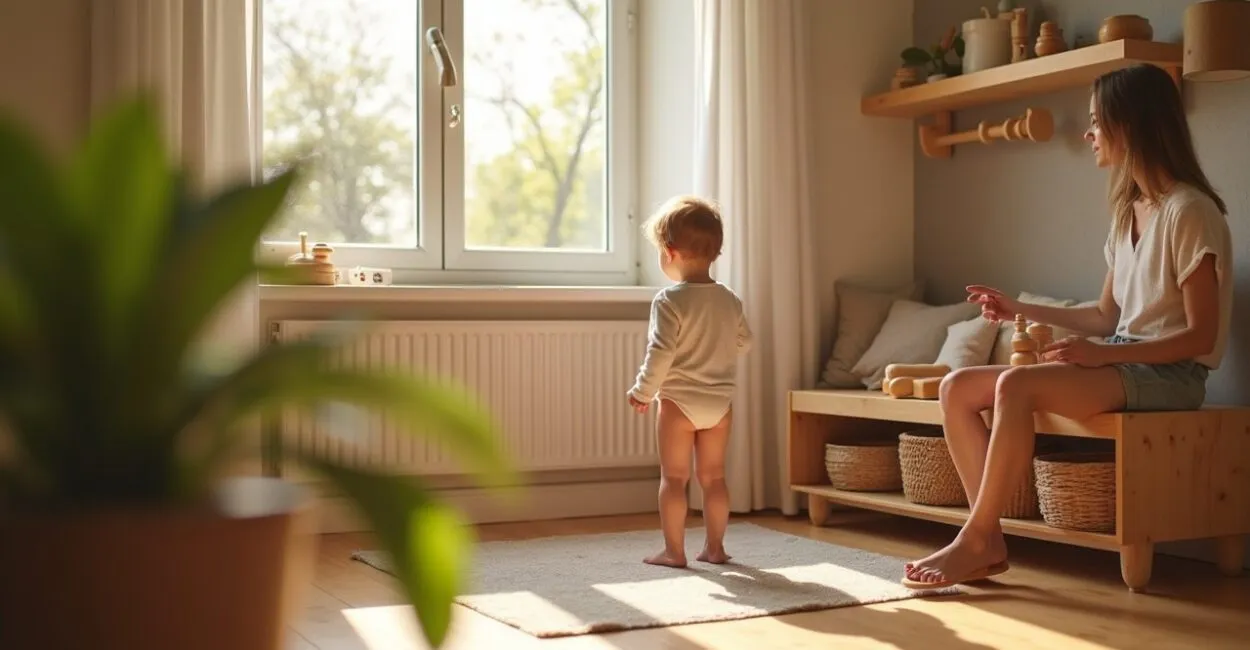
They are organized sets of principles, practices, and materials that guide educational practice. At their core, methods define what to observe, how to intervene, and what outcomes to pursue in the relationship between adults, children, and their environment. Well-designed methods turn theories into repeatable, measurable practices, making evaluation and ongoing adjustment possible.
In the context of early childhood education and online courses for families, choosing a method doesn’t mean following a fixed formula. It means choosing a set of assumptions about independence, safety, and learning. Putting a method into practice requires alignment between the adult’s goals, the child’s needs, and the resources available at home.

We’ll discuss Montessori, Pikler, and Fortezas, compare their practical features, and show how to use them in family life with a focus on observable outcomes.
Key Takeaways
- Montessori emphasizes independence through prepared environments and self-correcting materials; it requires families to observe children and adapt their spaces.
- Pikler values free movement and responsive caregiving; it supports greater motor skills and confidence, especially in babies and toddlers.
- Fortezas combines structured routines with emotional security; it’s practical for families who need predictability and clear boundaries.
- To compare methods, consider three factors: the physical environment, the adult’s role, and the learning sequence. Each method involves different trade-offs.
- Using these methods at home requires adaptation: low-cost materials, short routines, and systematic observation to measure progress.
Why Methodologies Matter for Early Childhood Education
A well-chosen methodology provides a roadmap for everyday decisions. It sets priorities—for example, motor independence versus adult-directed tasks—and guides which indicators to track. In online courses, this means focusing on modules about the environment, materials, and routines. A clear methodology reduces trial and error and makes family interventions more effective.
Measurable Indicators
Practical indicators include time spent in independent play, the number of falls per week, responses to frustration, and the ability to complete simple tasks. These data make it possible to compare outcomes before and after changes to the environment.
Quality courses teach families how to collect and interpret these signs without adding unnecessary paperwork.
Trade-Offs Between Approaches
Methods that promote independence require more preparation upfront. Approaches with structured routines may produce quick improvements in behavior, but can limit a child’s initiative. Understanding the trade-offs prevents frustration and helps families adapt a method to their circumstances.
Montessori at Home: Adapt the Environment to Encourage Independence
Montessori emphasizes freedom within limits and learning materials that allow children to correct their own mistakes. At home, this means low furniture, real child-sized utensils, and activities that encourage repetition and refinement. The adult’s role is to observe, prepare the environment, and step back when intervention isn’t necessary.
How to Prepare a Montessori Environment at Home
Use low shelves, open baskets, and materials chosen for a specific purpose. Replace electronic toys with objects that promote coordination, such as spoons, containers, and boxes. Set up clearly defined areas for meals, rest, and sensory activities. Visual order helps children understand boundaries and possibilities.
Common Mistakes When Using Montessori
Mistake 1: confusing aesthetics with the method. Attractive objects without a purpose don’t foster independence. Mistake 2: assuming the adult should be passive—the adult should observe, not disengage. Mistake 3: offering too many materials at once. A practical rule: give each activity one goal, allow for repetition, and give the child time to master it.
Pikler: Free Movement and Respect for Motor Development

Pikler emphasizes spontaneous movement and trust in children’s ability to develop motor skills without directed exercises. The adult creates a safe environment and observes without guiding every movement. The focus is on quality caregiving and continuity between care routines and play.
Essential Pikler Practices
Let babies explore the floor freely, without confining them to infant seats or walkers. Give them time on firm surfaces and provide objects that encourage gentle climbing. During diaper changes, avoid giving motor instructions; use these interactions to talk and connect, strengthening the bond.
Read also: Methodologies in Early Childhood Courses: Montessori and More
Observable Outcomes and Evidence
Studies and reports from Pikler centers show gains in coordination and motor independence during early childhood. Children in environments that allow free movement often show better balance and greater confidence when facing new motor challenges. Parenting courses turn these practices into simple daily routines.
Fortezas: Routines, Connection, and Emotional Regulation
The Fortezas method combines clear routines, warm communication, and consistent boundaries. It is based on the idea that children regulate their emotions through a predictable environment and the adult’s responses. For families with demanding schedules, it offers practical tools for regulation and transitions.
Strategies for Using Fortezas at Home
Create micro-routines—short sequences for waking up, playing, and going to bed. Use verbal and visual cues to signal transitions. Respond consistently to specific behaviors, leading with empathy while maintaining boundaries. Predictability reduces meltdowns and encourages cooperation.
When to Choose Fortezas
Fortezas is a good fit when a family needs structure to reduce stress and a child responds well to clear boundaries. It can be combined with Montessori or Pikler: it can provide the structure while other practices support independence and movement.
A Practical Comparison: Montessori, Pikler, and Fortezas
To compare these methods, consider the physical environment, the adult’s role, the developmental focus, and cost and practicality. The table below summarizes practical differences and where each method works best at home. Use the comparison to choose elements that can work together, rather than ruling out entire methods.
| Criterion | Montessori | Pikler | Fortezas |
|---|---|---|---|
| Primary focus | Independence and materials | Free movement | Routines and regulation |
| Adult’s role | Observer and guide | Provider of safety | Consistent regulator |
| Use at home | Moderate to high complexity | Low complexity; requires space | Low complexity; requires consistency |
| Measure of success | Tasks completed independently | Quality of movement | Fewer meltdowns during transitions |
Consider each item in light of your priorities: if space is limited, Pikler may require adjustments; if routines are a problem, Fortezas may be a good first step. Montessori requires an investment in materials, but many can be replaced with useful everyday objects.
Common Mistakes When Using Methods at Home—and How to Avoid Them
Mistakes often stem from a partial understanding of a method or trying to implement it fully without preparation. Don’t try to recreate an entire school at home. Another mistake is measuring success by comparing your child with others. Simple steps can help you avoid these pitfalls: start with one aspect, document changes, and make adjustments.
- Mistake: introducing materials without showing how to use them. Solution: demonstrate once, then observe.
- Mistake: offering too many activities. Solution: keep sessions short and repeat them.
- Mistake: caregivers being inconsistent. Solution: agree on shared expectations with everyone responsible for the child.
After any change, observe for 3–6 weeks to assess its impact. Keep simple notes on two target behaviors and how often they occur each week. This turns subjective impressions into practical evidence you can use to make adjustments.
How to Combine Methods Effectively
Combining methods means choosing complementary elements, not mixing everything without a plan. One effective approach is to use Fortezas for routines, Montessori for materials that encourage independence, and Pikler for free floor time. This combination is theoretically consistent and easy to use in daily life.
A Practical 30-Day Plan
Week 1: adjust routines using Fortezas and visual schedules. Week 2: prepare the environment using Montessori, with three simple activity stations. Week 3: introduce free movement using Pikler for 15–30 minutes a day. Week 4: review and collect indicators. This sequence reduces the workload and makes it easier for the whole family to stick with the plan.
Guidelines for Combining Methods Safely
Rule 1: Put safety first. Rule 2: Use consistent cues and language. Rule 3: Don’t change practices before testing them for at least three weeks. These guidelines prevent contradictions that could confuse the child.
Next Steps for Putting These Methods into Practice
First, decide what problem you want to address: greater independence, better emotional regulation, or motor development. Choose a measurable goal and make one small, reversible change. Track three indicators and evaluate the results after 3–6 weeks. If the data show progress, expand the approach; if not, adjust one element at a time.
Enroll in courses that offer practical materials and assessments (look for resources from organizations such as UNICEF and academic databases). For national data on families and childhood, consult the IBGE, Brazil’s national statistics agency. Courses with mentoring and feedback from experienced observers tend to produce better results than video lessons alone.
Frequently Asked Questions
How Can I Adapt My Home to Montessori on a Budget?
Start by choosing a small area and removing anything that gets in the way of independence, such as piles of toys or tall furniture. Replace these with accessible surfaces, baskets containing just a few objects at a time, and real child-sized utensils. Make your own materials using plastic bottles with holes, wooden containers, and fabric. Set aside 10–20 minutes a day to observe and make adjustments. Replace one item every two weeks to keep things interesting and gauge your child’s interest. This lets you apply the principle without spending much.
At What Age Is Pikler Most Effective, and Why?
Pikler has its greatest impact during the first two years, when motor development is especially responsive. The method values spontaneous movement that builds a foundation for balance, coordination, and confidence. From newborns who spend more time on the floor to two-year-olds who climb safely, the benefits show up in the quality of movement and independence during transitions. Later interventions can help, but early childhood offers a window of motor plasticity.
How Can Parents Fit Fortezas Routines Around Work Schedules?
The key is to create predictable yet flexible micro-routines: short sequences for waking up, meals, and bedtime that stay the same even when schedules vary. Use visual and auditory cues to signal quick transitions. Choose one primary caregiver to maintain consistency and share agreements with other caregivers. Write the routine on a simple chart to keep everyone on the same page. Small, predictable routines reduce stress for both children and parents with irregular schedules.
What Simple Indicators Can I Use to Tell Whether a Method Is Working?
Choose three observable indicators that are easy to track: average time spent playing independently, the number of weekly frustration episodes involving a loss of control (crying or screaming), and the ability to complete a simple task, such as getting dressed or putting away a toy. Record the numbers for two weeks before making a change and for three to six weeks afterward. Consistent positive changes suggest the method is working. If there’s no improvement, review one element at a time: the environment, the adult’s role, or the routine.
Can I Combine Montessori Materials with Pikler Practices Without Creating Conflict?
Yes. Montessori materials that encourage independence and Pikler movement spaces can complement each other when used consistently: set aside separate areas for exploring materials and moving freely. Avoid giving conflicting instructions—for example, don’t tell a child “do it this way” when Pikler values initiative. Keep cues consistent, and have an adult observe and intervene only when there’s a safety risk. This combination supports both cognitive and motor development.
Artigos Relacionados
 Free Early Childhood Education Courses: Where to Start Today
 The Ideal Course Length for Early Childhood Education
 Early Childhood Curriculum: What to Expect from Online Courses
 Early Childhood Education Courses for Parents
 Play at School: Bringing Free Play Into the Early Childhood Curriculum
 Early Childhood Literacy: Effective Methods for the Early Years
