
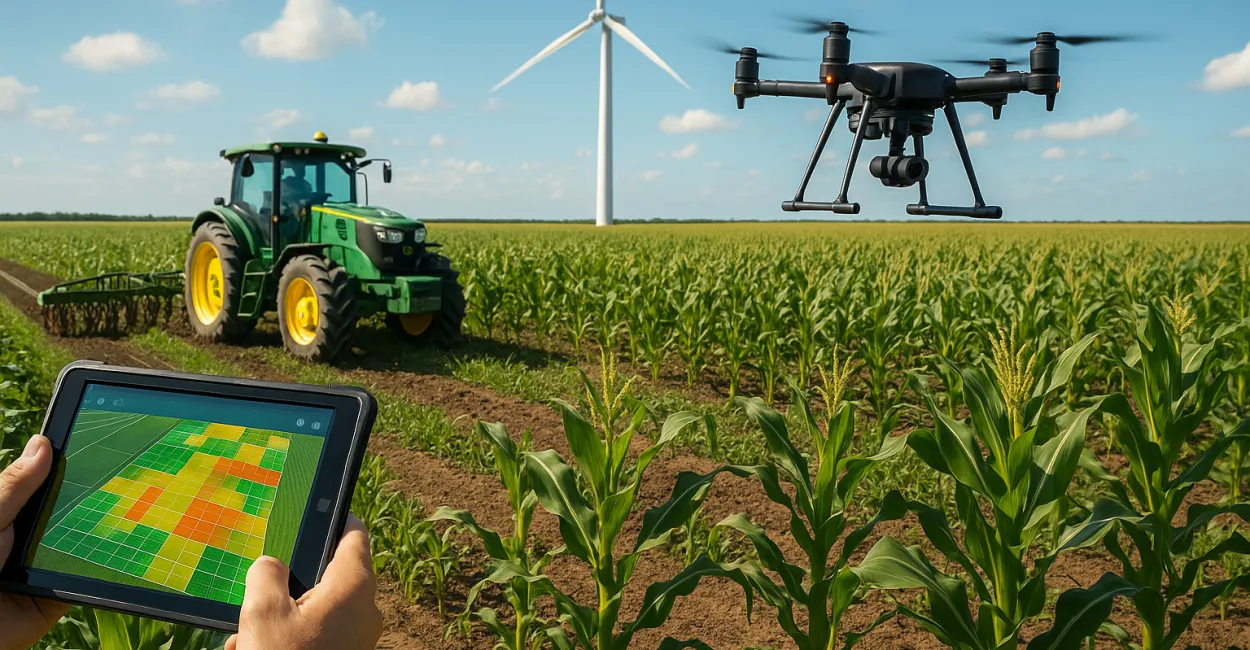
The difference between harvesting more and spending less often comes down to something invisible to the naked eye: where the soil responds well, where plants struggle, and where inputs are being wasted. Precision agriculture turns this variability into actionable decisions, using georeferenced data, sensors, imagery, and calibrated equipment to manage by zone rather than by average.
In practice, this changes how a farm is managed. Instead of treating an entire field as if it were uniform, growers can identify yield patterns, adjust fertilizer applications, amend the soil, calibrate seeding, and even rethink harvest logistics based on evidence.

Here’s a look at what this approach can deliver, where it makes a difference, and when the numbers do—or don’t—add up.
The Essentials
- Precision agriculture is a management system that combines positioning, sensors, and agronomic analysis to apply inputs at the right rate and in the right place.
- Its value lies not in the amount of data collected, but in the quality of the decisions made from it.
- Not every farm needs to start with a complete package. The first step is to confirm that there is enough variability to justify zone-based management.
- On land with uneven soil, terrain, and yields, the benefits often show up sooner because management is no longer based on averages.
- When implemented well, this approach reduces waste, improves harvest predictability, and helps sustain yields with a lower environmental impact.
How Precision Agriculture Connects Data, Equipment, and Field Management
Technically, precision agriculture is a management system that recognizes spatial and temporal variability across farmland and responds with targeted interventions. Put simply, the farm is no longer treated as one uniform block; it is divided into management zones with different needs.
This approach depends on four steps working together: data collection, agronomic interpretation, decision-making, and site-specific application. If any one of these steps fails, the technology becomes window dressing.
When the process is well designed, it becomes a method.
The Components That Really Matter
- GPS/GNSS: Positions field operations with high accuracy and helps map gaps, rows, and travel paths.
- Yield monitors: Record which areas of a field produce more or less during harvest.
- Georeferenced soil sampling: Reveals differences in pH, phosphorus, potassium, organic matter, and soil texture.
- Variable-rate application: Adjusts seed, fertilizer, soil amendments, and crop protection products to each zone’s needs.
- Satellite and drone imagery: Helps detect water stress, planting gaps, and reduced plant vigor.
Anyone who works with these tools knows raw data rarely tells the whole story. An NDVI map, for example, can show differences in plant vigor, but it cannot tell you whether the cause is compaction, disease, lack of water, or a planting error. That’s why field scouting remains essential.
What separates useful technology from an expensive purchase isn’t the number of sensors, but the ability to turn observations into actionable agronomic recommendations.
When Field Variability Justifies Zone-Based Management
The biggest mistake is adopting precision agriculture as a trend without checking whether the farm actually has variability worth mapping. On very uniform farms, it may take longer to see a return. On land with uneven fields, recurring problem areas, and different responses to inputs, the benefits tend to appear sooner.
In practice, the question isn’t “Do we have the technology?” but “Do we have an identifiable agronomic problem?” If soil conditions change significantly over short distances, the terrain varies, or yields fluctuate in the same spots year after year, site-specific management makes sense.
Signs Your Fields Need Zone-Based Attention
- Persistent yield differences between neighboring fields.
- Recurring areas that respond poorly to fertilizer.
- Uneven emergence and plant stands.
- Areas affected by compaction, waterlogging, or concentrated erosion.
- A history of overapplication in some areas and underapplication in others.
A common example is a field that looks “good” in the overall report but hides major losses in specific areas. I’ve seen growers assume weather was keeping yields below potential, when the real problem was poor drainage and compaction in recurring strips of the same field. After mapping and addressing the cause, the crop’s response to fertilizer changed noticeably.
Public resources help illustrate the scope of the issue. Embrapa’s technical publication on precision agriculture highlights that gains come from managing actual variability, not indiscriminately using digital tools. Technology cannot make up for a weak diagnosis.
The Data That Best Guides Agronomic Decisions

Not all data is equally useful. In the field, the information that most helps improve management is what explains the cause, not just what things look like. This is where soil maps, harvest history, multispectral imagery, and electrical conductivity sensors come in.
From Map to Diagnosis
A yield map shows where results differed, but it cannot explain why on its own. Georeferenced soil sampling helps connect fertility, acidity, and texture to crop performance. When these two sets of information are combined, the diagnosis becomes much more reliable.
On more advanced farms, combining satellite data, planter operation records, and yield maps can help identify planting gaps, compaction, and edge effects. This kind of analysis helps prevent decisions based on visual impressions alone.
Agricultural data only becomes an advantage when it helps answer practical questions: where to make changes, what to fix, and what rate to apply in each zone.
Read also: Website and Blog Traffic: Advanced SEO Strategies to Increase Visits
Official sources also reinforce this approach to decision-making based on detailed observation. Brazil’s Ministry of Agriculture and Livestock offers resources on innovation and sustainability in agriculture, while Embrapa, Brazil’s agricultural research corporation, has an extensive collection of publications on management, soil, and production systems adapted to Brazilian conditions.
How Variable-Rate Application Changes Fertilizing, Seeding, and Crop Protection
Variable-rate application is one of the best-known uses of precision agriculture because it turns a map into action. Instead of applying the same rate across an entire field, equipment adjusts the application to the needs of each area.
Read also: Agricultural Equipment: Technology and Modernization in Farming
Where It Delivers the Greatest Return
- Fertilizing: Reduces excess applications in areas with adequate nutrients and boosts rates in deficient zones.
- Liming and gypsum application: Targets soil acidity and improves the soil profile more precisely.
- Seeding: Adjusts plant populations based on yield potential and the risk of stress.
- Crop protection products: Improves targeting through spot spraying or prescription maps.
This method works well when the diagnosis is accurate, but it can fail when maps are interpreted mechanically. An area with low vigor does not necessarily need more fertilizer. The cause could be compaction, shading, drainage problems, or disease. Agronomic interpretation must come before a prescription.
For technical resources on remote sensing and drone use, organizations such as the USDA, the U.S. Department of Agriculture, offer useful studies and programs on agricultural digitalization, along with universities conducting applied research on site-specific management. These resources can help distinguish mature tools from those still in the experimental stage.
The Real Benefits for Yields, Costs, and Sustainability
The benefits of precision agriculture aren’t limited to higher yields. On many farms, the first noticeable effect is less waste. Fertilizer, soil amendments, and crop protection products are no longer applied across the whole field as a precaution; instead, applications are guided by local needs.
What Usually Improves First
- Input-use efficiency.
- Stand and crop development uniformity.
- Operational predictability throughout the growing season.
- Traceability of decisions by field.
- Lower environmental impact from excessive product use.
One point people often overlook is that sustainability here isn’t just talk; it’s a result of efficiency. When the system applies less where there is already enough and adds more where it is needed, environmental impact falls along with waste. This applies to nutrients, water, and crop protection products.
At the same time, there is a real limitation: the investment does not always pay off in the first season. On small farms, farms without historical data, or farms with poorly calibrated operations, payback takes longer. Experts disagree on how much scale is needed to justify full adoption, because results depend heavily on crop type, the degree of variability, and the ability to implement the system effectively.
The Mistakes That Most Often Undercut Project Returns
The problem isn’t the technology itself; it’s making decisions in the wrong order. Many farms buy software, sensors, and auto-steer systems before identifying their agronomic challenges. The investment then becomes a fixed cost without creating a competitive advantage.
Common Field-Level Mistakes
- Adopting tools without a clear agronomic objective.
- Collecting data without a consistent sampling plan.
- Creating maps without interpreting soil and crop conditions.
- Failing to train the team to operate variable-rate equipment.
- Neglecting equipment maintenance and calibration.
In practice, the crop often shows signs that don’t match what the report suggests. A polished chart won’t fix a miscalibrated row unit or make up for poor sampling. The right project starts with a management question, not a purchase.
Investing in precision agriculture makes sense when a farm can consistently follow through on recommendations; without that, data becomes a report and delivers no gains.
How to Get Started Without Making an Impulse Purchase
The best approach is usually to scale up gradually. First, identify actual variability across the farm. Then, validate it in one or two fields. Only after that should you expand to the entire operation. This step-by-step approach reduces the risk of turning innovation into frustration.
A practical way to get started is to:
- Map yield history and recurring problem areas.
- Conduct georeferenced soil sampling.
- Compare the results with satellite imagery and field inspections.
- Define management zones using agronomic criteria.
- Test variable-rate application in a pilot area and measure the results.
This approach also helps build a stronger culture within the organization. The team starts to see that every operation needs a technical justification, not just a routine. When that happens, gains no longer depend on a single season; they become part of the process.
Next Steps for Deciding Whether the Technology Is Right for Your Farm
The right question isn’t whether to adopt precision agriculture, but what to adopt, where to adopt it, and in what order. On land with proven variability, precision agriculture can deliver value by reducing waste and improving management accuracy. On uniform land without reliable historical data, investment should be more selective.
A useful next step is to validate variability with field data, compare fields with different performance patterns, and determine whether the agronomic response justifies zone-based management. If the data show real differences, the project stops being a technology gamble and becomes an operational decision.
Frequently Asked Questions
What Is Precision Agriculture in Simple Terms?
It is a management approach that uses data to treat crops site by site, rather than as one uniform area. The goal is to apply the right input, in the right place, at the right rate. This improves efficiency and reduces waste.
Is It Only for Large Farms?
No. Smaller farms can benefit too if they have variability in soil, terrain, or yields. Feasibility depends on the differences between zones, not simply on the size of the operation.
What Is the First Step in Implementing This System?
The first step is to identify variability across the farm. This usually involves reviewing yield history, conducting georeferenced soil sampling, and scouting the fields. Without a diagnosis, the technology is likely to be underused.
Does Variable-Rate Application Always Pay Off?
Not in every case. It is more likely to pay off when there is clear variability, strong operational execution, and reliable historical data. Returns may take longer on very uniform land.
What Is the Biggest Mistake Beginners Make?
Buying equipment before defining the agronomic problem. Another common mistake is failing to properly calibrate data and machinery, which compromises prescription maps. Technology without operational discipline rarely delivers the expected results.
Which Crops Benefit the Most?
Annual crops often show the clearest response when there is substantial variability within a field, including soybeans, corn, cotton, and sugarcane. The same approach can also work for perennial crops, as long as the management system is well designed.
Artigos Relacionados
 Technology in Agriculture: Innovation Transforming Modern Farming
 Autonomous Cars: Revolutionary Technology and the Future of Mobility
 Technology in the Workplace: A Complete, Practical Guide
 Quantum Computing: Understanding the Present and Future of Technology
 3D Printing: The Technology Revolutionizing Modern Manufacturing
 The 5 Most In-Demand Careers in Technology
