
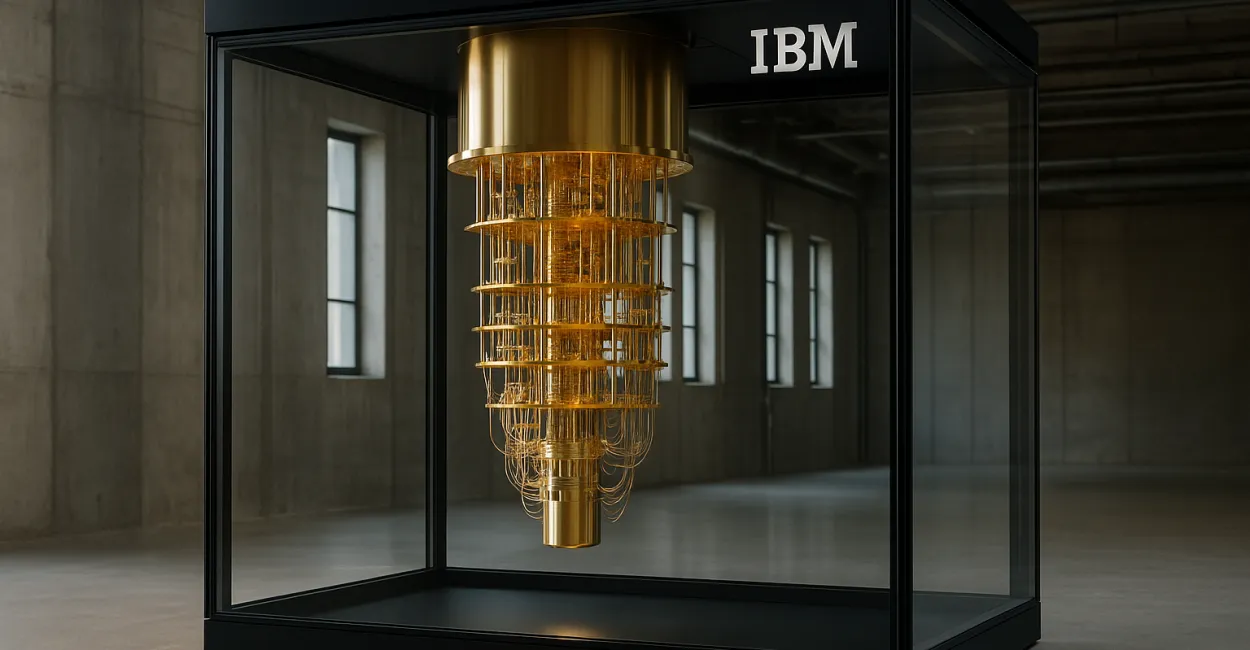
A quantum computer can harness the effects of quantum physics to solve certain tasks differently from a conventional computer. It doesn’t speed up every program, and today’s systems still face limits in scale and error correction. IBM offers remote access to quantum processors, but that doesn’t mean quantum PCs are available for home use.
To determine whether this technology is right for a company or research project, consider the type of problem, how far the solution has progressed, and the cost of combining quantum processing with classical resources. Here’s how it works, what you can test today, and where the promises still outpace demonstrated applications.

What Is a Quantum Computer, and How Does It Work?
A quantum computer is a system that processes information using quantum states and operations on qubits. Unlike a classical bit, which represents 0 or 1, a qubit can exist in a quantum combination of states until it is measured. This makes it possible to harness patterns of interference and correlations between qubits, but it doesn’t mean getting all possible answers at once.
A quantum computer relies on circuits that apply quantum gates to qubits. Measurement turns the quantum state into a classical result. Because the outcome is probabilistic, an algorithm is usually run multiple times to estimate the most likely answers.
- Qubit: A unit of quantum information implemented by a controllable physical system, such as a superconducting circuit or a trapped ion.
- Superposition: A combination of quantum states that lets a circuit create interference among possible computational outcomes.
- Entanglement: A quantum correlation between qubits that cannot be described by treating each one as independent.
- Measurement: A readout that produces a classical result according to the probabilities of the prepared state.
A qubit is not equivalent to a fixed number of classical bits, nor does it store all the answers to a problem in a directly accessible form. An advantage only emerges when an algorithm uses quantum structure to favor useful results. IBM Quantum Learning offers introductory materials on these concepts and circuits.
Quantum vs. Classical Computing: Differences, Limits, and Types of Computers
The main difference lies in how information is represented and manipulated. Classical computers are the right choice for everyday tasks, databases, and most business calculations. Quantum computers may be useful for specific classes of problems, provided the algorithm and hardware are a good fit.
Aspect Classical computing Quantum computing Basic unit Bit, with a value of 0 or 1 Qubit, subject to superposition and measurement Typical use General applications, control, and data processing Experiments and algorithms for specific problems Current state Mature and widely available technology Developing field, limited by noise and scale Speed Performance is predictable based on hardware and algorithms No automatic advantage; depends on the problem and implementation
“Four types of PC” isn’t a single, universally accepted classification. Introductory classifications often include supercomputers, mainframes, servers, and personal computers; other sources group or name these categories differently. Quantum computers represent a different approach to processing, not a fifth equivalent category in that list.
Quantum computing makes sense only when a problem’s structure can take advantage of quantum operations and the potential benefit outweighs the cost of preparing, running, and reading the results.
How Does IBM Provide Access to Quantum Processors?

IBM provides remote access to quantum systems through its platform, along with tools for building circuits and running experiments. A quantum processor is the component that contains the qubits; the chip is its physical implementation, while the system also includes control, cooling, and integration with classical computers. This integration is necessary because a quantum computer doesn’t operate on its own: classical machines prepare tasks, control the hardware, process measurements, and help validate results. In practice, small differences in circuit compilation or qubit connectivity can affect the number of operations required and the error rate. Check IBM’s official source for current resources and access terms.
People who work with systems can start by modeling the problem and running classical simulations before reserving time on quantum hardware. The other reference on systems also provides context on the technology roles involved in this kind of project.
Read also: Starlink Global 2.0: Transforming High-Speed Internet Around the World
Where Can Commercial Applications Help Today?
The most widely explored areas include chemistry and materials science, optimization, finance, and pharmaceutical research. In many of these fields, the work still involves testing algorithms, comparing results with classical methods, and determining whether any advantage can withstand the limits of available hardware.
- Finance: Research explores portfolio optimization, risk analysis, and sampling problems. A quantum financial system needs to be compared with classical methods using the same data, constraints, and quality criteria.
- Health and pharmaceutical research: Molecular simulations could, in principle, help researchers understand chemical interactions. They don’t replace trials, clinical validation, or the work of health professionals.
- Logistics and supply chains: Routing and allocation problems can be formulated for experiments, but the scale and quality of the solutions need to be compared with classical optimizers.
- Industry: Materials and process simulation is a research area connected to industry, but no general advantage for current operations has been established.
A useful test defines the expected outcome in advance—for example, reducing computation time while maintaining the same solution quality. If an experiment requires more preparation, error correction, and post-processing than the classical method, the quantum demonstration may be technically interesting without delivering commercial value.
Read also: The 5G and 6G Revolution in Brazil: Future Impacts and Challenges
What Are the Challenges, and What Changes for Security?
Qubits are susceptible to noise and easily lose their quantum properties. Error correction requires additional resources, and building larger, reliable systems remains an engineering challenge. That’s why results from small circuits don’t, by themselves, show that a business problem can already be solved more effectively in production.
In digital security, the future risk centers on public-key cryptographic algorithms that could be vulnerable to sufficiently large, fault-tolerant quantum computers. That doesn’t mean today’s systems can already break all encryption. NIST publishes guidance and standards for the transition to post-quantum cryptography; organizations should inventory where they use encryption and plan migrations based on their security needs.
Practical limits depend on the hardware, algorithm, circuit size, and comparison with the best classical alternative. These factors vary across approaches and problems, so there is no reliable, universal timeline for widespread commercial advantage.
How Do You Compare Providers, Majorana 1, and Other Technologies?
Providers use different physical methods to implement qubits, and access may be available through the cloud or at on-premises facilities. A proper comparison considers the technology, connectivity, errors, tools, and validation status—not just the advertised qubit count. IBM works with superconducting circuits and offers cloud access. Other groups, such as IonQ and Quantinuum, develop trapped-ion systems; providers such as D-Wave explore quantum annealing, which targets a narrower class of optimization problems. These approaches are not interchangeable and shouldn’t be compared solely by raw qubit count.
Majorana 1 is a chip announced by Microsoft as part of its research into topological qubits. The initiative is notable as an emerging technology, but announcing a chip doesn’t make it a general-purpose quantum computer available for commercial applications. The Microsoft quantum processor should be evaluated based on what has been demonstrated in technical documentation and independently validated, not just promotional claims.
The phrase “NASA PC” often causes confusion: NASA uses classical supercomputing for scientific and engineering tasks, but that’s not the same as having its own general-purpose quantum computer. Similarly, a “quantum laptop” isn’t a typical consumer product for sale; there’s no standard price for a consumer quantum laptop.
How Can Businesses and Professionals Get Started?
Start with a well-defined, measurable problem, not a hardware purchase. First establish a classical baseline, identify which steps might benefit from a quantum formulation, and estimate the total cost, including cloud access, data preparation, repeated runs, and results analysis.
- Choose a problem with a clear metric, such as solution quality or processing time.
- Check whether a relevant quantum algorithm exists and whether the problem fits within available resources.
- Run a small-scale simulation or experiment and compare it with the best accessible classical method.
- Invest further only if the results are reproducible and relevant to the operation.
Professionals in software, mathematics, physics, and engineering can build skills in circuit programming, linear algebra, and algorithm analysis. Demand for these skills will likely depend on advances in applications and investment in each sector; there’s no basis for treating job growth as guaranteed. The safest next step is to select a use case and establish its classical baseline before experimenting in the cloud. If there’s no measurable gain or clear technical hypothesis, sticking with conventional computing is a sensible choice.
Frequently Asked Questions
Is quantum physics real?
Yes. Quantum physics is a scientific theory supported by experiments and used to explain and develop technologies such as semiconductors and lasers. Quantum computing applies principles of this theory to information processing.
Is a quantum laptop available for consumers to buy?
There is no consumer quantum laptop comparable to a conventional laptop. Access to quantum processors is primarily available through cloud platforms or specialized facilities, and there’s no standard price for a “quantum laptop.”
Can Majorana 1 already run commercial quantum programs?
Majorana 1 is a chip associated with Microsoft’s research into topological qubits. Its announcement shouldn’t be mistaken for the availability of a universal quantum computer ready for widespread commercial use.
Will quantum computers replace classical computers?
There’s no indication they’ll replace PCs, servers, or supercomputers for general tasks. The more plausible expectation is specialized use, integrated with classical resources when a demonstrated advantage exists.
How can I tell if a provider offers a real advantage?
Ask for a reproducible comparison with classical methods, using the same problem, data, and equivalent quality criteria. Also consider setup and readout time, error rates, and access costs—not just the performance of the circuit on its own.
Artigos Relacionados
 Quantum Computing: Understanding the Present and Future of Technology
 Web3: The Decentralization Revolution in Cryptocurrency
 Biotechnology: The Revolution Transforming the Food IndustryCareersComputer Science: Growth, New Opportunities, and Careers
 Microcomputers: What They Are, How They Began, and How They Changed Computing
 Computer Scientist: A Complete Guide to Your Career and Future
