
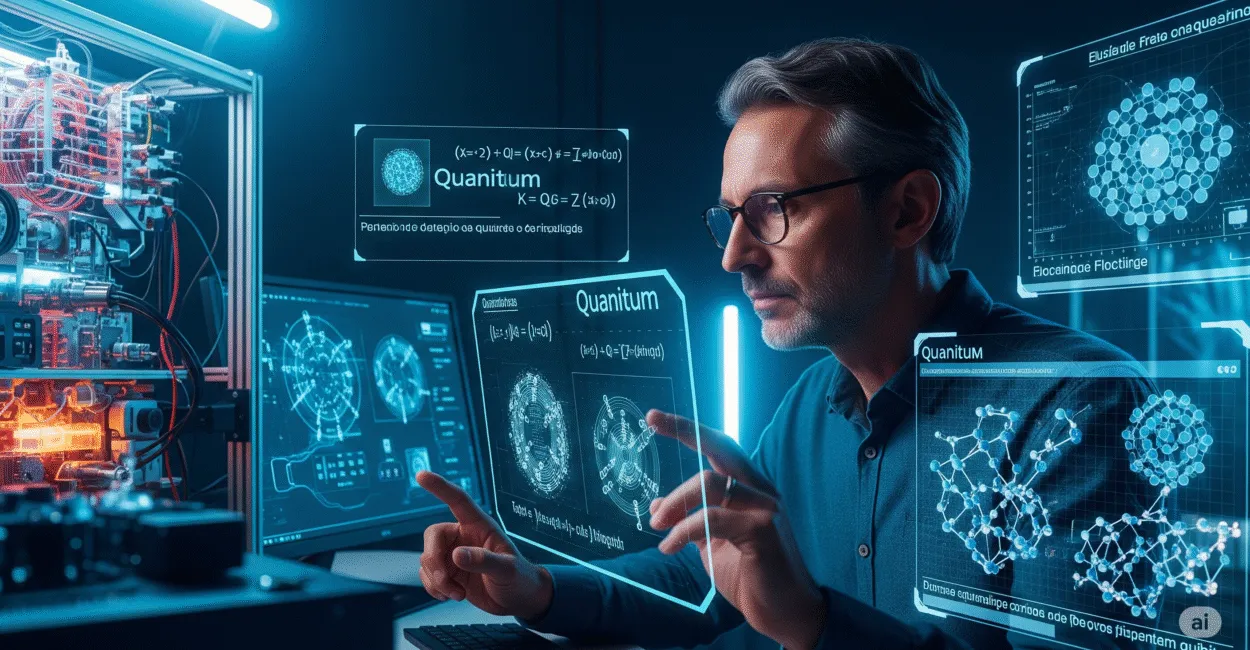
A quantum computer isn’t a faster home PC. It’s a specialized machine, usually accessed through remote platforms or research institutions. A quantum computing specialist works to understand when these resources can help, develop methods, and evaluate results without mistaking experiments for commercially ready solutions. You can enter the field with a background in physics, math, computer science, or engineering. The path you take depends on the work you want to do: research physical phenomena, design hardware, program algorithms, or apply quantum techniques alongside classical systems.
The challenge for newcomers is choosing a program that offers more than an appealing name. Strong fundamentals, programming, access to tools, and projects others can review are more useful criteria for comparing programs and planning your next steps.

What a quantum computing specialist does and where they work
A quantum computing specialist studies, develops, or applies computational methods based on phenomena from quantum mechanics, such as superposition and entanglement. The work might involve creating algorithms, testing circuits in simulators, investigating hardware, or assessing whether a specific task could benefit from a quantum approach. There’s no single job description. A quantum physicist might research how devices behave; a quantum engineer might work on hardware, control, and integration; and a software specialist might build circuits and compare their results with classical methods. The boundaries between these roles vary by team and organization.
Areas of work include:
- Academic and industry research: Studying algorithms, devices, and error-mitigation methods.
- Hardware and engineering: Developing components, controlling qubits, and working with cryogenic systems.
- Software and algorithms: Quantum programming, simulation, and integration with classical systems.
- Information security: Assessing cryptographic risks and preparing for post-quantum algorithms.
- Chemistry, materials, and finance: Researching applications in simulation and optimization problems.
Technology companies, universities, laboratories, and startups may bring together these specialists. Systems work can also be an entry point for software professionals looking to move into quantum projects.
Key fundamentals for identifying real opportunities
A qubit is the unit of information in a quantum system. It can be described as a combination of possible states until a measurement produces a result. Superposition allows this combination; it doesn’t mean a qubit is several classical bits that can all be read at once. Entanglement is a quantum correlation between parts of a system that can’t be described as a simple combination of independent states. Interference can amplify some results and reduce the likelihood of others. Quantum algorithms use these effects through carefully designed circuits and measurements.
This doesn’t make every calculation faster. Any advantage depends on the problem, the algorithm, the quality of the hardware, and the cost of preparing data and interpreting results. A circuit may work in a small simulator but fail on a real device because of noise.
A quantum advantage matters only when the algorithm, hardware, and real-world task align.
Quantum applications: what’s being researched and what’s useful today

In cryptography, the best-known risk involves quantum algorithms that, under specific conditions, could threaten certain public-key systems. That doesn’t mean all current encryption has been broken. Post-quantum cryptography develops classical methods designed to withstand attacks from quantum computers; it’s different from quantum communication, which uses physical properties to transmit or distribute information.
The NIST has published post-quantum cryptography standards and shares information about this work on its post-quantum cryptography page. For organizations, a practical response includes mapping where encryption is used and tracking the transition to appropriate standards, rather than waiting for a quantum computer capable of threatening current systems.
Simulating molecules and materials is an area of interest because quantum mechanics already describes these phenomena in nature. Still, producing useful results for relevant problems depends on hardware with sufficient quality and scale, as well as methods for controlling errors.
Read also: What Is an E-Learning Specialist?
Optimization and artificial intelligence also feature in proposed applications, but gains aren’t automatic. In many cases, research is still comparing quantum algorithms with classical methods to determine whether there’s a real advantage. Artificial intelligence projects can combine classical and quantum techniques, but adding quantum components doesn’t guarantee better performance.
There’s also growing discussion of quantum communication and new businesses. The phrase “Brazil’s entrepreneurial ecosystem is beginning to explore” appears in broad discussions about innovation, but the linked article is about paleoecology, not quantum computing; it doesn’t provide evidence of adoption or a market for this technology.
Read also: Career Reinvention Later in Life: New Professional Opportunities After 50
How to choose a program and get started
The right educational path depends on the role you’re aiming for. Physics provides a foundation for understanding devices and physical phenomena; computer science prepares you for algorithms and software; engineering helps you work with control systems, electronics, and hardware integration. None of these degrees alone guarantees expertise in the field: math and programming remain important across all paths.
Path Most useful foundation Likely focus Physics Quantum mechanics, linear algebra, and mathematical methods Research on devices, materials, and fundamentals Computer science Algorithms, programming, data structures, and complexity Software, circuits, simulators, and hybrid applications Engineering Electronics, control systems, instrumentation, and applied physics Hardware, control systems, and integration
When comparing a quantum computing program, a graduate program in quantum computing, or a quantum engineering course, check four things: clearly stated prerequisites, math content, programming exercises, and an assessable final project. Access to tools and guidance on interpreting results matter more than the certificate title.
An online graduate program in quantum physics can help you build theoretical foundations, but check whether it includes hands-on work and programming. If you’re looking for a quantum computing specialist program, contact the institution directly about the curriculum, requirements, and activities instead of assuming the program’s name answers those questions.
One possible starting path is to review linear algebra and probability, learn the concepts behind qubits and circuits, program small examples, and compare ideal results with those from a simulator or accessible hardware. If you’re looking for an IBM Quantum course, start with IBM Quantum Learning materials and the Qiskit documentation. A useful first project is to build a simple circuit and record how noise changes its measurements.
What quantum programming is and which tools to use
Quantum programming involves building circuits or procedures that manipulate quantum states to perform a task and produce results through measurement. In practice, it typically involves quantum gates, circuits, simulators, and statistical analysis of results, along with classical code to prepare data and manage execution.
Qiskit, from IBM, is one tool for building circuits and working with simulators and devices available through the platform. Other providers offer their own environments, and there are academic libraries as well. Choose a tool based on your project’s goals, the available documentation, and compatibility with the hardware you plan to use.
One detail that often confuses beginners: the output of a quantum run is sampled. When a circuit is run repeatedly, the frequency of each result helps estimate probabilities. A single measurement is rarely enough to determine whether the algorithm behaved as expected.
Technical limitations, access, and the cost of quantum computers
Current devices face noise, operational errors, and scaling limitations. Quantum error correction requires additional resources and precise control, so simply counting qubits isn’t enough to conclude that a machine can solve larger problems or outperform a classical computer.
Use also depends on integration with conventional computers, which handle tasks such as preparing data, controlling experiments, and analyzing outputs. In hybrid applications, classical processing may perform a significant part of the work. Any overall advantage must take the entire workflow into account, not just one isolated quantum step.
There’s no single price for “a quantum PC” comparable to the price of a personal computer. Quantum hardware requires specialized infrastructure and is typically accessed through remote platforms, universities, or laboratories. For learning, simulators and cloud access can lower the barrier to entry, though availability, usage limits, and service costs vary. A health insurance quote, for example, tells you nothing about the cost of accessing this equipment.
If your goal is to develop conventional software, study post-quantum cryptography, or use AI without a defined quantum research question, you may not need to work with quantum hardware. An AI ethics specialist, for example, works on different issues; the fact that two fields involve technology doesn’t make them the same profession.
Job market and next steps in your career
Opportunities exist at technology companies, in academic research, at laboratories, and in innovation initiatives, but the market is still specialized and varies by region and background. There’s no basis for promising a number of openings, salary, or timeline for adoption. Transferable skills in programming, physics, math, security, and data analysis can open up other options while quantum applications mature.
Before investing in a long program, choose a path and complete a project others can verify. For example, build a circuit, document its parameters, and compare an ideal simulation with a noisy run. Then use the results to identify knowledge gaps and assess programs by what you’ll be able to build, not just their names.
Frequently asked questions
Can an AI specialist course replace a quantum computing education?
No. It may teach useful programming and machine learning skills, but it doesn’t replace quantum mechanics, linear algebra, or the study of quantum circuits.
Do I need a Ph.D. to work in the field?
Not for every role. Cutting-edge research usually requires advanced graduate education, while software development, engineering, and applications may value other combinations of education and demonstrated experience.
Are quantum computing and quantum communication the same thing?
No. Quantum computing uses quantum systems to process information; quantum communication studies ways to transmit or distribute information using quantum resources. Post-quantum cryptography, in turn, uses classical algorithms designed to resist quantum attacks.
Do I need to buy a quantum computer to study the field?
No. You can learn with simulators and, when available, access hardware through remote platforms or research institutions.
How can I tell whether my first project is well documented?
Record the problem, circuit, tool, and configuration you used. Include results from multiple runs and explain the differences between ideal simulation and noisy measurements.
Artigos Relacionados
 Quantum Computing: Understanding the Present and Future of Technology
 IBM’s Quantum Computer: A Revolution in Commercial Computing
 Endocrinologist: A Complete Guide to Hormone Health Specialists
 Foot care specialists: what they do and when to see one
 Gynecologist: Complete Training, Current Challenges, and Career OpportunitiesCareersComputer Science: Growth, New Opportunities, and Careers
