
When a forest is managed well, few people notice the work behind it. When it’s poorly planned, the effects can last for decades: degraded soil, biodiversity loss, increased fire risk, and inconsistent production.

That’s where the Forest Engineer plays a central role, balancing conservation, production, and the responsible use of natural resources.
This profession combines science, fieldwork, and decision-making. In practice, the work involves forest inventories, sustainable management, restoration of degraded areas, environmental permitting, and land-use planning. Below, you’ll learn what these professionals do, where they work, which skills really matter, and why the job market continues to create opportunities for people who understand forests, soil, water, and management.
What You Need to Know
- Forest engineers plan, assess, and monitor the sustainable use of forests and related ecosystems.
- The field goes far beyond tree planting and includes environmental permitting, ecological restoration, geospatial technologies, and natural resource management.
- Professionals who stand out in this field often combine landscape interpretation, data analysis, and fieldwork, because forests don’t respond well to one-size-fits-all decisions.
- The job market calls for technical expertise, but places even greater value on people who can turn environmental assessments into practical solutions.
- No two forestry projects are alike: the biome, laws, and land use all shape the strategy.
Forest Engineers: What They Do, Where They Work, and Why the Profession Matters
Technically, a forest engineer is a professional with a degree in Forest Engineering who designs, carries out, and oversees activities related to managing native and planted forests, conserving natural resources, and using land sustainably. Put simply, forest engineers help generate value from forests without destroying the foundation that sustains it.
This role has become even more important as demand grows for responsible production, traceability, and climate targets. Paper and pulp companies, steelmakers, biomass energy producers, environmental consultancies, government agencies, and restoration projects all need people who can work with data, field conditions, and regulations at the same time.
A forest engineer’s value isn’t just in planting or cutting trees, but in deciding where, when, how much, and with what impact those activities can take place.
Most Common Areas of Work
- Forest management: setting harvest plans, cutting cycles, inventory methods, and regeneration strategies.
- Ecological restoration: restoring degraded areas, riparian forests, and wildlife corridors.
- Forest inventories: measuring vegetation volume, density, height, diameter, and quality.
- Environmental permitting: providing technical support for permits, mitigation measures, and legal compliance.
- Geospatial analysis: using GIS, remote sensing, and satellite imagery for land analysis.
Forest Engineering Education and the Skills Employers Really Want
Forest Engineering programs typically provide a strong foundation in botany, ecology, soils, statistics, surveying, forest mensuration, forest genetics, and management. These subjects aren’t just academic window dressing. Each one supports decisions that can be costly when they’re made poorly in the field.
In practice, employers want less talk and more results: the ability to read maps, interpret data, write clear reports, visit a site, identify problems, and propose solutions. A strong education, then, doesn’t end in the classroom; it takes shape in the field, in the lab, and through hands-on experience with operations.
Skills That Make a Difference
- Analytical skills: turning measurements into assessments.
- Landscape interpretation: understanding terrain, soil, vegetation cover, and surrounding land use.
- Knowledge of regulations: understanding rules on vegetation clearing, Permanent Preservation Areas (APPs), Legal Reserves, and environmental agency requirements.
- Technical communication: writing reports and assessments that make sense to people who control the budget.
Anyone who follows this field knows that the best forest report isn’t the longest—it’s the most useful. A clear document with a well-made map, sound methodology, and defensible conclusions is often worth more than pages of generic text.
Job Market, Industries, and Key Areas of Opportunity

Job opportunities for forest engineers span both production industries and conservation projects. Demand comes from forest products companies, consultancies, environmental monitoring startups, cooperatives, municipal governments, utilities, nurseries, nonprofits, and regulatory agencies. The common thread is that someone needs to make technical decisions about vegetation and land.
Some of the strongest sectors include eucalyptus and pine forestry, protected-area restoration, watershed planning, and environmental liability monitoring. In regions with intensive agriculture, demand grows when conflicts arise over water, erosion, APP restoration, and the balance between production and conservation.
Public data can help put this in perspective. The IBGE, Brazil’s national statistics agency, maintains important datasets on land, land use, and economic activity, while IBAMA, Brazil’s federal environmental agency, provides information related to enforcement and environmental permitting. These sources show that forest management depends on the regulatory context, not just biological knowledge.
Where These Professionals Are Most Valued
- Projects with forest certification, such as FSC and PEFC.
- Companies that rely on biomass, paper, pulp, and charcoal.
- Areas facing pressure to meet environmental requirements and restore native vegetation.
- Consultancies that use geospatial technologies and remote monitoring.
The job market values forest engineers who can connect fieldwork, maps, and regulations; professionals who know only one of these three areas are limited.
Read also: Gynecologist: Education, Current Challenges, and Career Opportunities
Tools, Technologies, and Workflows That Have Changed the Profession
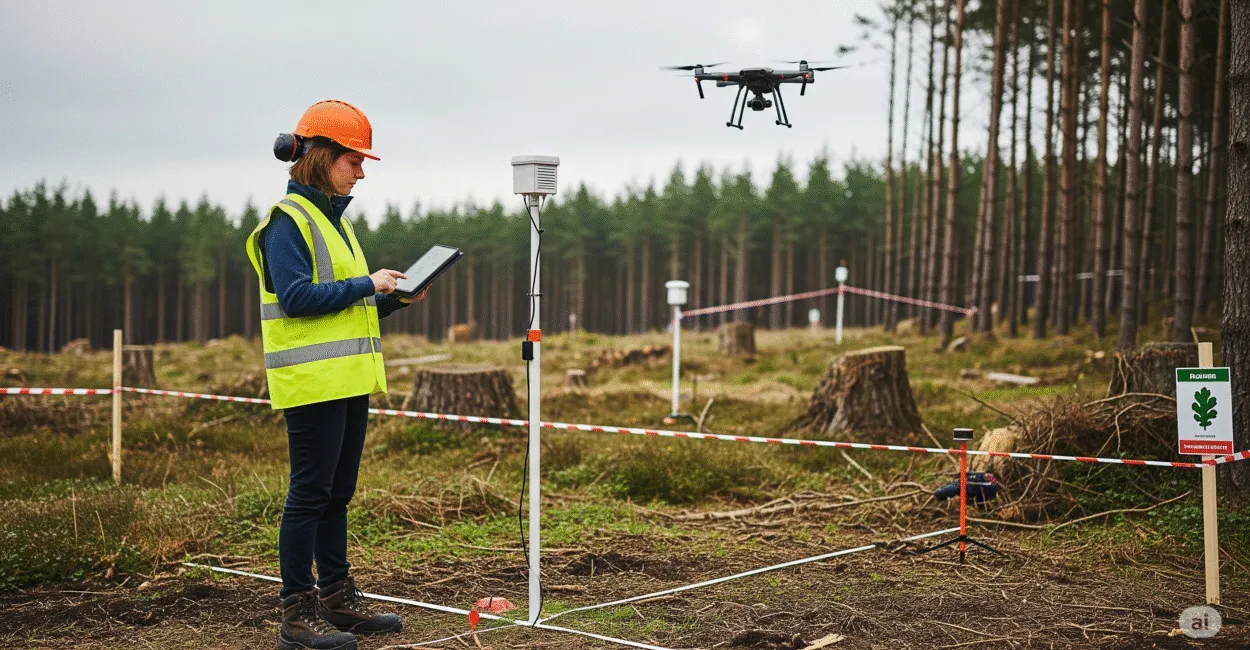
The old image of a professional walking through dense woods with a tape measure and clipboard no longer tells the whole story. Modern work includes drones, satellite imagery, GIS software, forest growth modeling, and georeferenced databases. These tools speed up assessments and improve decision-making—as long as the team knows how to interpret what the technology shows.
Common tools include QGIS, ArcGIS, precision GPS, LiDAR, forest inventory spreadsheets, and remote sensing platforms. A common mistake is to assume technology replaces field knowledge. It doesn’t. It reduces uncertainty, but it doesn’t remove the need to assess a site carefully.
Read also: Rethinking Your Career Later in Life: New Opportunities After 50
Technologies You’ll See Often
| Tool | Main use | Practical impact |
|---|---|---|
| QGIS / ArcGIS | Mapping and land analysis | Organizes spatial information and supports decision-making |
| Drones | Aerial surveys and photogrammetry | Speeds up site assessments and reduces travel |
| LiDAR | 3D vegetation modeling | Improves estimates of forest structure and biomass |
| Remote sensing | Vegetation cover monitoring | Makes it possible to track changes over time |
A real-world example helps illustrate the point. In a degraded pasture in the interior of Minas Gerais, a team found gullies encroaching on a spring. The landowner’s first instinct was to plant seedlings without an assessment. After a topographic survey and soil analysis, the priorities changed: erosion control, restoration of the riparian buffer, and selecting species suited to the local conditions. Progress was slower at first, but much more stable over time.
Salary, Career Paths, and What Affects Pay
Salary discussions in forestry require some caution, because pay varies widely by region, industry, company size, level of responsibility, and experience with fieldwork and software. In general, compensation tends to rise as professionals build expertise in high-demand areas such as team management, forest inventories, permitting, geospatial analysis, and audits.
The first job may be more operational, involving site inspections, inventory support, and area monitoring. Over time, career options expand to project coordination, senior consulting, environmental management, and strategic sustainability roles. There are also opportunities in research, teaching, and civil service exams.
One honest observation: this field pays better when professionals solve complex problems, not when they repeat routine tasks. This approach works well at companies with well-structured operations, but falls short in places where technical staff are treated as mere implementers, without autonomy or the chance to consider the broader context.
Factors That Can Increase Pay
- Experience with environmental permitting and compliance.
- Expertise in forest inventories and growth modeling.
- Ability to use GIS, drones, and spatial analysis.
- Experience on projects with demanding technical requirements and audits.
- A proven track record in restoration, forest management, or silviculture.
Real Challenges of the Profession and Common Misconceptions
From the outside, it can seem like the job is all about trees. In practice, most challenges involve decision-making: land-use conflicts, regulatory deadlines, economic pressures, unpredictable weather, and implementation costs. Forests are living systems, but their management must also account for budgets, engineering, and regulations.
Another point that doesn’t get much attention: not every environment calls for the same solution. Species that thrive in a eucalyptus plantation may fail in an ecological restoration project; production methods don’t always work for restoration. Experts sometimes disagree about the right level of intervention for certain projects because biodiversity, cost, and timelines rarely move at the same pace.
Technical resources from Embrapa, Brazil’s agricultural research corporation, can help clarify these complexities, particularly in forest management, soils, and restoration. When a project overlooks these variables, the result may look elegant on paper but prove ineffective in the field.
How to Get Started and Build a Strong Profile
To get a strong start in this profession, focus less on “having a degree” and more on “showing what you can do.” Internships, research experience, outreach projects, and hands-on work with inventories, mapping, and nurseries all count. Graduates who can read a map, write a clear report, and communicate with field crews have an edge.
If you want to strengthen your profile, focus on three areas: a solid technical foundation, familiarity with digital tools, and knowledge of environmental regulations. This combination opens doors at consultancies, forestry companies, and government agencies. Additional courses in geospatial analysis, ecological restoration, and environmental auditing can also carry significant weight.
A strong profile in forestry doesn’t come from theory alone; it takes shape when technical knowledge leads to sound decisions on the ground.
Next Steps for Anyone Considering This Career
If you’re trying to decide whether this profession is right for you, start by considering one thing: it takes an interest in fieldwork, comfort with incomplete data, and the discipline to work toward long-term results. Those looking for immediate results may get frustrated. Those who enjoy solving practical problems, reading landscapes, and connecting production with conservation are likely to find plenty of opportunities.
A good next step is to compare degree programs, look for internships in forest inventories or restoration, and talk with professionals who work for companies, consultancies, or environmental agencies. You can make a more informed decision when you understand the day-to-day work, rather than relying on a general image of the profession.
Frequently Asked Questions
What does a forest engineer do day to day?
Forest engineers assess sites, plan forest management, oversee inventories, support environmental permitting, and take part in conservation or forestry projects. The routine varies considerably by industry, but usually combines fieldwork, data analysis, and report writing.
Is Forest Engineering only for people who want to work with tree plantations?
No. The degree also prepares graduates for ecological restoration, native vegetation monitoring, geospatial analysis, environmental consulting, and work on land-use policies. This is one of the most common misconceptions about the field.
Do you need to like math to pursue this career?
Yes, because the field uses statistics, area and volume measurements, modeling, and data analysis. You don’t have to love abstract calculus all the time, but you should be comfortable with numbers and technical interpretation.
Which areas have the strongest job markets?
Silviculture, ecological restoration, environmental permitting, environmental monitoring, and geospatial technologies tend to offer good opportunities. Companies with sustainability goals and regulatory compliance needs also hire people with this background.
Is geospatial analysis required in this profession?
It isn’t required for every position, but it has become a major competitive advantage. Professionals who can use GIS, satellite imagery, and drones often deliver assessments faster and with greater spatial accuracy.
Is this career more technical or more strategic?
It’s both. Early roles tend to be more operational; with experience, professionals begin to influence decisions about land use, budgets, compliance, and long-term planning.
%%AGPTRH8%%
Artigos Relacionados
 Software Engineer: A Complete Guide to Building a Successful Career
 Nursing Technician: The Complete Guide to a Successful Career
 Complete Guide to Becoming a Laboratory Technician: Career, Training, and Job Market
 Gardener: The Complete Guide to Mastering the Profession and Advancing Your Career
 Film Director: A Complete Guide to Starting Your Career in Film
 Fashion Designer: A Complete Guide to Building a Successful Career
