
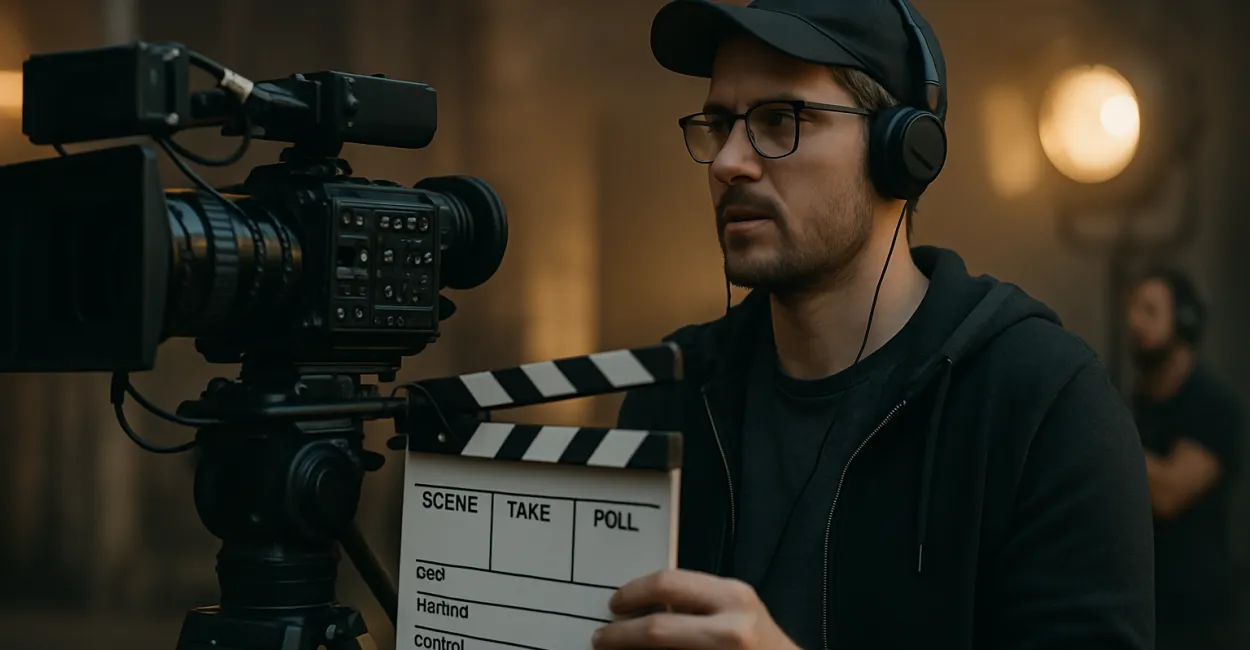
A film rarely fails because it lacks a good camera; it fails because no one makes clear decisions. The film director is the person who transforms a script into an audiovisual language, aligning performances, cinematography, sound, editing, and pacing so everything tells the same story.
In practice, directing isn’t about “bossing everyone around.” It’s about making choices quickly, reducing friction between departments, and standing by a vision without ignoring the budget, schedule, or crew.

People who understand this have an advantage because they recognize that directing is about method, listening, and reading the situation—not just inspiration.
The Essentials
- Film directing is the creative and operational coordination of a film, from script analysis through final delivery.
- The director sets the tone, staging, emotional framing, and approach to working with actors, but depends on genuine collaboration with cinematography, production design, sound, and editing.
- Anyone looking to break into the field needs to master screenwriting, set work, planning, and communication before trying to impose a “personal style.”
- Independent short films, a portfolio, and hands-on experience on small sets often open more doors than a degree alone.
- The most common beginner mistake is confusing directing with improvisation; preparation is what keeps a set running smoothly.
How a Film Director Guides the Story and Crew on Set
First, the technical definition: film directing is the role responsible for translating a script into visual, sonic, and dramatic decisions while maintaining a unified style throughout production. Put simply, the director decides how the story will be experienced by the audience—not just what will be shown.
The job begins before filming. Reading the script, breaking it down, discussing it with the crew, aligning on references, and defining the tone are all part of the real work. Skip this stage, and you may pay for it later with scenes that work on their own but don’t feel connected.
What the Director Decides in Practice
- Dramatic tone: light, tense, realistic, comedic, or a mix.
- Staging: actor positions, blocking, pacing, and subtext.
- Visual language: shot types, camera movement, and the relationship to the space.
- Stylistic consistency: everything must serve the same narrative intention.
What sets strong directing apart from merely competent directing isn’t total control; it’s the ability to make consistent choices under pressure.
That consistency shows up in the details. A director may want a scene to feel intimate, but if the production design, lighting, and sound suggest something else, the result loses impact.
Anyone who works in film knows that a set is a place for constant negotiation, not blind insistence.
Skills That Matter Before You Develop a Personal Style
Before thinking about an artistic signature, you need to master the fundamentals. There’s no solid “personal vision” without technical knowledge, script analysis, an understanding of continuity, and strong communication skills.
Your style emerges once the basics are no longer a challenge.
Core Skills
- Dramatic analysis — identify the scene’s objective, conflict, and emotional turning point.
- Communication — speak clearly with the cast and crew without creating confusion.
- Planning — organize time, the shooting order, and real priorities.
- Decision-making — make and stand by choices without bringing the set to a standstill.
- Listening — take in useful suggestions without losing sight of the project’s vision.
Professionals disagree about how much technical know-how a director needs in each department. My view is straightforward: you don’t need to replace the cinematographer, editor, or sound technician, but you do need to know enough to communicate precisely. If you don’t understand the effect of a backlight, a continuity cut, or room tone, your direction will be on shaky ground. Resources from the Brazilian Academy of Cinema and audiovisual training programs at universities can help build that knowledge. For a broader view of the industry, you can also consult FGV, a Brazilian university and research institution, for studies on the creative economy and cultural production.
From Script Analysis to Shot Breakdown: Where Directing Really Begins

A script is more than text; it’s working material. The director reads for pacing, subtext, tension, dramatic escalation, and turning points.
From there, the director translates that intent into a shot breakdown: dividing the scene into shots and actions planned for filming.
This stage separates the prepared professional from the beginner who arrives on set hoping to “feel it out.” In practice, time runs out, the crew waits, and decisions become costly.
A good shot breakdown doesn’t kill spontaneity; it makes room for spontaneity without creating chaos.
What to Look for in a Script
- Each character’s objective in every scene.
- What the audience needs to learn at that moment.
- What can be shown without dialogue.
- The sequence’s overall pacing and any potential lulls.
A shot breakdown isn’t red tape; it’s the most efficient way to turn dramatic intent into a shootable plan.
A simple example: in a goodbye scene, a director might cut lines and use silence, a close-up of the actor’s hands, and more prominent ambient sound. The emotion shifts without anyone having to explain it. From the outside, it may look minimalist; on set, people know that choice usually comes from a precise reading of the script and scene.
Directing Actors, Rehearsals, and Communication on Set
Working with actors is one of the most delicate parts of the job. The director doesn’t “act for the actor”; they create the conditions for a truthful, consistent performance. That takes listening, precision, and a clear understanding of what the scene calls for.
A classic mistake is giving overly abstract notes like “make it more intense” or “be more natural.” These aren’t helpful because they don’t identify an action, intention, or objective. It’s better to explain what the character wants, what they’re hiding, and what needs to change in the shot.
What Works Best with Actors
- Give actors concrete objectives: persuade, resist, hide, provoke.
- Avoid overexplaining right before a take.
- Explore subtext in rehearsal before filming.
- Address observable behavior, not personality traits.
Good directors tend to rehearse thoughtfully, not rigidly. Rehearsals help uncover obstacles, adjust pacing, and align the scene’s energy. This is even clearer on small productions: if the cast doesn’t understand the scene, the whole crew quickly feels the uncertainty.
Sesc, a Brazilian cultural organization, often hosts discussions and screenings that offer insight into how acting, staging, and visual language intersect in audiovisual work. The IBGE, Brazil’s national statistics agency, is useful for understanding the cultural market and employment trends in the country’s creative sector.
Cinematography, Sound, and Editing: The Collaborations That Shape a Film
No director makes a film alone. Good directing depends on real collaboration with cinematography, production design, sound recording, and editing. Each department interprets the same story from a different perspective, and the director’s job is to keep those interpretations aligned.
The cinematographer helps build the lighting, contrast, and framing; sound establishes presence, depth, and texture; editing shapes the film’s emotional timing. If the director doesn’t stay involved in these decisions, the project loses unity. A scene can look beautiful without being right for the story.
Department
Main Contribution
What Can Go Wrong
Cinematography
Lighting, framing, and atmosphere
Beautiful images with no dramatic purpose
Production sound
Clarity, ambience, and presence
A scene that makes visual sense but lacks impact
Editing
Pacing and the construction of meaning
A story with strong individual scenes but no flow
This becomes clear in post-production. I’ve seen scenes that seemed “finished” on set but only came alive in the edit because the pauses between lines weren’t working. In other cases, the cinematography was so stylized that it undercut the emotion. Directors need to anticipate these tensions before filming, not afterward.
A film feels cohesive only when cinematography, sound, and editing all support the same dramatic choice.
How to Break In with More Portfolio, Less Wishful Thinking
The most effective way to get started in directing is usually through hands-on work. Short films, personal experiments, assistant directing, visual content production, and work on small sets all build practical experience. A degree can help, but rarely carries you on its own.
To grow, you need to show that you can solve problems, not just that you love movies. A portfolio of three solid projects is worth more than ten ideas you never made. And in hiring processes, organization and clarity matter as much as visual references.
Useful First Steps
- Read scripts and turn them into shot breakdowns.
- Direct short scenes with a focus on performances and continuity.
- Take on crew roles to understand the production workflow.
- Build a focused portfolio instead of including too much material.
- Watch movies by analyzing staging choices, not just the story.
The best shortcut is to observe other people’s work on real sets. Theory helps you learn faster, but practice reveals where communication breaks down, where the schedule slips, and where a plan on paper doesn’t work in daylight. That’s where your directing skills mature.
Common Beginner Mistakes and How to Avoid Them
Beginners tend to stumble over the same things: trying to control everything, talking too much, not rehearsing enough, and ignoring the production’s real-world limits. These problems may seem minor at first, but they quickly create friction.
Another recurring mistake is chasing a “signature style” before mastering the fundamentals. The result is films with attitude but no structure. Aesthetic choices become decoration when pacing, performance, and narrative decision-making aren’t under control.
The Most Common Mistakes
- Confusing inspiration with copying someone else’s style.
- Using vague language with the crew.
- Neglecting sound by focusing only on the image.
- Ignoring the schedule and disrupting the pace of the set.
There’s a limit you have to accept: not every scene turns out perfectly, and even good directing can’t overcome a poorly planned budget. This approach works well when there’s preparation, but falls short when a project relies on total improvisation. A director shows maturity by understanding what must be preserved and what can be adapted.
Next Steps to Grow as a Director
Progress comes from short cycles of making, reviewing, and revising. Choose a simple script, cut the excess, break down the scenes, shoot, watch critically, and make adjustments. This process teaches you more than watching tutorials without putting them into practice.
If your goal is to enter the industry on solid footing, the best approach is to prove yourself on small projects before aiming for larger productions. A collection of short films, portfolio scenes, and well-edited material can show consistency. The next practical step is to plan a short shoot focused on one skill: performance, pacing, or visual composition.
Frequently Asked Questions
What Does a Film Director Do Day to Day?
A film director makes creative and operational decisions that keep a film coherent from the script through the edit. This includes script analysis, shot breakdowns, directing actors, aligning with the crew, and overseeing filming and post-production.
Do You Need a College Degree to Become a Film Director?
It’s not required, but it can help you build knowledge and professional connections. In practice, a portfolio, set experience, and well-executed short films often carry a lot of weight when breaking into the industry.
What’s the Difference Between a Director and a Cinematographer?
The director is responsible for the film’s overall vision and narrative decisions. The cinematographer translates that vision into images, focusing especially on lighting, framing, and camera design.
How Can You Start Directing with No Experience?
Start by directing short scenes, analyzing scripts, and joining small productions to learn how a set really works. The initial goal isn’t to make a perfect film, but to show that you can organize a scene and communicate a vision.
What Should a Director Know Besides Film?
You need to know how to work with people, meet deadlines, manage budgets, and make decisions under pressure. Good directors usually understand human behavior, production basics, and how to resolve conflict without losing sight of the scene.
What’s the Biggest Mistake Aspiring Directors Make?
Thinking directing is all about creativity. In practice, the work requires method, planning, and clear communication; without them, even a good idea can turn into a chaotic set.
Artigos Relacionados
 Flight Attendant: A Complete Guide to Starting Your Career Today
 Fashion Designer: A Complete Guide to Building a Successful Career
 Anesthesiologist: A Complete Guide to Building a Successful Medical Career
 Software Engineer: A Complete Guide to Building a Successful Career
 Pharmacist: A Complete Guide to the Profession and Career Opportunities
 Writer: A Complete Career Guide and Essential Writing Tips
