

The brain doesn’t learn by “absorbing information.” It learns by filtering, connecting, consolidating, and sometimes forgetting. When the neuroscience of learning enters the picture, the conversation shifts from “how much was taught” to “what was actually retained.”

This matters to schools, families, and businesses because it changes how we organize attention, memory, practice, and feedback.
In practice, anyone who works in education knows that two classes exposed to the same material can get very different results. The difference rarely comes down to intelligence or discipline alone; it often involves factors such as cognitive load, sleep, spaced repetition, emotion, and how well learners retrieve information. Below, you’ll see what science supports, where marketing claims go too far, and how to turn these findings into practical steps.
What You Need to Know
- Learning is more than receiving information: the brain must select, process, and strengthen neural connections to keep material accessible later.
- Strategies such as retrieval practice, spaced repetition, and interleaving tend to work better than passive rereading and studying for hours without a break.
- Attention is one of the most underestimated bottlenecks in learning; without a basic level of focus, working memory can’t support encoding new material.
- Not every tip marketed as “neuroeducation” has a solid foundation; many practices without robust evidence come wrapped in scientific-sounding language.
- The best way to use brain science is simple: adjust the environment, sequence, feedback, and rest time to reduce cognitive friction.
Neuroscience of Learning and What It Changes at School and at Home
Technical definition: the neuroscience of learning is the field that studies how brain circuits contribute to the acquisition, consolidation, and retrieval of knowledge, skills, and habits. In everyday terms, it explains why someone can understand something in the moment but forget it the next day—and why someone else can retain the same material with seemingly less effort. This field connects with cognitive psychology, education, pediatrics, speech-language pathology, and even sleep health. When schools ignore this, they tend to confuse exposure with learning. When families understand it, they stop demanding “more studying” and start adjusting the conditions for studying.
Learning well isn’t about piling on more content. It’s about creating the conditions for the brain to select what matters, practice retrieval, and consolidate memories over time.
The Three Processes That Matter Most
First comes attention, which determines what gets in. Next is encoding, which organizes information into meaningful patterns. Finally, consolidation strengthens connections, especially with sleep, review, and active use of the material.
This cycle helps explain why a student can “follow the lesson” and still do poorly on a test. The lesson may have been well taught, but without active retrieval and spaced repetition, the brain doesn’t turn the initial record into a lasting memory.
Memory, Attention, and Cognitive Load: The Trio That Determines Outcomes
Working memory is limited. It can hold only a small amount of information at a time, and only briefly, so too many stimuli can undermine learning. This is where cognitive load comes in: the harder it is to process a lesson, the less mental capacity is left to understand something new.
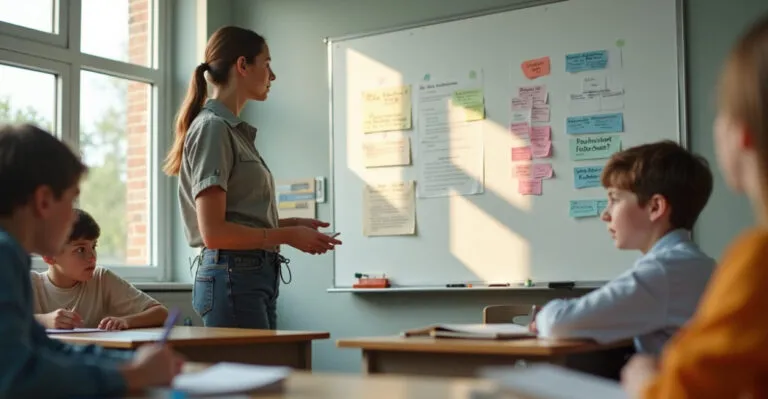
This comes up every day in the classroom. When a teacher gives lengthy instructions, fills slides with text, and assigns a complex activity all at once, students’ brains spend energy just trying to keep up. The material may seem “explained,” but it doesn’t come through clearly enough to become usable knowledge.
What Really Helps
- Break instructions into short steps.
- Use examples before introducing more difficult abstractions.
- Reduce visual and textual clutter in learning materials.
- Take short breaks between blocks of content.
For a more technical foundation, see materials from the National Institute of Mental Health, which explains the connections between attention, memory, and cognitive processes. In education, the most useful takeaway is always the same: reduce overload and improve organization.
What Happens in the Brain When Content Becomes Learning

The brain learns through neural plasticity—the ability to change the strength and organization of connections between neurons. This doesn’t mean “anything can shape anything.” It means that repetition, meaning, and context can change the efficiency of specific brain networks.
A good lesson alone doesn’t complete this cycle. Students need to retrieve information, apply it, make mistakes, correct them, and review. This process engages networks involved in episodic memory, semantic memory, and executive functions, which is why practice matters more than passive listening.
What separates exposure from learning isn’t the amount of information—it’s the quality of retrieval and consolidation over time.
A Brief Example from the Classroom
An elementary school class received short math lessons and spent five minutes reviewing at the end of each class. After two weeks, the teacher replaced rereading notes with quick questions answered without looking at the material.
The results surprised the team: students made more mistakes at first, but they remembered more later. That initial discomfort was expected. From the outside, it might seem like “studying without looking” gets in the way. In practice, the effort of retrieving an answer is exactly what strengthens memory.
This kind of intervention works very well for factual and conceptual material, but it falls short when students don’t yet have a basic foundation. Not every subject calls for the same strategy; it depends on how much the student already knows.
Evidence-Based Strategies That Work Better Than Rereading
Several practices have repeatedly been linked to better retention. The most underestimated is retrieval practice: trying to remember without looking at the material. Next comes spaced repetition, which spreads review over time, and interleaving, which mixes different types of problems or related topics.
Read also: Applied Neuroscience of Learning
These strategies tend to outperform studying everything in a single session because they make the brain reconstruct knowledge instead of simply recognizing the text. For more, the American Psychological Association website offers research-based resources on memory, learning, and teaching.
| Strategy | Why It Helps | Where It Falls Short |
|---|---|---|
| Retrieval practice | Strengthens access to memory | When there’s no basic foundation |
| Spaced repetition | Improves consolidation and retention | When the gaps between reviews are too long |
| Interleaving | Helps distinguish between similar concepts | When students are still confused about the basics |
| Rereading | Creates a sense of familiarity | Offers limited retention in the medium term |
The Most Common Mistake
Many people confuse reading fluency with mastery. A student reads quickly, recognizes the words, and thinks they’ve learned the material. Later, when they have to explain it without help, they realize the information only felt “familiar”—it wasn’t consolidated.
Sleep, Emotion, and Environment: Factors That Change the Game
Learning doesn’t happen in a vacuum. Insufficient sleep, chronic stress, and a chaotic environment reduce the quality of attention and consolidation. This matters even more for children and teens because their executive functions are still developing.
Sleep deserves special attention because it helps stabilize memories and reorganize neural networks. In practical terms, studying late and sleeping poorly usually pays off less than spending less time reviewing and getting better sleep.
Johns Hopkins Medicine offers useful resources on sleep and brain function, and the link between rest and learning is consistently documented in the research. This doesn’t mean “sleep solves everything”; it means that sleep deprivation can undermine any good method.
The Ideal Environment Doesn’t Have to Be Perfect
- Good lighting and fewer interruptions.
- Keep your phone out of reach during short study sessions.
- Set a consistent routine for starting and ending the activity.
- Be clear about what needs to get done.
There’s an important limit here: a better environment helps a lot, but it can’t make poorly designed instruction well designed. A quiet space won’t fix an assignment that hasn’t been clearly explained.
How to Bring Brain Science into Your Study Routine
Applying these findings doesn’t require a lab. It requires planning. Teachers need to think about goals, sequence, practice, and review. Students need to trade aimless hours for short, active sessions.
A Practical Plan
- Decide what needs to be remembered, explained, or applied.
- Break the material into small sections.
- Include questions that students answer without looking at their notes at the end of each section.
- Review after some time has passed, not right away.
- Test again on different days.
This plan works well for math, Portuguese, science, and languages. It also helps with corporate training, because training that only “presents slides” almost always leads to poor retention. The principle is the same: less passivity, more effortful retrieval.
What’s Still Myth, Hype, or Marketing in Neuroeducation
Not every promise marketed as an innovation has scientific support. “Learning styles” treated as a fixed rule, for example, don’t have the same backing as strategies such as active retrieval or spacing. The same goes for solutions that promise better performance through a single stimulus, app, or miracle technique.
Experts also disagree about how far transfer goes: learning one skill doesn’t always improve another automatically. A student may get better at a practiced task and remain average at another task that seems similar. This limitation matters because it helps set realistic expectations.
The science of learning isn’t a collection of tricks; it’s a set of principles for designing experiences the brain can process, consolidate, and retrieve more efficiently.
If an approach ignores evidence, promises instant transformation, or uses neuroscience-sounding language without measurable claims, be skeptical. The best question isn’t “Does it sound smart?” but “What mechanism does it affect, and under what conditions does it work?”
How to Tell Whether a Strategy Really Works
The most honest test is simple: Can the student remember and apply the material without help after some time has passed? If not, the activity may have been interesting, but it hasn’t yet produced stable learning.
Look for three signs: more correct answers after a few days, less dependence on visual cues, and better explanations in the student’s own words. These indicators say more than a sense of ease during the lesson.
For a broader reference on evidence in education, take a look at the What Works Clearinghouse from the U.S. Department of Education. It organizes evidence-based practices, helping distinguish tested methods from educational fads.
CTA: Choose a retrieval strategy, use it for two weeks, and compare performance before and after. If recall without notes and application in a new context improve, the practice is worth making part of the routine.
Frequently Asked Questions
Is the neuroscience of learning the same as neuroeducation?
Not exactly. The neuroscience of learning is the scientific field that studies the brain mechanisms involved in learning, remembering, and retrieving information. Neuroeducation is the effort to bring these findings into teaching practice, and translating between the two isn’t always straightforward.
What’s the most effective strategy for memorizing material?
Retrieval practice is often one of the most effective strategies because it makes the brain find information without support. Combined with spaced repetition, it tends to work better than rereading or passive summarizing.
Does studying for many hours always work?
No. After a certain point, attention declines and retention drops. Shorter sessions with breaks and active retrieval generally work better than long study marathons.
Does sleep really affect learning?
Yes. Sleep helps consolidate memories and reorganize what you learned during the day. Poor sleep tends to reduce attention, processing speed, and retention.
Are there “learning styles” I should follow?
Not as a fixed rule. Scientific evidence doesn’t support the idea that each person learns best through one single, unchanging channel. It’s more useful to vary how you teach based on the content and the task’s goal.
%%AGPTRH8%%
Artigos Relacionados
 Automated Learning Tools: A Complete Guide to Better Learning
 Digital Literacy: A Complete Guide for Educators
 Educational best practices: A complete guide to transforming teaching
 Neuroscience and Learning: Insights to Boost Your Learning
 Child Psychology: A Complete Guide to Understanding Children’s Emotions
 Working From Home: The Complete Guide to an Ideal Workspace
