
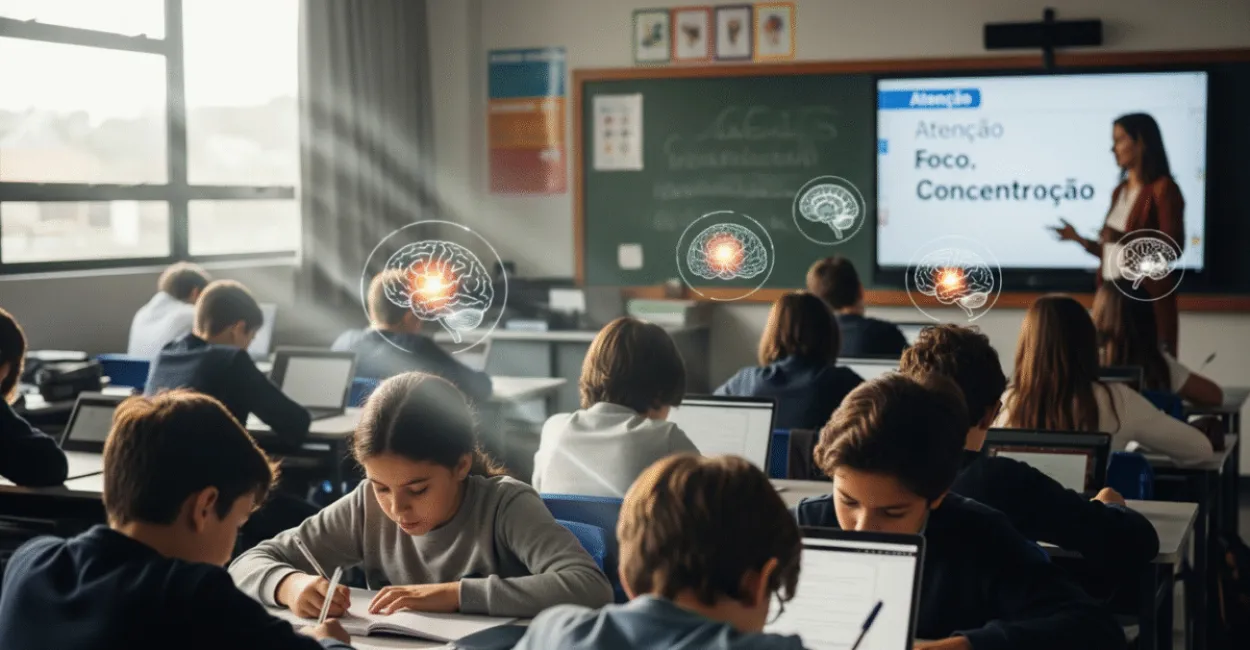
A class can be seated, quiet, and “present” without actually processing much of anything. In practice, the problem isn’t a lack of intelligence. It’s scattered attention, cognitive overload, and an environment that competes with the lesson every step of the way.

For teachers and school administrators, this changes the priority. Instead of trying to “cover more material,” the most effective approach is to design lessons that reduce distractions, increase predictability, and help students refocus with less effort.
Here’s what really works in the classroom, why it works, and where most strategies fall short.
What You Need to Know
- Attention is a limited resource: the more competing stimuli there are, the less students retain from the lesson.
- Effective classroom strategies combine routines, clear instructions, active participation, and short breaks.
- Discipline and focus aren’t the same thing: controlled behavior doesn’t guarantee mental engagement.
- Improving the physical environment helps, but the biggest gains come from how the lesson is organized minute by minute.
- A lapse in focus doesn’t always mean a student is “disinterested”; sometimes the cause is fatigue, anxiety, lack of sleep, or overload.
Strategies to Improve Attention in the Classroom Without Losing Instructional Time
When a lesson relies on long lectures, attention drops in predictable waves. Students listen for a few minutes, start missing details, refocus because of an external cue, and then tune out again. This back-and-forth takes a toll on comprehension, memory, and independence. The key point is this: attention isn’t something you can simply “demand”—it has to be structured. Teachers know that students focus better when they understand what’s coming next, how long it will take, and what they need to do with the information.
A Straightforward Technical Definition
From a cognitive perspective, attention is the mechanism that selects, prioritizes, and sustains the processing of relevant stimuli. In everyday terms, it’s the ability to keep your mind on what matters and block out the rest long enough to learn.
This selection depends on internal and external factors. Fatigue, anxiety, lack of sleep, noise, phones, confusing tasks, and vague instructions pull attention away.
Clear goals, moderate novelty, interaction, and short tasks help keep attention on the lesson.
In practice, attention in the classroom works best when teachers reduce the number of decisions students have to make each minute.
This principle appears in reference materials from Brazil’s Ministry of Education, the government agency responsible for education, and in research on learning and cognitive development. It also aligns with health and school well-being evidence published by the World Health Organization, which links sleep and stress to the ability to concentrate.
What Most Often Undermines Students’ Focus Day to Day
The problem isn’t always an “inattentive student.” Often, the lesson itself creates the disconnect. Class begins without a transition, the material starts without context, and the explanation goes on without interaction. The result is predictable.
The Four Most Common Focus Killers
- Too much uninterrupted lecturing: after a few minutes, retention drops if there’s no change of pace.
- Long, open-ended instructions: when students don’t know what to do first, they spend mental energy just getting started.
- A distracting environment: noise, constant movement, notifications, and scattered materials break up attention.
- Low predictability: abrupt changes in activity increase the effort required to adjust.
Here’s something many people overlook: attention also drops when an activity is too easy or too difficult. The first can lead to boredom; the second, to feeling stuck. The sweet spot is usually a balance of challenge and clarity.
What separates an engaging lesson from a draining one isn’t the amount of content—it’s the quality of the transitions between activities.
A useful resource for thinking about school organization is UNICEF Brazil, which addresses school attendance, engagement, and learning in their social and educational context. For data on student performance and school attendance, see reports from INEP, Brazil’s National Institute for Educational Studies and Research.
Routines, Cues, and Short Tasks: The Foundation for Sustained Focus

Routine isn’t rigidity. It saves mental energy. When students already know how class begins, how to get materials, and when to speak and listen, they spend less effort figuring out what to do and have more capacity left for learning.
Three Adjustments That Really Work
- Predictable start: a brief opening with a clearly stated goal reduces early distraction.
- Short segments: breaking an explanation into 5- to 10-minute chunks helps refresh attention.
- One consistent refocusing cue: a word, gesture, or command used consistently avoids unnecessary repetition.
In practice, this can make a difference even in lively classes. I’ve seen cases where simply replacing “copy this from the board” with “read, mark two ideas, and share them with a classmate” reduced side conversations because the task was concrete and brief.
What Doesn’t Work as Well
Routine can’t solve everything. If a class is exhausted, anxious, or missing basic background knowledge, predictability helps, but it isn’t a cure-all. Experts also disagree about the ideal length of uninterrupted instruction, since age, context, and the complexity of the material can change that number significantly.
Active Participation: How to Get Students Out of Passive Mode
Focus doesn’t improve through silence alone. It grows when students have to do something with the information. Reading, answering, comparing, sorting, explaining something to a classmate, and solving a short problem are all ways to turn listening into active processing.
Simple Strategies to Increase Engagement
- Check-for-understanding questions: interrupt passive listening without turning every minute into a quiz.
- Think-pair-share: thinking individually, talking in pairs, and sharing with the class increases the chances of meaningful participation.
- Quick-response activities: a sentence, an example, or a forced choice can bring students’ minds back to the task.
- Visual organizer: displaying steps, goals, and deadlines gives students immediate direction.
The key is not to turn everything into a show. Too much stimulation can be tiring, too. Active participation works best when it’s brief, frequent, and tied to the lesson objective—not when it creates noise for its own sake.
The Physical Environment, Phones, and Hidden Distractions
The space itself sends a message. A classroom packed with visual stimuli, uncontrolled movement, and phones within reach creates quiet competition for attention. It can undermine concentration without anyone noticing. Students may not even “notice” the distraction; they just feel tired of trying to keep up.
What to Adjust First
| Factor | Practical adjustment | Expected effect |
|---|---|---|
| Phone | Set a clear rule for phone use and storage during instruction | Fewer shifts in attention |
| Noise | Agree on a quiet signal and designated talking areas | Less effort needed to listen |
| Layout | Make the board easy to see and keep pathways clear | Better spatial orientation |
| Materials | Keep only what’s needed within reach | Fewer small interruptions |
These changes may seem small, but their cumulative effect is significant. An organized environment doesn’t “cure” inattention, but it reduces how often the brain has to reorient itself.
A Short Story: When Less Explanation Led to More Learning
In an elementary school class, a teacher noticed that students always lost track during the first 15 minutes. She didn’t change the content; she changed the sequence. She began class by writing a goal on the board, assigning a two-minute task, and breaking her explanation into short segments.
The following week, the same class was still lively, but students were less distracted. They asked fewer repeat questions, made fewer copying mistakes, and finished more assignments. What changed wasn’t “magical motivation”—it was structure.
This kind of adjustment is valuable because it shows the difference between teaching well and simply talking a lot. In the classroom, clarity almost always beats volume.
How to Tell Whether Attention Is Really Improving
If a school wants to move beyond subjective impressions, it needs to observe concrete signs. It’s not enough to ask whether the class “seems more focused.” The best approach is to look at simple, repeatable indicators.
Signs Worth Tracking
- Fewer requests to repeat the same instruction.
- More students starting the task without extra help.
- Fewer side conversations during instruction.
- Faster completion of short activities.
- Better-quality answers immediately after instructions are given.
If possible, track these data points for two or three weeks before and after making a change. This helps avoid the “I think it improved” trap. In education, impressions are useful, but evidence from your own school matters more.
Next Steps You Can Take Today
The best strategy isn’t the most sophisticated one. It’s the one a teacher can sustain without adding to their workload. Start with one change at a time: shorten the opening explanation, keep the goal visible, reduce distractions, and check for understanding after each segment.
If the school wants to take this issue seriously, it can create a simple classroom observation protocol covering routines, noise, teacher talk time, participation, and student feedback. Small, consistent adjustments usually deliver more than major but infrequent interventions.
Frequently Asked Questions
What’s the difference between attention and concentration?
Attention is the process of selecting what deserves focus; concentration is sustaining that focus over time. In practice, they depend on each other, but they aren’t the same thing. A student may pay attention for a few seconds without maintaining enough concentration to learn.
Do phones always interfere with attention in the classroom?
Generally, yes, because they create constant shifts in attention. Even when not in use, a phone’s presence can compete with the main task. The impact is smaller when there’s a clear rule, a defined educational purpose for using phones, and no confusion about when they can be accessed.
Do group activities improve focus?
They can, as long as they have a short-term goal, a set time limit, and a clear task. An unstructured group can become distracted very quickly. The benefits appear when each student knows exactly what to do and for how long.
What should I do when the class is very restless?
Make the task simpler rather than raising your voice. Give short instructions, regroup the class, return to the routine, and offer a concrete action instead of a long explanation. In many cases, the issue isn’t simply misbehavior; it’s too much stimulation and too little direction.
Is there one technique that can fix a lack of focus?
No. Attention depends on context, age, sleep, cognitive load, the environment, and how relevant the task feels. The most effective approach is usually a combination of routines, clarity, active participation, and environmental adjustments.
%%AGPTRH7%%
Artigos Relacionados
 Classroom Lighting: Student Health and Attention
 Active Learning in Lesson Planning: Strategies and Examples
 How to Include Students with Disabilities in the General Education Classroom
 The Classroom of the Future: Emerging Technologies Transforming Education
 People Manager: 7 Effective Strategies
 Emotional Intelligence: Essential Strategies for Managing Anxiety
