
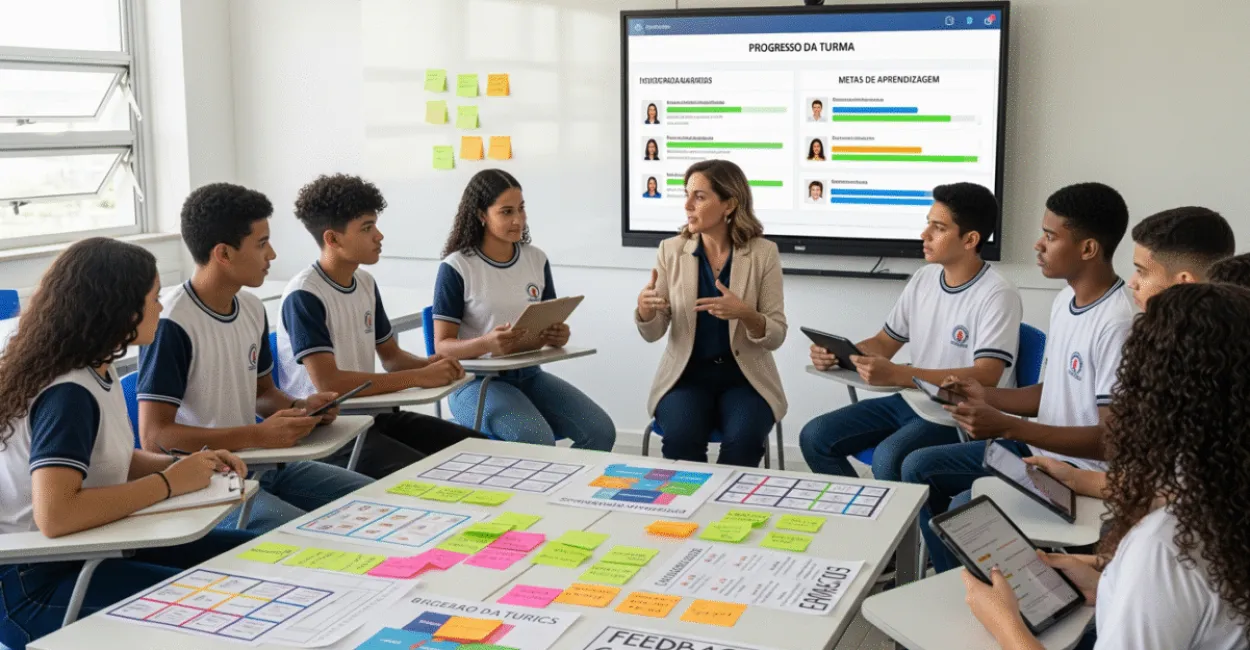
The difference between a class that makes progress and one that gets stuck rarely comes down to “more content.” More often, it comes down to noticing early what students have understood, where gaps have emerged, and what needs to change before mistakes lead to frustration.

Formative assessment does exactly that: it gathers evidence of learning throughout the process to guide teaching decisions in real time.
In practice, this changes how a lesson works. Instead of waiting for the final exam to discover that half the class hasn’t mastered a skill, the teacher observes, asks questions, listens, compares responses, and steps in along the way. This applies to elementary, middle, and high school, career and technical education, and even corporate training. The benefit isn’t “more assessment”; it’s better teaching based on evidence.
The Essentials
- Formative assessment measures learning along the way and guides immediate adjustments, rather than simply assigning a grade at the end.
- It works best when teachers use brief, frequent evidence, such as diagnostic questions, rubrics, self-assessments, and clear feedback.
- Its real value lies in the intervention: useful feedback without a practical response is just data sitting still, not improved learning.
- Not every activity needs to become a formal assessment; the point is to make students’ thinking visible as it happens.
- In diverse classrooms, this kind of monitoring keeps learning gaps from building up until the end of the term and being mistaken for a “lack of effort.”
Formative Assessment In Lesson Planning: What Really Changes
The technical definition is straightforward: formative assessment is a set of ongoing strategies for checking learning and adjusting instruction, timing, support, and activities while learning is still underway. Put simply, it answers three questions every teacher needs to ask regularly: Did the student understand? What got in the way? What should I do now?
When this approach becomes part of lesson planning, a lesson stops being a linear sequence and becomes a cycle. You teach, look for evidence, interpret what you see, and recalibrate.
This applies to conceptual content as well as practical skills, reading, writing, problem-solving, and project participation.
The difference between teaching and simply presenting content becomes clear when evidence of learning changes the teacher’s next decision.
This approach aligns well with INEP’s education data and assessments, which reinforce the idea of using educational information to guide action, not just record performance. It also aligns with the BNCC, Brazil’s National Common Core Curriculum established by the Ministry of Education, which calls for skills-based planning, progression, and ongoing monitoring.
In other words, assessment isn’t an event; it’s part of lesson design.
Why It Keeps Difficulty From Turning Into Failure
Anyone who works in a classroom knows that difficulty rarely appears out of nowhere. It tends to show up in small signs: vague answers, repeated mistakes, unusual silence, copying without understanding, or uncertainty about how to explain one’s reasoning.
If no one notices these signs early, students accumulate gaps and start to seem “disengaged” when, in fact, they’re lost.
That’s what happened in a seventh-grade class struggling with writing. The teacher didn’t wait for the monthly essay to take action. Over three consecutive class meetings, she started with a brief question, asked students to explain their answers aloud, and used a simple coherence checklist. She discovered the problem wasn’t a lack of ideas; it was paragraph organization. Within two weeks, the class improved because the adjustment was targeted, not generic.
This is what many people underestimate: good feedback gets learning back on track, but feedback that comes too late only explains the mistake. Formative assessment reduces that delay.
Signs That Need Immediate Attention
- Correct answers based on repetition, but no explanation of the reasoning.
- The same mistakes across multiple students, suggesting an unclear explanation or missing prerequisite knowledge.
- Low participation in speaking, writing, or problem-solving activities.
- Strong performance on recognition tasks but weak performance when applying knowledge.
Tools That Work In The Classroom Every Day

There’s no single magic tool. Teachers get the most out of combining simple, quick strategies that fit the lesson’s goals. The key is to gather evidence without using up all the instructional time.
Simple, Effective Tools
- Diagnostic questions: Check for prerequisite knowledge before moving on.
- Exit tickets: Capture, in a sentence or short response, what students understand and what’s still unclear.
- Rubrics: Describe quality criteria and help students see where their work stands.
- Self-assessment: Teaches students to recognize their own progress more accurately.
- Guided observation: Useful in discussions, labs, projects, and shared reading.
The OECD’s PISA has reinforced an important point for years: consistent learning depends on clear goals, monitoring, and instructional intervention—not just exposure to content. That doesn’t mean copying international models, since every school system has its own realities. It means recognizing that monitoring progress makes a measurable difference.
A good tool isn’t the most sophisticated one; it’s the one that leads to a useful teaching decision that same day.
There’s a limit, though. In classes with very limited instructional time or significant accumulated learning gaps, formative assessment loses its effectiveness if it becomes extra paperwork. In that case, precision matters more than quantity: one good question is worth more than five forms.
How To Integrate Formative Assessment Into Lesson Planning Without Complicating Your Routine
The most common mistake is treating assessment and planning as separate documents. Planning defines the goal; assessment shows whether the approach is working. When the two inform each other, lessons become more responsive.
A Routine-Friendly Process
- Define the target skill for the lesson or instructional sequence.
- Choose the evidence that will show whether students have made progress.
- Plan the intervention you’ll use if the evidence shows students are struggling.
- Look for patterns, not just isolated cases.
- Adjust the plan for the next activity based on what you observed.
This process works well with skills-based lesson plans and teaching practices built around clear objectives. If the goal is to interpret graphs, the evidence needs to show interpretation, not just literal reading. If the goal is to make an argument, the evidence should reveal reasoning, logical connections, and the use of relevant knowledge.
The important thing is not to turn everything into a short test. In many situations, a class discussion, a two-paragraph response, or a worked solution with commentary can reveal more than a closed-ended test. Formative assessment works when the tool matches what you want to observe.
Feedback, Rubrics, And Self-Assessment: The Most Helpful Trio
Three practices deserve priority: feedback, rubrics, and self-assessment. Together, they make the process visible to both teacher and student. On their own, they help; combined, they raise the level of classroom discussion.
What Each One Does
| Tool | Main purpose | Where it can fall short |
|---|---|---|
| Feedback | Clearly identify the next step | When it becomes a vague comment or just praise |
| Rubric | Make quality criteria explicit | When it’s too generic to guide action |
| Self-assessment | Develop metacognition and independence | When students select options without reflecting |
Anyone who’s graded stacks of assignments knows that “looks good” or “try harder” doesn’t help anyone. Useful feedback points to a specific change: “Your idea is right, but your argument doesn’t yet connect cause and effect” or “You got the concept right, but your example needs evidence.”
In education, especially K–12, the quality of feedback matters as much as the content itself. Research and guidance documents from universities and education organizations emphasize feedback that is specific, frequent, and actionable. A good place to start is the Harvard Graduate School of Education resources on teaching practice and visible learning.
Limits, Pitfalls, And What Doesn’t Always Work
It would be misleading to present formative assessment as a universal solution. It works very well when teachers can monitor students closely, set clear goals, and make time to intervene. It falls short when it creates too much recordkeeping, when teachers can’t act on the data, or when schools demand evidence without providing the conditions to use it.
Experts also disagree about how structured the process should be. Some advocate for more formal records; others prefer frequent, lightweight evidence with little paperwork. In practice, the best approach depends on the grade level, subject, and students’ independence.
Formative assessment without intervention is just monitoring; its educational value comes when the evidence changes what you do.
Another common risk is confusing monitoring with control. If students feel that every response will be used only to hold them accountable, they participate less and start trying to “get the right answer to get by,” rather than to learn. At that point, trust in the teacher-student relationship makes a real difference.
How To Tell Whether The Strategy Is Working
The most reliable sign isn’t whether students “enjoy the activity.” It’s a change in the quality of their responses, greater independence in solving problems, and fewer repeated mistakes. It’s also worth noticing whether students use the language of the subject more effectively, support their answers more precisely, and can revise their own work.
If students keep making the same mistakes even after receiving feedback, the problem may lie elsewhere: an unclear initial explanation, a poorly designed tool, or an objective that’s too broad. Not every unsuccessful outcome is the assessment’s fault; sometimes the skill itself hasn’t been clearly defined.
Practical Signs Of Progress
- Fewer generic answers and more explanations supported by examples.
- More precise language from students.
- Fewer repeated mistakes after intervention.
- More participation in reviewing, rewriting, and getting back on track.
If you want to deepen your practice, review official curriculum documents, instructional plans, and the standards used by your school system. The strength of formative assessment doesn’t come from following an educational trend; it comes from aligning evidence, intervention, and learning goals.
How To Apply This In Your Next Instructional Sequence
The best way to start is small: choose one skill, define a simple form of evidence, decide in advance what intervention you’ll use if students struggle, and record what you observe. Once this process becomes a habit, planning stops being predictable in the worst sense and becomes responsive.
For your next sequence, the smartest step is to try just one change: turn an ordinary activity into a genuine opportunity to observe learning. Then adjust the next lesson based on what students showed you, not what you assumed they would show. That’s what separates teaching by routine from teaching with intention.
Frequently Asked Questions About Formative Assessment
What’s the difference between formative and summative assessment?
Formative assessment monitors learning and guides interventions along the way. Summative assessment wraps up a learning cycle, usually with a grade, rating, or final result. Both can be used, but they serve different purposes.
Do I need to grade every formative activity?
No. Often, a grade gets in the way because it shifts the focus from learning to classification. It’s more useful to record evidence, provide feedback, and use the information to adjust the lesson.
What’s the most effective tool to start with?
The best tool is one that fits your routine and informs a teaching decision. To start, exit tickets, diagnostic questions, and simple rubrics often deliver good results with little extra work.
Is formative assessment only for K–12 education?
No. It works very well in higher education, career and technical education, and even corporate training. Whenever students are developing a skill, monitoring their progress makes a difference.
Does it replace traditional tests?
Not necessarily. In many settings, tests remain part of summative assessment. The point is not to rely on tests alone to understand student progress.
What should I do when students have very different skill levels?
In that case, formative assessment becomes even more important because it shows who needs extra support, who has already made progress, and who is ready for more complex challenges. Your plan can include different learning paths without losing sight of the shared goal.
%%AGPTRH8%%
Artigos Relacionados
 Playful Assessment: How to Measure Learning in a Fun Way
 How to Plan Interactive Lessons for EJA
 Big Data in Education: Turning Data Into Better Teaching Practices
 Blended Learning: Successfully Integrating In-Person and Remote Instruction
 Family Financial Planning: Build Your Financial Freedom
 Contemporary Education: Integrating Artificial Intelligence in Colleges and Its Impact on Careers
