
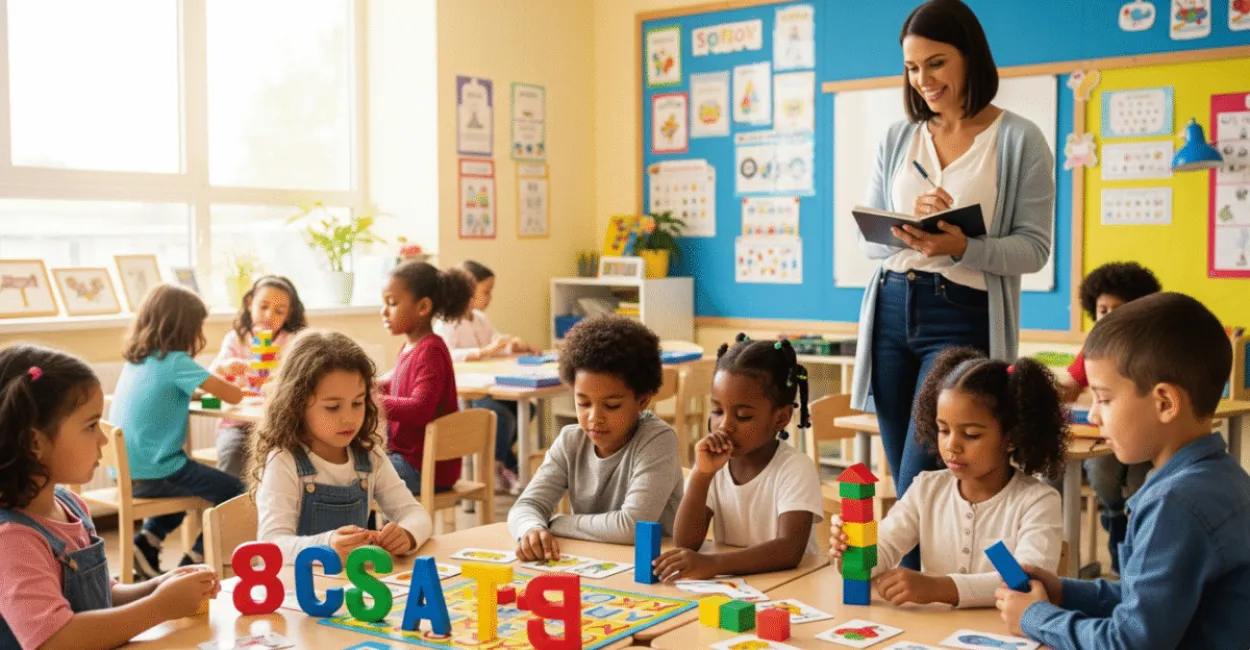
A class can win a game without mastering the material. That’s why playful assessment needs to focus on evidence of learning, not just enthusiasm or correct answers.

It uses games, challenges, and activities to assess knowledge and skills against defined criteria, helping educators understand what each participant has learned and where they need support.
This approach can be used in early childhood education, other grade levels, and training. To be effective, the activity needs an explicit learning objective, observable behaviors, and a way to record results.
Without these elements, a game is more likely to measure familiarity with the activity, speed, or luck than the knowledge it was meant to assess.
Quick overview
- Purpose: observe evidence of learning during a playful activity.
- Formats: rule-based games, challenges, role-playing, simulations, and activity stations.
- Tools: rubrics, checklists, and observation records.
- Key criterion: align the task with the learning objective.
- Limitation: the result of a single activity does not, by itself, represent a student’s overall mastery.
Playful assessment: what it is, what it’s for, and its limitations
Playful assessment is a way to assess learning that uses a game-like or play-based activity to gather evidence related to defined objectives. Put simply, the educator creates an engaging situation and observes how participants apply their knowledge, strategies, or skills.
Fun can encourage engagement, but it does not prove learning on its own.
Playful assessment helps identify what students can already do, track their progress, and guide instructional interventions. It can also reduce the pressure associated with some formal assessment situations, although that depends on the participants and how the activity is conducted.
There are real limitations. A child may know the answer but be unable to explain it in the format chosen; another may progress in the game through trial and error. Reading ability, motor coordination, anxiety, language, or familiarity with rules can also affect performance. For important decisions, combine the activity with other evidence, such as written work, conversations, and individual tasks.
What to observe: skills, behaviors, and evidence of learning
Before choosing a game, turn the objective into something you can see or hear. If the goal is to solve addition problems, evidence might include choosing an appropriate strategy and explaining how the student reached the answer. If the objective is collaboration, look for specific actions, such as dividing tasks, listening to suggestions, and justifying group decisions.
It helps to distinguish three layers: the content applied, the process used to solve the task, and the autonomy demonstrated. A correct answer may indicate mastery, but it could also be a guess or the result of help from classmates. So record how the answer was developed, not just whether it is correct.
For example, during a board game with math problems, note whether the student identifies the operation needed, calculates accurately, and can explain their reasoning. If the class plays in teams, observe each participant at some point: the group’s performance may hide who made the decisions and who simply followed along.
How to plan a playful activity with objective criteria

- Define the objective: choose a specific learning goal, such as classifying living things by their characteristics or making an evidence-based argument.
- Choose the activity: use rules and materials that let participants demonstrate that learning. Avoid mechanics that reward speed if speed is not part of the objective.
- Describe the criteria: decide which actions count as evidence and which performance levels will be recorded.
- Set instructions and timing: explain the rules, criteria, and how everyone will have a chance to participate.
- Plan the records and feedback: decide who will observe, where notes will be recorded, and how the results will guide next steps.
For example, a playful activity to assess fractions could ask groups to assemble different combinations that represent one whole. The objective might be to see whether students recognize equivalent fractions, choose appropriate pieces, and explain how they make up the whole. If the task also requires manual dexterity or extensive reading, account for those demands so they don’t distort the interpretation.
Assessment tools: rubrics, checklists, and observation records
Assessment tools make criteria visible and help reduce vague judgments. An assessment rubric describes performance levels for each criterion. A checklist marks whether behaviors are present or absent. An observation record captures brief examples of what the participant did or said.
| Tool | What it helps record | Example criterion |
|---|---|---|
| Rubric | Quality or level of performance | Explains the strategy independently, with support, or not yet |
| Checklist | Presence of observable actions | Sorts the cards according to the agreed-upon criterion |
| Observation record | Context and evidence in words | Tested two hypotheses before choosing an answer |
A checklist may be enough for a short round. If learning involves the quality of an argument or problem-solving, a rubric usually provides more information. A narrative record complements both: “participated well” isn’t very useful; “compared the two strategies and explained why one followed the rule” describes evidence that can guide the next lesson.
The Base Nacional Comum Curricular, Brazil’s national curriculum framework published by the Ministry of Education, can help connect instructional objectives to the competencies and skills set out for basic education. However, the chosen tool needs to translate the objective into actions that can be observed in the specific activity.
Examples of assessment through games in classes and training
Early childhood education
During an activity sorting objects by color, shape, or size, an educator can observe whether a child identifies the requested attribute and applies the same criterion as new pieces are added. For young children, short instructions and accessible materials help distinguish understanding of the task from difficulties with reading or complex rules. Assessment should respect each child’s development and context.
Elementary and middle school
In a science trivia card game, each student can explain an answer before earning points. The teacher records whether the student names the concept, uses relevant evidence, and revises a hypothesis when new information comes up. The score keeps the game moving; the criteria show what students learned.
Professional training
In a customer service simulation, participants can respond to situations involving customers with different needs. A rubric can assess whether they asked questions to understand the situation, consulted the correct procedure, and clearly explained the solution. For this purpose, the NIST Cybersecurity Framework is an example of an institutional reference with functions and outcomes that can inspire cybersecurity training scenarios. The simulation alone does not certify competence in every workplace context.
How to interpret results, assign scores, and give feedback
Interpret each result in light of the criteria, the conditions of the activity, and the evidence recorded. If a participant didn’t make progress, check whether they understood the rules, had an opportunity to act, and received the planned support. An observed difficulty should be investigated before being treated as a conclusion about ability or effort.
Assigning points can help track progress, as long as the scale has a clear meaning. For example, a rubric can distinguish between carrying out a strategy independently, doing so after a guiding question, and not yet demonstrating it. Avoid awarding points for speed, number of times someone speaks, or winning if those qualities aren’t part of the objective being assessed.
Feedback should point to evidence and a next step: “You sorted the cards correctly by habitat; now explain why two animals ended up in the same group.” This helps students understand what to keep doing and what to develop. A simple, dated record linked to the criteria also makes it easier to compare observations from different activities.
Playful assessment, tests, and gamification: differences and choices
A test is a tool that can assess knowledge under more standardized conditions, while a playful activity gathers evidence through a game or play-based format. Gamification, in turn, incorporates game elements—such as levels, challenges, badges, or points—into an experience that doesn’t have to be a complete game or serve an assessment purpose.
These approaches can complement one another. A playful activity may reveal strategies and interactions that a written test doesn’t; a test may assess individual knowledge with less influence from classmates. The choice depends on the objective, the stage of learning, the conditions for administering the assessment, and the importance of the decision being made.
UNESCO views education as a process involving different dimensions of learning. This perspective reinforces the value of gathering a range of evidence without assuming that one format works for every skill. When assessing complex skills, such as collaboration or argumentation, a single test may leave out important aspects; when checking an individual’s understanding of a specific answer, a team game may not provide enough evidence.
Next step: test the alignment before you begin
Before your next activity, write one sentence describing what participants should demonstrate. Then check whether the rules actually let you observe that learning and prepare a record for each criterion. If the game measures something else, adjust the activity before using the results to guide decisions.
Frequently asked questions
Can playful assessment replace a traditional test?
Not in every case. It can complement or replace a test when it provides evidence that fits the objective, but higher-stakes assessments usually require more than one source of information.
How can I tell if a game is really assessing learning?
Check for an explicit learning objective and criteria that match actions you can observe during the activity. If the only measure is who won, the game doesn’t yet provide enough information about what each participant learned.
What tools can support this approach?
Rubrics, checklists, and observation records are common options. The choice depends on the type of evidence you need: levels of quality, the presence of behaviors, or a description of reasoning and context.
Does this strategy work with young children?
Yes, as long as the activity suits their age, communication styles, and motor skills. The educator should observe actions and statements that are developmentally appropriate, without expecting an explanation the child cannot yet express in that way.
Are gamification and playful assessment the same thing?
No. Gamification uses game elements in an activity or experience; playful assessment uses a playful activity to gather evidence of learning. A gamified activity may not assess anything, and playful assessment can take place without points or badges.
%%AGPTRH2%%
Artigos Relacionados
 Active Learning Pedagogy in Extracurricular Activities: Engagement and Learning
 Professional Cameras for Educators: Essential Tools for Digital Learning
 Social-Emotional Learning in Schools: Transforming Learning and Whole-Child Development
 Neuroscience and Learning: Insights to Boost Your Learning
 Educational Technology and Blended Learning: The New Normal in Education
 Digital Transformation in Education: How to Revolutionize Learning
