
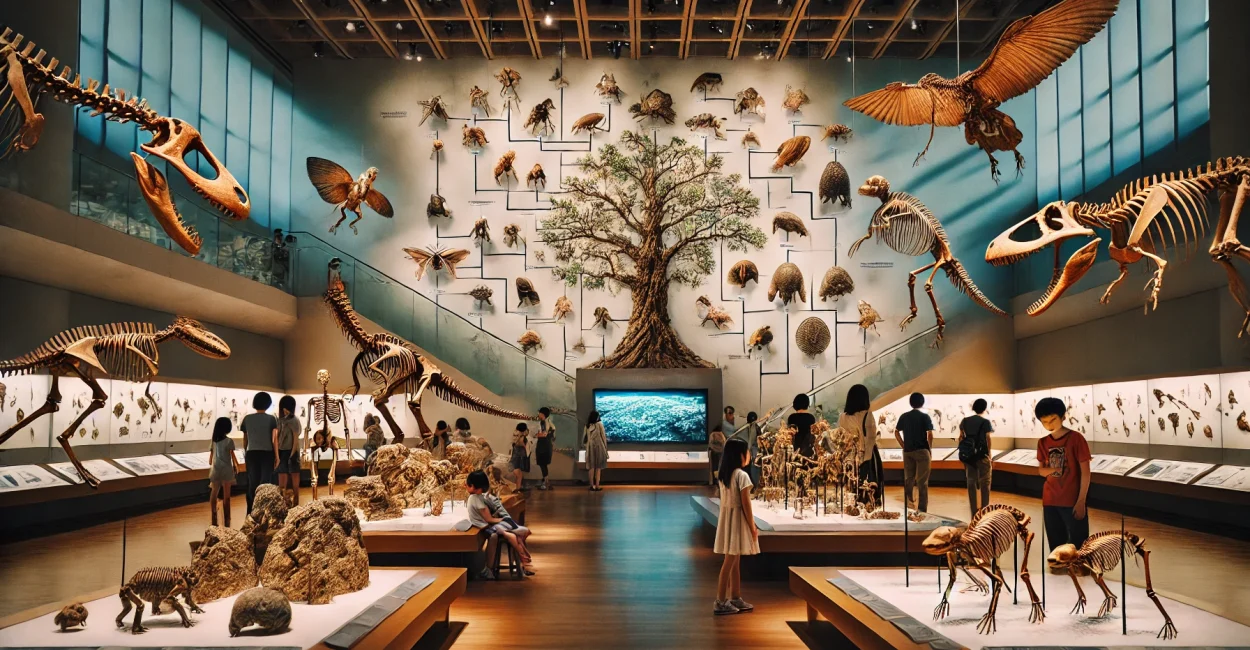
A species doesn’t appear fully formed. It changes, population by population, under pressure from the environment, chance, and genetic inheritance. The evolution of species explains why bacteria become resistant to antibiotics, why island birds develop different beaks, and why all of Earth’s biodiversity shares a common history.

In practice, this process doesn’t happen in a magical leap. It unfolds through the accumulation of small variations over time. Understanding this helps us see life more clearly: what changes, what stays the same, and why some organisms adapt while others disappear. Here, you’ll find a straightforward explanation of evolutionary mechanisms, major theories, and examples that bring the subject out of the textbook and into the real world.
The Essentials
- Biological evolution is a change in the heritable traits of populations across generations, not the transformation of a single individual.
- Natural selection is the best-known mechanism, but it doesn’t act alone: mutation, genetic drift, recombination, and gene flow also shape diversity.
- Species can form when populations stop exchanging genes, a process called speciation.
- Antibiotic resistance, crop varieties, and adaptation to island environments are concrete examples of evolution happening today.
- Not every evolutionary change is an “improvement”; many simply increase the odds of survival in a specific context.
How The Evolution Of Species Explains The Diversity Of Life On Earth
Technically, evolution is a change in the frequency of genes in a population over time. Put simply, genes passed on more often from one generation to the next become more common, changing observable traits such as size, color, metabolism, or behavior. The key point is this: evolution doesn’t happen because an organism “wants” to adapt. It depends on preexisting genetic variation and an environment that favors some individuals over others. That’s why evolutionary theory isn’t about linear progress, but about local adaptation.
Populations, Not Individuals
A person doesn’t evolve during their lifetime in the classical biological sense. Populations evolve. This may seem like a minor distinction, but it changes everything: selection acts on individuals, while its effects show up across groups of descendants over many generations.
Heritable Variation As Raw Material
Without genetic variation, adaptive evolution can’t happen. This variation arises through mutations, genetic recombination during meiosis, and, in some cases, horizontal gene transfer, which is common in microorganisms.
Evolution occurs when heritable differences affect who leaves more offspring in a given environment; without inheritance, there can be no lasting evolutionary change.
Natural Selection, Genetic Drift, And Other Mechanisms That Change Populations
Charles Darwin and Alfred Russel Wallace proposed natural selection as an explanation for adaptation that didn’t rely on purpose or intention. Rather than “needing” to adapt, a population already contains variations; the environment filters them. But reducing evolution to natural selection oversimplifies the subject. In many situations, chance—not an adaptive advantage—changes a population’s course. This is clear in small populations, where genetic drift can make rare alleles common without any clear benefit.
Natural Selection
It favors individuals with traits that increase survival or reproduction in a specific environment. A classic example is the peppered moth, whose darker coloring gained an advantage in industrial areas because it was less visible to predators.
Genetic Drift
This is random variation in gene frequencies. It has a greater impact on small populations and can eliminate useful alleles or make neutral ones more common, regardless of adaptation.
Gene Flow And Recombination
Gene flow occurs when individuals migrate and exchange genes between populations. Recombination mixes genetic material and creates new combinations. Both processes maintain diversity and can speed up or slow down evolutionary change.
| Mechanism | What It Does | When It Has The Greatest Impact |
|---|---|---|
| Natural selection | Favors advantageous heritable traits | Environments with strong selective pressure |
| Genetic drift | Changes gene frequencies by chance | Small or isolated populations |
| Gene flow | Exchanges genes between populations | Migration and contact between groups |
| Mutation | Creates new genetic variants | Every generation, with cumulative effects |
What distinguishes adaptation from chance isn’t whether change occurs—it’s what causes the change.
From Mutation To Adaptation: The Path To Biological Change

Mutation is the primary source of genetic novelty. It can occur because of errors in DNA replication, radiation, chemical agents, or cellular defects. Many mutations are neutral, some are harmful, and a few provide an advantage in a particular context.
In practice, an isolated mutation usually has a small effect. Its real impact becomes clear in a specific ecological setting, such as an environment with antibiotics, a new predator, or a sudden climate shift. That’s when biology stops being abstract and becomes a matter of selective pressure.
A Practical Example: Antibiotic Resistance
In hospitals, the evolution of bacteria can be observed almost like a textbook demonstration. When an antibiotic is used repeatedly or improperly, some bacteria survive by chance because they already carried resistance genes. These survivors multiply, and the population becomes more resistant.
This example highlights an important limitation: evolution doesn’t “create” resistance out of need. It selects variants that are already present or arise through mutation. That’s why the responsible use of antimicrobials, a priority emphasized by organizations such as the World Health Organization, is critical to slowing the spread of resistance.
Read also: The Immune System: Natural Strategies to Strengthen Your Health
Adaptation Doesn’t Mean Perfection
A trait can work well in one environment and be harmful in another. Thick feathers help in cold weather but can be a disadvantage in extreme heat. This challenges the idea that evolution always produces ideal solutions.
Speciation: When One Population Splits Into Two Lineages
Speciation is the process by which an ancestral population gives rise to two or more distinct species. The decisive factor is usually reproductive isolation: the groups stop exchanging genes often enough to remain a single species. This can happen because of geographic separation, ecological differences, behavioral changes, or accumulated genetic incompatibilities. In many cases, these mechanisms act together rather than separately.
Read also: The Influence of Nationalism and Enlightenment Ideas on the History of Brazil
Allopatric Speciation
This occurs when a physical barrier separates populations, such as mountains, rivers, or islands. Over time, mutations, selection, and genetic drift take different paths in each group.
Sympatric Speciation
This occurs without complete geographic separation. It can result from a change in niche, sexual preference, or chromosome duplication, especially in plants.
Reproductive Isolation
This is the inability of groups to mate and produce fertile offspring. It can be prezygotic, when mating or fertilization doesn’t occur, or postzygotic, when a hybrid is born but is inviable or sterile. Phylogenetic and comparative genetics studies, widely discussed by universities and research centers, help reconstruct these divisions. A useful starting point is the University of California, Berkeley’s overview of evolution, which clearly explains the connections between inheritance, adaptation, and speciation.
What Darwin Explained—And What The Modern Synthesis Revised
Darwin laid the conceptual groundwork for natural selection, but he didn’t know about genetic inheritance as we understand it today. The Modern Synthesis of evolution, developed in the 20th century, brought Darwin’s ideas together with Mendelian genetics and population biology. This addressed a major gap: scientists could now explain how traits are passed on and how variation is maintained in populations. Without this bridge, the theory would have remained incomplete.
Darwin, Mendel, And DNA
Darwin observed patterns; Mendel described inheritance; DNA revealed the physical basis of biological information. Together, these pillars support the modern understanding of evolution.
The Theory Continues To Evolve
There’s debate about the relative importance of certain mechanisms, such as group selection, phenotypic plasticity, and epigenetic inheritance in specific contexts. The foundations of the theory remain solid, but research continues to refine the details.
Evolutionary theory isn’t an opinion about life; it’s a scientific model supported by genetics, fossils, direct observation, and comparisons among species.
Fossils, Genetics, And Comparisons That Support Evolution
The strength of the evidence for the evolution of species lies in the full body of evidence, not in a single proof. Fossils show changes over time; genetics reveals molecular relationships; comparative anatomy identifies homologous structures; and biogeography explains why islands and continents are home to distinct lineages. The fossil record, though incomplete, is far more robust than popular criticism suggests. It preserves important transitions, including intermediate forms in lineages from fish to tetrapods, reptiles to birds, and land mammals to cetaceans.
Island Biogeography
Islands are natural laboratories of evolution. Isolated species tend to diversify rapidly because they encounter new resources, new predators, and little competition from close relatives.
Molecular Genetics
DNA sequences make it possible to compare species precisely. The more similar the genomes, the more recent their common ancestor is likely to be, though this reasoning requires care because mutation and recombination rates vary.
A Note Of Caution
Not every similar trait indicates close kinship. Convergent evolution can produce similar solutions in distantly related groups, such as the wings of bats and birds or the streamlined bodies of sharks and dolphins. This is one of the most common pitfalls for anyone interpreting evolution superficially.
Why Evolution Matters In Health, Agriculture, And Conservation
Evolution isn’t just a classroom topic. It informs strategies in public health, pest management, genetic improvement, and biodiversity protection. Those who ignore this process often make decisions that work briefly and then fail.
In agriculture, for example, pests and weeds evolve resistance when the same chemical pressure is applied repeatedly. In conservation, small populations are more vulnerable to genetic drift and inbreeding, which reduce variability and increase the risk of extinction.
- Health: Controlling antibiotic resistance requires monitoring and careful use of medications.
- Agriculture: Rotating strategies reduces selection for resistant pests.
- Conservation: Preserving gene flow between populations can prevent genetic erosion.
- Research: Understanding evolution helps predict how organisms will respond to environmental changes.
Data and recommendations from organizations such as the Centers for Disease Control and Prevention reinforce this practical perspective, especially when it comes to combating antimicrobial resistance and protecting public health. Those who work in this field know that ignoring evolutionary dynamics comes at a high cost.
Next Steps For Reading Nature More Precisely
The real benefit of studying evolution isn’t memorizing names; it’s changing how you interpret life. When you start thinking in terms of populations, inheritance, selection, and deep time, biological diversity stops looking like a random mosaic and begins to reveal patterns.
If you want to take a systematic approach, choose a specific example—bacteria in a lab, island birds, insect resistance, or cultivated plants—and ask which evolutionary forces are at work. This exercise is more valuable than repeating definitions from memory.
Frequently Asked Questions About The Evolution Of Species
What’s the difference between evolution and adaptation?
Evolution is heritable change in populations over time. Adaptation is one possible outcome of that change, occurring when a trait increases the chances of survival or reproduction in a particular environment.
Can an individual evolve during their lifetime?
Not in the classical biological sense. An individual can develop, learn, and respond to the environment, but evolution occurs when the genetic makeup of a population changes across generations.
Is natural selection the only mechanism of evolution?
No. Mutation, genetic drift, gene flow, and recombination also change populations. Natural selection is often the most visible mechanism, but it doesn’t act alone.
How do new species arise?
New species arise when populations stop exchanging genes effectively and accumulate genetic, behavioral, or ecological differences. This process is called speciation.
Is there evidence for the evolution of species?
Yes. Evidence comes from genetics, the fossil record, comparative anatomy, biogeography, and direct observations, such as antibiotic resistance and changes in wild populations.
Why does evolution matter in everyday life?
It helps us understand diseases, drug resistance, agricultural pests, and nature conservation. It also explains why organisms respond differently to environmental changes.
%%AGPTRH6%%
Artigos Relacionados
 Childhood and Learning: How They Shape Adult Life
 Healthcare Professions: Their Evolution and Impact on Modern Society
 Employment and Artificial Intelligence: Changes and Opportunities in the Workplace
 How Daily Reading Improves Quality of Life: Benefits and Practical Tips
 The Age of Discovery: Historical Transformations and Legacies
 Agricultural Technical Training: Boost Productivity and Stand Out in the Field
