
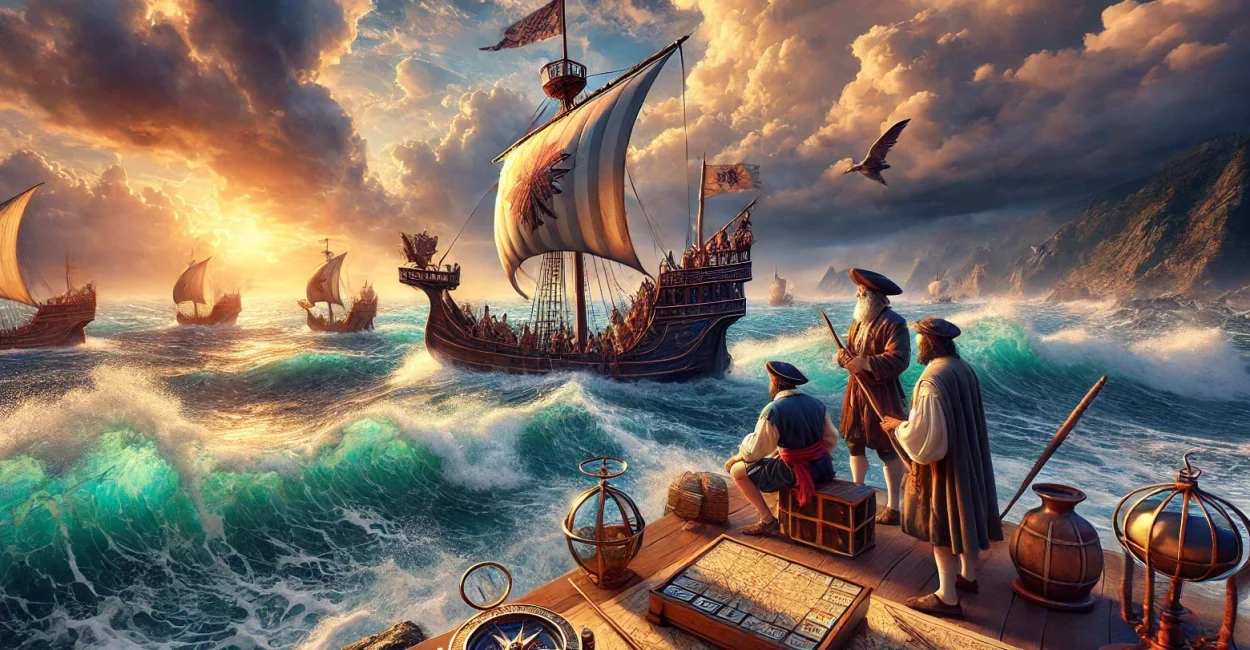
European maritime expansion in the late 15th century was neither a heroic accident nor an isolated romantic adventure. It was a profound reorganization of trade, power, and the way the world was mapped. The Age of Discovery shifted the center of the global economy, brought continents closer together, and opened routes that reshaped empires, wars, and cultures. Understanding this period helps explain why Portugal and Spain rose to prominence, how naval technology made long-distance voyages possible, and what human costs came with this process. It also helps separate myth from reality: the era brought innovation, strategy, and profit, but also violence, colonization, and widespread enslavement.

The Essentials
- Iberian maritime expansion grew out of a combination of commercial interests, political rivalry, and advances in navigation.
- The caravel, astrolabe, compass, and cartography did not “create” ocean voyages, but made the Atlantic more predictable to navigate.
- The economic impact was global: new routes weakened traditional middlemen and shifted the center of trade to the ocean.
- The period’s legacy includes extensive cultural exchange, the establishment of colonies, and lasting changes in power relations between continents.
- Not every “discovery” was new to the people who already lived in those lands; the term reflects the European perspective of the time.
The Age of Discovery and Portuguese and Spanish Maritime Expansion
Historically, the Age of Discovery was the period when European kingdoms, especially Portugal and Spain, began investing systematically in ocean navigation. Their goal was not simply to “explore.” They sought direct routes to spices, gold, silver, and markets previously controlled by intermediaries in the Mediterranean and the East. In practice, this meant moving from a regional outlook to an Atlantic one. Lisbon, Seville, Atlantic islands, and African ports became strategic points in a network connecting Europe, Africa, Asia, and, later, the Americas.
What distinguishes medieval maritime expansion from its modern counterpart is not the courage of its navigators, but the state’s ability to fund, measure, document, and profit from long voyages.
How the Balance of Power Shifted
Power came to depend not only on conquered land, but also on control of routes, trading posts, and ports. This was a political shift, not just a geographic one. Whoever controlled the sea could influence prices, the movement of goods, and access to entire territories.
Portugal and Spain—and More
Portugal opened routes along the African coast and reached India by sea. Spain financed Columbus’s voyage and accelerated European expansion into the Americas. Later, the Netherlands, England, and France would compete for the same prize, showing that expansion did not end with the first “discoverers.”
Economic, Religious, and Political Motivations
Reducing this period to a “spirit of adventure” is a common mistake. The expeditions arose from concrete interests: profit, prestige, territorial control, and the spread of Christianity. These motives overlapped, but they were not always equally important.
Profit Above All
Spices such as pepper, cloves, and cinnamon were highly valuable in Europe, both for cooking and for preserving food and use in the medicine of the time. Finding a direct route to these goods meant avoiding the markups charged by Arab, Italian, and Ottoman intermediaries.
Evangelization and the Struggle for Prestige
The Church and European monarchies also viewed expansion as part of a religious and civilizing mission—a concept that should be treated with caution today. The language of faith was often used to legitimize conquest and political domination.
- Economic: The pursuit of precious metals, spices, and new sources of revenue.
- Political: The strengthening of monarchies and rivalry between the Iberian crowns, followed by other powers.
- Religious: The spread of Christianity and the symbolic struggle against other powers.
This combination of motives is clear in period documents and in analyses by institutions such as Britannica’s overview of the Age of Discovery and the historical resources from National Geographic on the Age of Exploration, which help put the era in context without romanticizing it.
Caravels, Astrolabes, and Cartography: The Technology That Made the Ocean Feel Smaller

Ocean routes could not have been sustained without technological advances. The caravel, a light and maneuverable vessel, made it easier to navigate irregular coastlines and shifting winds. The compass, astrolabe, and improved maps also helped sailors find their way in open water.
The Role of Astronomical Navigation
Astronomical navigation used the position of celestial bodies to estimate latitude. It did not eliminate risk, but it reduced guesswork. This was crucial on long crossings, especially when sailors spent weeks out of sight of land.
Maps Became More Than Drawings
Cartography began incorporating firsthand observations, routes, currents, and winds. Instead of purely symbolic maps, practical records emerged to guide commercial and military voyages. This knowledge circulated among pilots, cosmographers, and mapmakers.
The caravel did not “discover” the world; it gave European states a tool for turning geographic information into economic power.
For a more technical look at nautical instruments and navigation methods, see the educational resources from the Library of Congress on the Atlantic and maritime history resources from universities and maritime museums. They show how technology and politics went hand in hand.
Routes, Ports, and the Rise of an Atlantic Economy
As Atlantic routes became more established, European commerce changed in scale. The Mediterranean lost some of its central importance, while Atlantic ports began attracting capital, ships, insurance, tax revenue, and information.
The Shift in the Center of Trade
This shift did not happen overnight. Venice and Genoa remained important for a long time, but the trend was clear: whoever controlled ocean crossings also controlled the flow of goods between continents.
The Trading-Post System
Trading posts along the African coast, islands in the Atlantic, and, later, ports in the Americas served as logistical hubs. They supported resupply and trade, and helped enforce surveillance and control.
| Element | Historical role | Impact |
|---|---|---|
| Trading posts | Exchange and supply points | Established a European presence in key regions |
| Caravels | Agile navigation | Expanded coastal and ocean exploration |
| Atlantic ports | Commercial hubs | Reshaped the flow of wealth |
| Trading companies | Financing and monopolies | Organized long-distance trade |
In practice, when a route gets shorter, everything around it changes: shipping costs, risk, insurance, profit margins, and even competition for ports. That is what turned the Atlantic into an economic center rather than just a body of water between continents.
Human Consequences: Conquest, Colonization, and Enslavement
This is the part many school narratives gloss over, but they should not. European maritime expansion opened new paths for trade and movement, but it also set in motion territorial conquest, cultural imposition, and enslavement on a transatlantic scale.
The Violent Side of the “Meeting of Worlds”
For Indigenous peoples of the Americas and African societies forcibly drawn into this system, the period meant loss of autonomy, war, epidemics, and social upheaval. Talking about “discovery” without mentioning this creates an incomplete and, in some ways, misleading version of history.
A Brief Story to Put Things in Context
Imagine a small European port in the early 16th century. A ship arrives after weeks at sea, bringing news of a distant coast and unfamiliar goods. Within days, word spreads: there will be more voyages, more investment, and more competition. What seems like commercial news becomes state policy.
This shift has been documented by research centers and historical archives, including the Library of Congress collections, as well as by academic institutions that study colonization, enslavement, and Atlantic exchange. There is broad agreement on the overall picture, though experts disagree on the relative importance of each factor in the early expansion.
People and Empires That Shaped the Period
It is impossible to discuss this subject without mentioning the figures who became symbols of their era: Prince Henry the Navigator, Vasco da Gama, Pedro Álvares Cabral, and Christopher Columbus. But focusing only on individuals distorts the picture. They operated within much larger state, financial, and religious structures.
Navigators and Their Limitations
Vasco da Gama did not “open” India on his own; he arrived in a preexisting trade network. Columbus did not “discover” an empty land; he encountered complex societies. Cabral did not “bring civilization”; he brought the territory that is now Brazil into a European imperial project.
Empires and a Prolonged Rivalry
Portugal and Spain were the pioneers, but the Netherlands, England, and France quickly recognized the value of Atlantic routes. The race for colonies, sugar, metals, and strategic outposts continued for centuries and shaped modern geopolitics.
- Portugal: A pioneer in African and Asian routes.
- Spain: Initially focused on the Americas and extracting metals.
- The Netherlands: A major commercial and naval presence in the 17th century.
- England: Maritime expansion and long-term imperial competition.
Legacies That Still Shape the World Today
The legacy of the Age of Discovery is not limited to old maps. It can be seen in the languages spoken today, the unequal distribution of wealth between regions, the colonial systems that left institutional marks, and the trade routes that remain influential.
What Remains Visible
Strategic ports remain enormously valuable assets. Global trade still depends on maritime corridors. And many political borders stem, directly or indirectly, from decisions made during this period of expansion.
An Important Caveat
This period also left us with a problem of terminology. The term “discoveries” reflects the European perspective, but does not describe the experience of peoples already living in the lands being “discovered.” For that reason, some historians prefer to use European maritime expansion or overseas expansion.
The greatest legacy of maritime expansion was not simply connecting continents; it was creating a hierarchical global system in which the movement of goods, military control, and inequality went hand in hand.
For reliable sources that explore the subject further, see Britannica’s overview of colonialism and university resources on the formation of the Atlantic system. They help readers look beyond the traditional heroic narrative.
How to Study This Period Without Falling for Myths
The most honest way to study this subject is to accept two truths at once: real innovation took place, and so did real violence. A mature reading of history does not have to choose between celebrating technology and condemning abuses; it needs to understand how one supported the other.
If the analysis focuses only on the epic voyages of navigators, it impoverishes the past. If it focuses only on condemnation, it also misses the complexity of economic, technological, and political change. The right approach balances method, context, and consequences.
Next steps
When reviewing this topic, compare school textbooks, academic writing, and collections from history museums. Then look at how each source describes the same events: who is presented as an actor, who is left out, and which interests appear in the narrative. This exercise encourages a much more critical reading and helps avoid repeating oversimplified accounts of the Age of Discovery.
Frequently Asked Questions
What was the Age of Discovery?
It was a period of European maritime expansion, especially during the 15th and 16th centuries, marked by ocean voyages, the opening of new trade routes, and contact between continents. The term usually refers to the activities of Portugal and Spain, though other powers also took part later.
Why did Portugal take the lead in maritime exploration?
Portugal had a favorable geographic position, prior maritime experience, and centralized political support. The kingdom also invested early in navigation techniques, coastal exploration, and control of strategic points in the Atlantic and along the African coast.
What were the main technological advances of this period?
The main advances included the caravel, the compass, the astrolabe, improved cartography, and more systematic use of astronomical navigation. These tools did not eliminate risk, but made voyages more predictable and extended the reach of expeditions.
Why is this period viewed critically today?
Because European maritime expansion went hand in hand with territorial conquest, enslavement, violence against Indigenous peoples, and colonial exploitation. Today, many historians avoid a heroic interpretation and also examine the human costs of this process.
Is the term “discoveries” still appropriate?
It depends on the context, but the term is widely criticized because it adopts the European perspective and ignores societies that already inhabited these territories. In more careful writing, “European maritime expansion” is usually more accurate.
%%AGPTRH7%%
Artigos Relacionados
 Transportation Engineer: A Key Professional for the Future of Urban Mobility
 Biotechnology: The Revolution Transforming the Food Industry
 How a Balanced Diet Can Transform Your Mental Health
 The Essential Role of Bees in Sustaining Ecosystems
 The History of the Olympic Games: From Ancient Greece to the Modern Era
 Librarian: An Essential Role in Modern Society
