
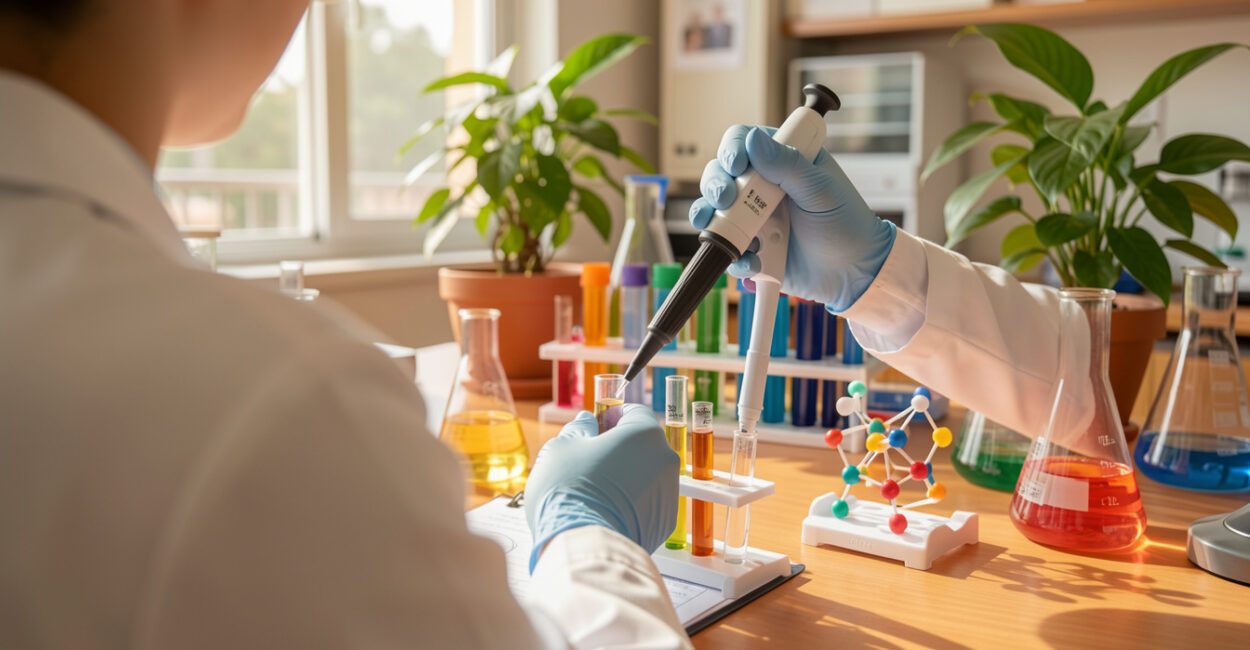
After a meal, some glucose may be used by cells, stored, or converted into other molecules. Biochemistry studies the reactions that make these outcomes possible. It connects the molecular makeup of living things to how cells function and helps explain processes such as digestion, energy production, and how medications work.
This field also provides context for laboratory tests and topics covered in biology and healthcare courses. Its concepts are easier to understand when molecules, reactions, and the body’s needs are studied together.

Key takeaways
- Metabolism is the set of chemical reactions in the body; biochemistry studies these reactions and other molecular properties of life.
- Enzymes speed up reactions without being consumed and help control the pace of metabolic pathways.
- ATP transfers energy between cellular processes, but it does not serve as a long-term energy reserve.
- Lab test results must be interpreted in a clinical context; on their own, they do not confirm a disease.
What is biochemistry, and what does it study?
Biochemistry is the field that investigates the chemical makeup of living things and the molecular changes that take place within them. In practical terms, it looks at how proteins, carbohydrates, lipids, and nucleic acids contribute to cellular activity, from individual reactions to integrated networks in tissues and organs. Some of its main areas of study include:
- Proteins: molecules with a range of functions, including catalysis, transport, and structural support.
- Carbohydrates and lipids: sources of energy and components of cellular structures, among other functions.
- Nucleic acids: DNA and RNA, which are involved in storing and using genetic information.
- Enzymes and metabolic pathways: catalysts and sequences of reactions that transform molecules.
- Cellular signals: mechanisms that allow cells to respond to hormones and environmental changes.
Cellular biochemistry examines these interactions inside cells. A reaction may produce a molecule that is used in another step or acts as a signal. That is why studying an enzyme in isolation does not always explain the effect of a change in the body: the tissue, the availability of substrates, and regulatory mechanisms also matter.
How do enzymes and ATP support metabolism?
Metabolism is the set of chemical reactions that keep the body functioning; biochemistry studies how these reactions take place and are regulated. Enzymes speed up specific steps by lowering activation energy, while molecules such as ATP help transfer energy to cellular processes that need it. Many enzymes are proteins, although some RNA molecules can also catalyze reactions. Each enzyme acts on particular substrates, but its activity depends on conditions such as pH, temperature, substrate concentration, and the presence of regulators. A change in these conditions can alter the rate of a reaction without necessarily stopping the entire pathway.
Catabolism breaks down molecules and can release energy; anabolism uses energy and precursors to build molecules. ATP helps transfer energy between these processes. It is continuously produced and consumed, so it is not a long-term energy reserve like lipids stored in adipose tissue.
Process Role in the body Example Glycolysis Breaks down glucose in stages and produces molecules that can enter other pathways. A muscle cell uses the products of glycolysis to meet its energy needs. Protein synthesis Builds proteins from amino acids, using energy. A cell produces proteins needed for its structure and activity. Fatty acid oxidation Breaks down fatty acids and provides molecules that can contribute to energy production. Depending on physiological conditions, muscle can use fatty acids as fuel.
A metabolic pathway is a regulated sequence of reactions, not a fixed route that works the same way in every tissue. For example, what happens to the products of glycolysis depends on the cell type, energy demand, and oxygen availability.
Enzymes control the pace of reactions, while ATP connects available energy to the cellular tasks that use it.

How do hormones and nutrients regulate reactions in the body?

Hormones and nutrients alter the activity of metabolic pathways according to the body’s current state. Insulin, for example, helps regulate how nutrients are used and stored; glucagon helps mobilize energy reserves under certain conditions. Their effects depend on the tissue and the signals received by the cell.
After a meal, nutrient availability changes and may promote storage and synthesis. Between meals, other pathways help maintain the supply of fuels. These responses are not isolated on-off switches: they involve hormones, enzymes, transporters, and communication between organs such as the liver, muscle, and adipose tissue.
A common mistake when studying this topic is memorizing the name of a pathway without following what happens to its intermediates. To avoid this, track a molecule: identify where it comes from, which enzyme transforms it, and what happens to the product. This approach also helps explain why the same substance can have different fates in different tissues.
Read also: Environmental Management Admission Scores: Understanding the Competition

Why is biochemistry important to health and biology?
Biochemistry helps explain how molecular changes can affect cells and tissues, and provides principles used in research on diseases and medications. It also helps us understand what laboratory tests measure, but clinical interpretation depends on a person’s overall condition, the method used, and other information. MedlinePlus, a service of the U.S. National Library of Medicine, provides information about laboratory tests, including what they may assess and factors that can affect results. A result outside the reference range does not, by itself, confirm a disease; results must be assessed by qualified professionals in the appropriate context.
Read also: Human Physiology: How the Body Works in Harmony
In research, biochemistry helps scientists investigate molecular targets and understand how a medication interacts with the body. Responses may vary from person to person and by circumstance; understanding a mechanism alone does not predict the clinical effect in every case.

What do you study in college biochemistry, and how can you prepare?
College courses typically cover biomolecules, enzymes, metabolism, bioenergetics, and regulatory mechanisms. The depth and sequence vary by program and institution: students in pharmacy, biomedical sciences, medicine, and biology may encounter the subject from different perspectives.
Biochemistry often requires an integrated approach because it connects chemistry, molecular structure, and physiology. It becomes harder when you try to memorize steps without understanding the balance of matter and energy. When studying a pathway, draw the main molecules, mark what goes in and out, and explain why the cell regulates that step.
When putting together a biochemistry study guide, a mind map, or looking for a PDF, check the author, responsible institution, references, and date of the latest update. A general biochemistry PDF can be useful for review, but it should not replace the bibliography or materials assigned for the course. The NCBI Bookshelf provides biomedical books and materials; check the author and scope of each work before using it.
What career paths are available, and how can you understand a career in biochemistry?
Career options depend on education, the scope of practice for each profession, and applicable regulations. Research, industry, teaching, and laboratory testing may involve biochemistry, but the title “biochemist” does not, by itself, define a person’s legal qualifications.
How much does a biochemist earn?
There is no single salary that represents everyone called a biochemist. Pay varies by region, experience, industry, role, work schedule, and required education; when evaluating an opportunity, compare similar jobs and check the job description and professional requirements.
Is a biochemist a doctor?
Biochemistry and medicine are distinct fields of study. A physician is trained in medicine and works within the scope of that profession; people in other fields may also apply biochemical knowledge, depending on their training and the rules governing their work.
What is the difference between a biomedical scientist and a biochemist?
Biomedical scientist is a profession with its own education and regulations; biochemistry is a scientific field and may also appear in the names of programs or qualifications. The terms are not interchangeable, and each professional’s scope of practice depends on their degree, qualifications, and current regulations.
The name of a course or field of study does not replace checking the education required to perform a professional activity.
Where can you find reliable references to learn more?
Start with the course syllabus and the reading lists provided by your institution. To explore further, look for materials from scientific societies, government agencies, and professional organizations; make sure the content matches your course level and is up to date.
The Brazilian Society of Biochemistry and Molecular Biology (SBBq) is an institutional reference in the field. For questions about pharmacy education, consult the National Curriculum Guidelines published by Brazil’s Ministry of Education and the guidance of the Federal Council of Pharmacy. The curriculum guidelines outline educational requirements, while the council addresses professional matters within its remit.
As a next step, choose a process you are studying, such as glycolysis or protein synthesis, and map it out by connecting the substrate, enzyme, product, and cellular purpose. Then compare your notes with the course materials or an identifiable institutional source.
Frequently asked questions
Is biochemistry the same as organic chemistry?
No. Organic chemistry broadly studies carbon compounds, while biochemistry focuses on the molecules and reactions of living things. The two fields are related, and organic chemistry concepts help explain biochemical structures and reactions.
Are human biochemistry and cellular biochemistry different subjects?
They are related areas of focus. Human biochemistry examines molecules and reactions in the human body; cellular biochemistry focuses on processes that take place inside cells. The subjects overlap because tissue activity depends on how cells function.
How can you tell if a biochemistry study guide is reliable?
Check who produced the material, which references it cites, and when it was reviewed. Prefer content from universities, scientific societies, or recognized agencies, and verify key points against your course reading list.
Artigos Relacionados
 Endocrinologist: A Complete Guide to Hormone Health Specialists
 Working From Home: The Complete Guide to an Ideal Workspace
 Film Director: A Complete Guide to Starting Your Career in Film
 School Bullying: A Complete, Practical Guide
 Fashion Designer: A Complete Guide to Building a Successful Career
 Anesthesiologist: A Complete Guide to Building a Successful Medical Career
