Why Test Reverse Logistics in the Circular Economy
Turning waste into value takes more than good intentions; the numbers have to work. In practice, the circular economy moves beyond the PowerPoint when a company can collect, sort, track, and reintegrate materials predictably—and that’s exactly why testing reverse logistics matters.

The point isn’t just to “be sustainable.” It’s to find out, using real numbers, whether returnable packaging, post-consumer recycling, and return routes work in your specific context—with your supplier, in your neighborhood, and for your customers.
Here’s why testing matters, what to measure, where things tend to go wrong, and how to apply these principles to supermarkets, plastic packaging, and other material streams.
The Essentials
- Reverse logistics involves more than collecting materials: it must prove economically, operationally, and environmentally viable.
- Pilot tests reveal bottlenecks that don’t show up in the planning stage, such as low return rates, contaminated materials, and higher-than-expected logistics costs.
- Returnable packaging tends to work best with high volumes, short distances between collection points, and strict traceability controls.
- Success depends on objective metrics: return rate, cost per cycle, emissions avoided, breakage losses, and customer acceptance.
- Without a well-designed operation and supply chain partnerships, recycling becomes an expensive promise—not a value-generating system.
How the Circular Economy and Reverse Logistics Move from Concept to Operational Testing
The technical definition is straightforward: reverse logistics is the set of processes that brings products, packaging, or materials back from consumers into the production cycle for reuse, remanufacturing, recycling, or environmentally sound disposal. Put simply, it’s the route waste takes to become a resource again.
The reason to test before scaling is simple: almost every circular initiative looks good in theory, but some fall apart as soon as they meet reality. Packaging may come back too dirty, collection may cost more than the savings it generates, or customers may not participate.
Testing separates intention from execution.
What separates a viable circular initiative from a polished campaign is the ability to close the loop at a cost and with quality and traceability levels that fit the actual operation.
This aligns with guidance from government agencies and technical sources, including the environmental policy of Brazil’s Ministry of the Environment, as well as waste management research from the U.S. Environmental Protection Agency (EPA) and academic publications on circularity. The institutional perspective matters because reverse logistics isn’t an isolated gesture; it’s a system involving contracts, infrastructure, and behavior.
What’s Really Worth Measuring Before You Scale
Anyone who works in this field knows that “it worked” can be a dangerous claim. A pilot may bring packaging back but still fail on cost per cycle, contamination rates, or washing logistics.
That’s why testing should start with just a few metrics—and plenty of discipline.
Metrics That Show Whether the Numbers Work
- Return rate: the percentage of packaging or materials that actually make it back into the system.
- Cost per cycle: the cost of collecting, transporting, cleaning, sorting, and reintegrating an item.
- Operational losses: breakage, loss, contamination, or disposal that doesn’t meet requirements.
- Turnaround time: the time between packaging leaving the system, returning, and being used again.
- Emissions avoided: a comparison between the linear and circular scenarios.
If a company doesn’t measure the entire cycle, it confuses volume with efficiency. Ten thousand returns mean nothing if half require rework or return shipping eats into the margin.
IBGE statistical data can help put consumption and household profiles in context, making it easier to design collection points that reflect local realities. IBGE is Brazil’s national statistics agency.
When a Pilot Fails, Technology Isn’t Always the Problem
In many cases, friction is the issue. Customers forget to return packaging, retailers lack space to store it, or logistics providers aren’t paid for every step. A classic mistake is investing in technology without fixing the flow, incentives, and governance.
There’s also an important nuance: not every package should be returnable. When collection points are sparse, distances are long, or breakage risk is high, single-use packaging made with recycled content may be more practical than reuse. Circularity doesn’t automatically mean physical returns.
Returnable Packaging: Where It Really Works

Returnable packaging tends to perform best in closed-loop networks with high turnover and control over where items go. Examples include regional distributors, beverage and dairy businesses, supermarkets with return programs, and B2B operations with frequent routes. Costs tend to rise in more dispersed channels.
The logic is similar to that of an asset. If packaging lasts longer, circulates more times, and fewer units are lost along the way, the cost per use goes down. But if it requires extensive handling, expensive washing, or long-distance transport, the environmental benefits may remain while economic viability collapses.
A Real-World Example from a Store and Warehouse
A supermarket chain in a smaller city in Brazil tested returnable trays and crates for fruits and vegetables. On paper, the savings seemed obvious: less disposable plastic, fewer purchases of new packaging, and greater standardization.
In practice, the first bottleneck was inconsistent returns. The system only began to deliver real benefits after the chain set up fixed collection points, trained warehouse staff, and negotiated with suppliers to reuse packaging by batch. It was a tough but useful lesson: without a consistent operating routine, returnable packaging becomes lost inventory.
Returnable packaging delivers value only when returns are predictable; otherwise, it shifts costs from disposal to operations.
Plastic Recycling at Supermarkets: The Easiest Case to Sell and the Hardest to Execute
Supermarkets seem like the perfect setting for circularity: they handle large volumes, see frequent customer traffic, and have regular consumer contact. But post-consumer plastic is heterogeneous, often contaminated, and highly dependent on proper sorting at the source. That’s why recycling plastic packaging at supermarkets takes operational planning, not just good intentions.
The challenge starts after consumption: plastic film, trays, bottles, and labels are made from different materials. Poor sorting reduces recycling efficiency and can lower the quality of recycled resin. Industry reports and data from Plastics Europe, along with university-reported recycling initiatives, can help explain the material bottleneck. But local solutions depend on the supply chain in your region.
What Tends to Work Best
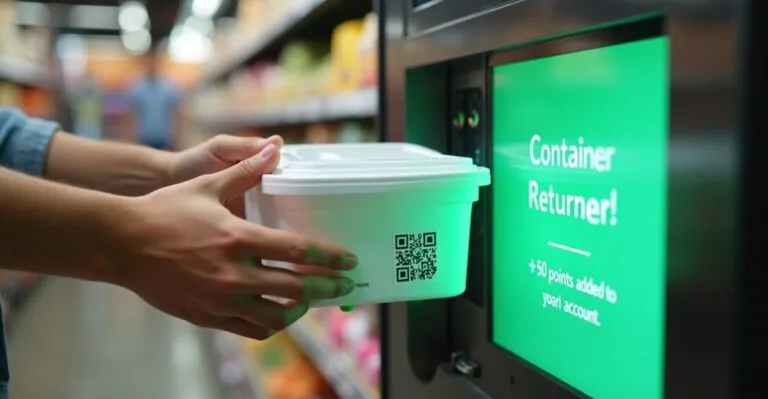
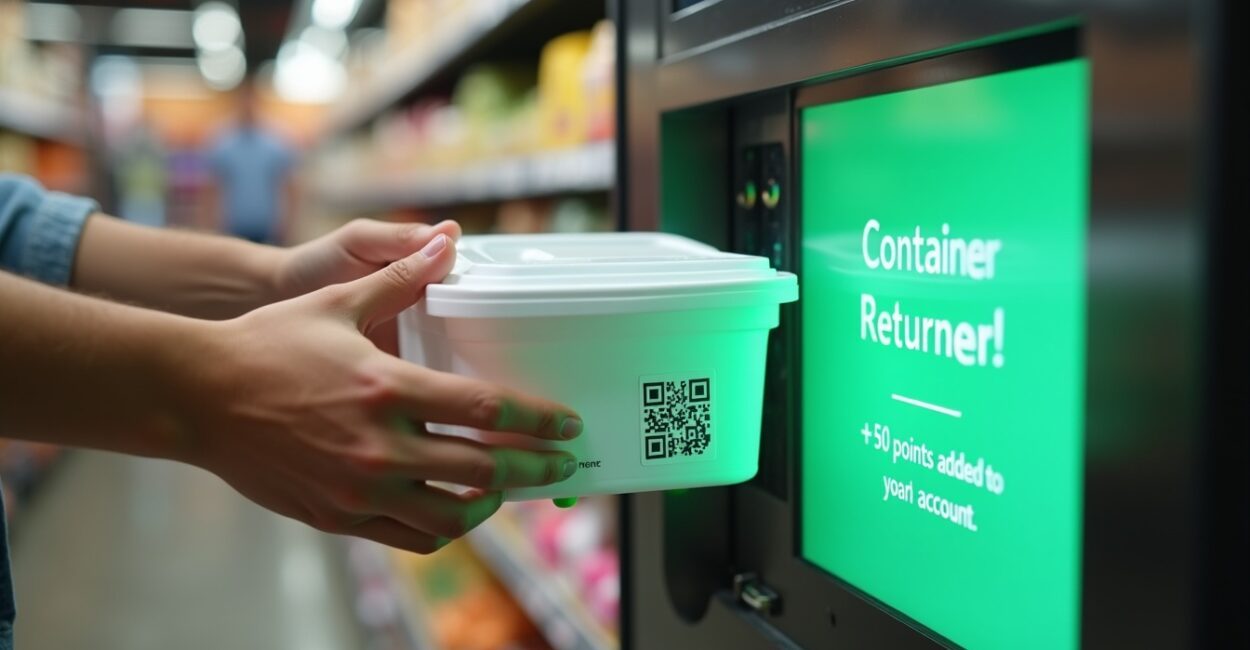
- Highly visible drop-off points near store exits.
- A clear incentive, such as a discount, cashback, or a loyalty program.
- Sorting by plastic type before materials are sent to a recycler.
- Partnerships with cooperatives, sorting facilities, and approved recyclers.
How to Design a Pilot Without Overspending
The right pilot starts small and has a clear exit criterion from day one. Without a minimum return target, an acceptable cost range, and an evaluation period, an initiative can become an endless project. Endless projects use up budgets without delivering useful insights.
A Lean Step-by-Step Approach
- Choose a single material stream: one type of packaging, one product category, or one collection point.
- Set a baseline: current volume, cost, and destination.
- Create a short loop with few participants and strong traceability.
- Set three core metrics: return rate, cost per cycle, and material quality.
- Run the pilot long enough to capture seasonality and real-world behavior.
This approach works well in concentrated operations but may fail across highly dispersed networks or with products that aren’t purchased often. In those cases, it may make more sense to start with recycled content, packaging redesign, or shared logistics rather than insisting on physical returns from day one.
Governance, Partners, and Traceability: What Keeps Operations Running
A circular system doesn’t depend on retailers alone. It involves manufacturers, logistics providers, cooperatives, recyclers, legal teams, and often municipal governments and regulators. Without clear contracts, no one knows who pays for washing, who is responsible for contamination, or who records the data.
Traceability ties it all together. Labels, QR codes, batch records, and ERP integration help companies see where materials are and how much has come back. In more mature supply chains, this control reduces losses and speeds up decision-making; in improvised ones, it becomes another cost with no real use.
Reference Sources That Can Help Validate Your Plan
- IBAMA for regulatory and environmental context. IBAMA is Brazil’s environmental protection agency.
- Federal portals on public participation and regulations for tracking public policies related to waste management.
- Ellen MacArthur Foundation for widely used concepts and examples of circularity.
How to Know Whether It’s Worth Scaling
Scaling is a business decision, not a reward for being sustainable. If the pilot improves the return rate, keeps cost per cycle competitive, and maintains material quality, expanding makes sense. If any one of these three pillars falls short, scaling is likely to multiply the problem.
The clearest sign of maturity is when a company can compare the circular and linear scenarios using the same yardstick. It’s not enough to say you “kept plastic out of the waste stream”; you need to show that the system reduced total costs, regulatory risk, or emissions per unit delivered. When that happens, the initiative stops being a project and becomes a strategy.
A mature circular system isn’t the one that reuses the most material; it’s the one that makes better decisions using operational data.
What to Do Now to Turn a Test into a Decision
Before investing in a full-scale rollout, choose a material stream with meaningful volume, measure the process from start to finish, and run a pilot with clear success criteria. This helps avoid a common mistake: adopting a “green” solution without proving its economic and operational fit. The circular economy works when testing is treated as a decision-making tool, not a marketing campaign.
The next step is to validate a real-world use case with simple metrics, a short timeline, and clearly defined partners. If the operation delivers consistent returns, expand; if it doesn’t, refine the design before adding complexity.
Frequently Asked Questions
Is Reverse Logistics Required for Every Company?
Not for every company. Requirements depend on the industry, product type, and applicable laws. In Brazil, packaging, electronics, tires, batteries, and other sectors have specific rules. Check the requirements for your product’s supply chain before choosing a model.
Is Returnable Packaging Always Better Than Disposable Packaging?
No. It makes sense only when return rates are high, transportation is efficient, and the packaging can withstand many cycles without losing quality. In dispersed settings, materials that are easier to recycle may be a more efficient choice.
Which Metric Is Most Misleading in a Circular Project?
Absolute volume. A thousand returns may look like a success but hide high logistics costs, contaminated materials, or little actual reintegration into the production process. What matters is performance per cycle.
Are Supermarkets a Good Place to Test Reverse Logistics?
Yes. They have a steady flow of customers, large volumes of packaging, and good visibility for collection points. But success depends on convenience and incentives; without them, return rates drop quickly. Retailers can make a big difference in participation when the operation is well coordinated.
How Can You Get Started on a Small Budget?
Start with a single type of packaging or material, one collection point, and modest but measurable targets. The first goal is to validate customer behavior and costs, not to scale. This reduces risk and speeds up learning.
What Most Often Causes a Circularity Project to Fail?
Poor governance. When no one is responsible for collection, sorting, traceability, and return quality, the system breaks down. In most cases, the problem isn’t the idea; it’s fragmented execution.