
Sustainability is no longer an abstract concept: today, it shapes costs, risks, and competitiveness. When a household cuts waste, a company rethinks its supply chain, or a city invests in clean transportation, the effects show up in people’s budgets, health, and quality of life.
Technically, sustainability is the ability to meet present needs without compromising the availability of resources and living conditions for future generations. In practice, that means balancing three dimensions at once: environmental, social, and economic.

Here’s what that really means, why it has become a priority, and how to apply this way of thinking to everyday life through concrete choices.
What You Need to Know
- Sustainability isn’t just about “being eco-friendly”: it depends on balancing environmental impact, social justice, and economic viability.
- Measures such as solar power, composting, and mindful consumption reduce emissions and cut recurring expenses.
- The circular economy and reverse logistics are more efficient than the linear “take, make, and dispose” model.
- People who start with small, consistent changes often make more progress than those who try to do everything at once.
- There are real limits: not every solution works in every context, and what works at home may fail in a condo or business.
Understanding Sustainability: Meaning and Importance in Everyday Life
The concept emerged from the need to reconcile development with ecosystem preservation. This means protecting water, soil, energy, and biodiversity, while also distributing benefits more fairly and keeping productive activities running without destroying the foundation that supports them.
People who work in environmental planning know the discussion isn’t about “saving the planet” in the abstract. In practice, the focus is on preventing local crises: more severe flooding, urban heat islands, water shortages, rising waste levels, and higher input costs. That’s why sustainability has become central to public and business agendas. Data and resources from organizations such as IBGE (the Brazilian Institute of Geography and Statistics), Ipea (Brazil’s Institute for Applied Economic Research), and the United Nations help show that this isn’t a passing trend. It affects energy production, urban planning, food, transportation, and even how companies assess reputational and regulatory risk.
What distinguishes a sustainable action from one that is merely “green” is its ability to deliver environmental, economic, and social results at the same time.
The Three Pillars of Sustainability
The three pillars appear in nearly every serious analysis of the subject. When one is missing, a project loses its footing. An environmentally sound solution that isn’t financially viable can’t scale. A profitable alternative that excludes people socially isn’t sustainable. And an inexpensive measure that damages the environment simply pushes the problem into the future.
- Environmental: reducing emissions, waste, water use, and pressure on natural resources.
- Social: health, equity, safety, decent work, and access to basic necessities.
- Economic: efficiency, productivity, predictable costs, and lasting value creation.
Why the Climate Crisis Changed the Rules
The urgency has grown because the impacts are no longer distant. The IPCC brings together evidence that extreme weather events are becoming more frequent and intense in many regions, affecting agriculture, infrastructure, and public health.
It’s not just about average temperatures: the problem also shows up in prolonged droughts, heavy downpours, and declining productivity.
In everyday life, this changes decisions about purchases, insurance, investments, and urban planning. Companies that ignore this reality tend to react too late, when they’re already paying more for water, energy, transportation, and waste disposal.
Households feel the impact too: bills go up, food prices become more volatile, and adaptation costs rise.
Where General Rules Fall Short
Not every “greener” solution is the best choice in every situation. Electric transportation, for example, reduces emissions during use, but its overall impact depends on the electricity mix, infrastructure, and scale. Recyclable packaging won’t solve everything if recycling collection is limited or unavailable. That’s why an assessment needs to consider the product or service’s full life cycle.
Sustainability isn’t about trading one problem for another; it’s about reducing overall impact throughout the life cycle.
The Circular Economy, Reverse Logistics, and Moving Beyond Disposable Products

The traditional linear model relies on extraction, production, consumption, and disposal. The circular economy offers a different approach: keep materials in use for as long as possible by repairing, reusing, remanufacturing, and recycling them.
This reduces pressure on natural resources and cuts the amount of waste generated.
Reverse logistics is a practical part of this system. It requires or organizes the return of products and packaging so they can be reused or properly disposed of. In Brazil, this issue is addressed by the National Solid Waste Policy, a Brazilian law, and by take-back programs for products such as electronics, tires, batteries, and packaging.
A Real-World Example: What Happens When a Supply Chain Closes the Loop
I saw a case where a small food business replaced disposable containers with returnable ones and set up drop-off points for returns. The initial cost was higher, but spending on continuous packaging purchases fell over the following months. The most visible benefit was better organization: less waste, fewer stockouts, and more predictable operations.
This kind of change isn’t magic. It works best when there’s a steady volume, a logistics partner, and operational discipline. For very small or widely dispersed businesses, it can take longer for the numbers to add up.
Read also: Sustainability Tips for Apartments: A Practical Guide
Sustainable Fashion, Mindful Consumption, and the Impact of Our Choices
Fashion is one of the most visible sectors when it comes to environmental impact because of its water, chemical, and energy use, as well as the rapid pace of disposal. Brands that use lower-impact fibers, make products to order, and focus on genuine durability reduce losses and avoid excess inventory.
But consumer behavior matters just as much as production. Buying less, choosing better-made pieces, repairing items before replacing them, and avoiding impulse purchases all influence market demand. This also pushes the supply chain to improve transparency, traceability, and working conditions—key areas in certifications and audits.
- Choose durability over short-lived trends.
- Check materials and origin whenever possible.
- Consider cost per wear, not just the price tag.
- Donate, resell, or recycle before throwing items away.
When “Cheap” Costs More
If a very inexpensive item doesn’t last, it can cost more per use than a pricier one that stays in good condition for years. The math is simple, but people often overlook it. The same logic applies to appliances, furniture, and even office supplies.
Solar Power, Efficiency, and What’s Really Worth It
Solar photovoltaic power has become one of the best-known entry points to the energy transition. The reason is straightforward: it reduces reliance on the grid for some of your electricity use and can deliver significant savings over the medium term. In Brazil, the regulatory framework for small-scale distributed generation came under greater discussion after ANEEL, Brazil’s electricity regulator, established rules for grid connections and energy credits.
Anyone considering the investment should look beyond the equipment. Factor in roof orientation, shade, usage patterns, panel warranties, the inverter, maintenance, and payback period. A poorly sized system can fall short of expectations; a well-designed one can run for many years with little intervention.
What to Prioritize First
Before installing panels, many people can save more through energy efficiency: LED bulbs, better temperature settings, weatherstripping, and more efficient appliances. This reduces baseline energy use and improves the payback on a solar system later. In other words, the home or business needs less energy before it starts generating its own.
Measure
Upfront cost
Complexity
Best suited for
LEDs and sensors
Low to moderate
Low
Any space with frequent use
Home composting
Low
Low to moderate
People who regularly generate food scraps
Solar power
Moderate to high
Moderate
Steady energy use and a sunny roof
Composting, Food Scraps, and Reducing Hidden Waste
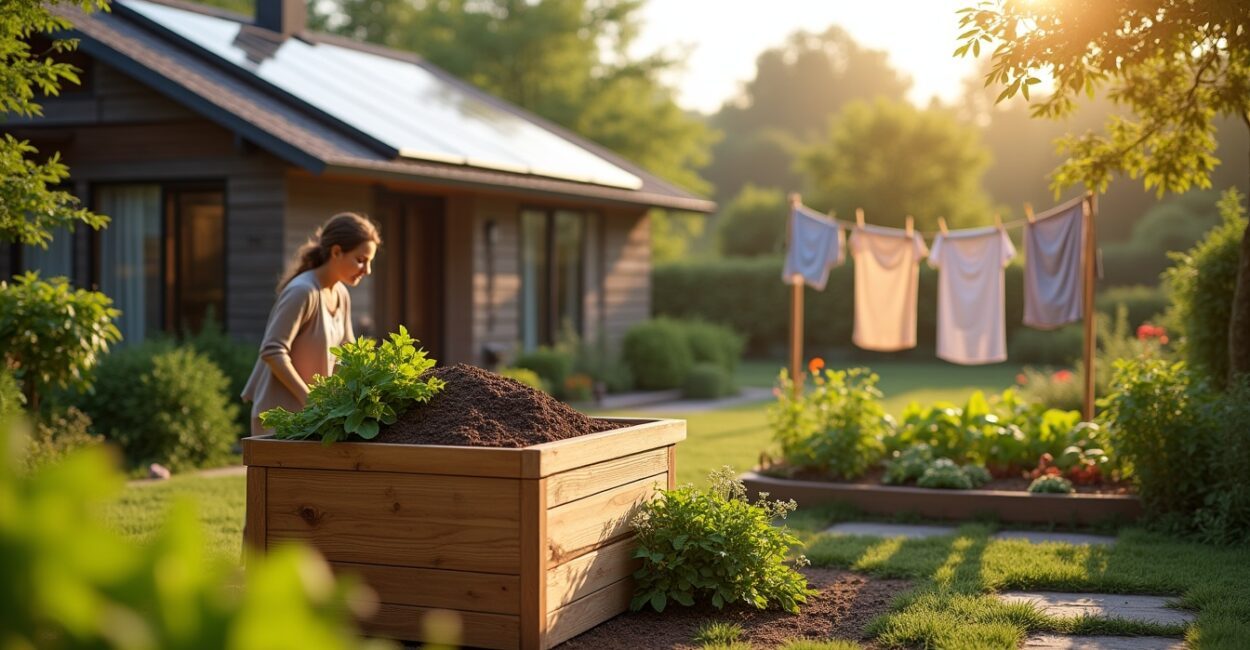
Home composting turns food scraps into compost and reduces the amount of organic material sent to landfills. This matters because decomposing organic waste produces methane, a greenhouse gas with a high warming potential. It’s one of the simplest changes with a tangible environmental benefit.
In practice, getting started requires changing habits, not technology. Separating peels, coffee grounds, and dry leaves takes consistency, and the results come when it becomes routine. If the compost gets too wet or isn’t aerated properly, the process becomes less effective—which is why maintenance matters as much as setup.
Simple Steps to Get Started
- Separate food scraps from other kitchen waste.
- Choose a home compost bin or a worm composting system.
- Balance wet and dry materials.
- Avoid meat, dairy, and too much oil at first.
- Watch for odors, excess moisture, and flies.
How to Bring Sustainability Home, to Your Neighborhood, and to Your Business
The most common mistake is treating sustainability as a standalone project. It works best when it becomes part of everyday decisions about shopping, disposal, energy, transportation, and food. A household that shops more thoughtfully, sorts waste, and reduces wastefulness already makes a difference. A neighborhood that strengthens recycling collection and community gardens can do even more.
For a business, the starting point is usually an assessment. Tracking energy, water, paper, packaging, and shipping routes reveals where losses are really happening. After that, small, measurable goals work better than grand promises without follow-through.
The most effective change is rarely the most visible; it’s the one that cuts recurring waste without creating a new dependency.
If you want to act strategically, start in three areas: reduce what doesn’t need to exist, extend the life of what’s already been produced, and replace things only when doing so offers a genuine environmental and financial benefit. That’s when sustainability stops being talk and becomes part of how you operate.
Next Steps
Choose one practical focus for the next 30 days: reduce food waste, reassess energy use, or review recurring purchases. The best strategy is to measure before and after, because impressions can be misleading, while numbers show results. Sustainability gains momentum when it moves from intention to routine.
If you’re looking for a quick impact, first identify where waste is happening continuously. If you have a budget for investment, compare the payback on energy efficiency, composting, or solar power based on actual usage. The best place to start is where you can stay consistent without relying on short-lived motivation.
Frequently Asked Questions
What Is Sustainability in Simple Terms?
It’s the ability to maintain human activities without depleting natural resources or worsening social and economic conditions. In everyday language, it means making better use of what we have so it remains available in the future.
Is Sustainability the Same as Recycling?
No. Recycling is one tool within sustainability, but it can’t solve the problem on its own. Sustainability also means reducing consumption, rethinking processes, using energy efficiently, and improving social equity.
What’s the Difference Between the Circular Economy and the Linear Model?
In the linear model, materials go from extraction to disposal. In the circular economy, materials stay in use longer through repair, reuse, remanufacturing, and recycling.
Is Solar Power Always Worth It?
Not in every case. The return depends on monthly energy use, sunlight, available space, design quality, and local electricity rates. In places with too much shade or very low energy use, it can take longer to recoup the cost.
What’s the Easiest Change to Make at Home?
Reducing food waste and separating food scraps are often the easiest ways to start. After that, adjusting energy use and choosing more durable products can build on the results.
Why Are Businesses Talking So Much About Sustainability Now?
Because sustainability affects operating costs, regulatory risk, reputation, and access to capital. Customers and investors are also demanding transparency about environmental and social impact.
Artigos Relacionados
 Sustainability: The Complete Guide to Building a Greener Future
 Sustainability: How to Build a Better Future
 Why Reading Matters in Early Childhood and Elementary School
 Gastroenterologist: A Complete Guide to the Specialty and Why It Matters
 Cognitive Therapy: A Complete Guide to Understanding, Using, and Benefiting from It
 Hematologist: A Complete Guide to the Specialty and Why It Matters
