
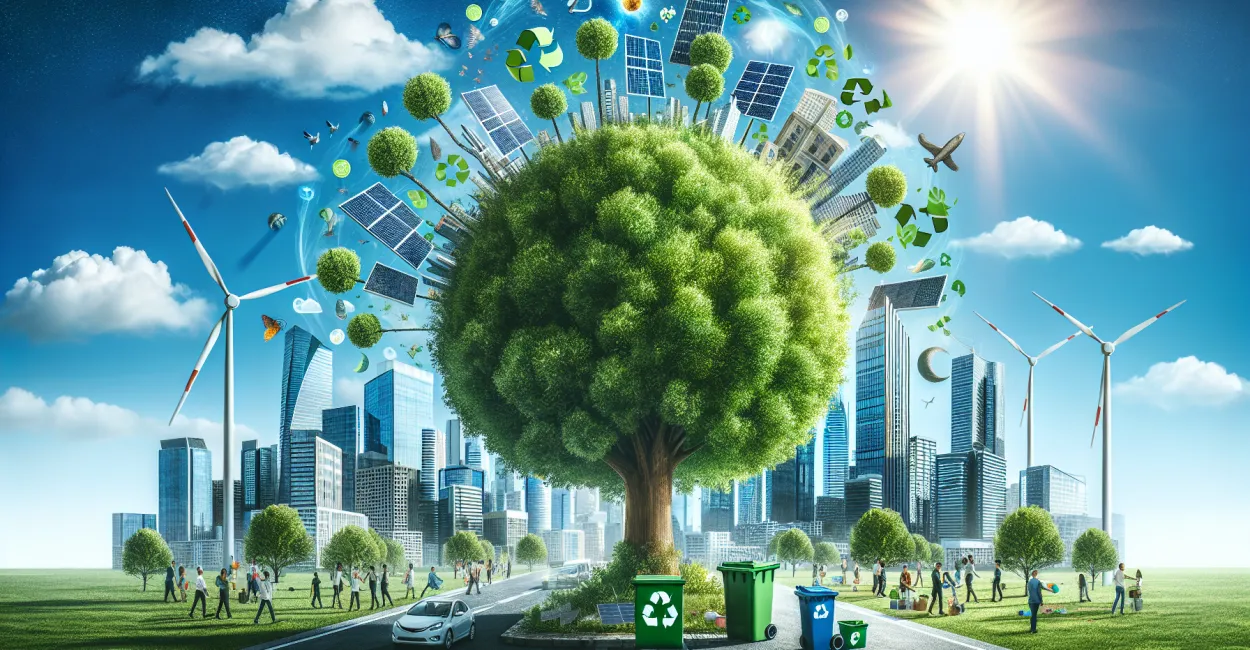
A city can recycle more waste and still be unsustainable if it uses water, energy, and land faster than nature can replenish them. That’s the central idea behind sustainability: it’s not enough to “do less harm.” We need to organize production, consumption, and public decision-making in ways that keep life—and the economy—going over the long term.
In practice, that means reducing waste, cutting emissions, using natural resources more efficiently, and creating fairer systems for people. In this article, you’ll get a clear definition, learn why sustainability matters now, and see how it applies to everyday life, businesses, and public policy.

What You Need to Know
- Sustainability is the ability to meet current needs without compromising the ability of future generations to meet theirs.
- The concept rests on three pillars: environmental, social, and economic. When one fails, the whole model becomes unbalanced.
- The most common practical mistake is treating sustainability as a one-off initiative; it works when it becomes a decision-making standard.
- Climate targets, energy efficiency, and waste management are concrete applications, not marketing slogans.
- People who work in this field know that real progress is usually incremental: measure, adjust, and repeat.
How Sustainability Brings the Environment, Economy, and Society Together
In technical terms, sustainability is a development model that preserves the ecological foundations that support life, ensures economic viability, and reduces social inequality at the same time. Put simply, a company shouldn’t profit by destroying its surroundings, and an environmental policy shouldn’t work by shifting the costs onto the most vulnerable people.
This three-pillar framework gained wider recognition after the Brundtland Report, published in 1987, and remains the most frequently cited reference on sustainable development. The idea isn’t romantic; it’s pragmatic.
Without fertile soil, clean water, reliable energy, and reasonably stable social relations, any economic gains are temporary.
What separates a sustainable action from one that’s merely “green” isn’t the intention—it’s the effect measured over time.
The Three Pillars in Practice
- Environmental: using resources within the planet’s capacity to replenish them, with a focus on climate, water, biodiversity, and waste.
- Social: inclusion, health, safety, access to opportunity, and respect for human rights.
- Economic: efficiency, resilience, financial longevity, and value creation without structural harm.
When One Pillar Breaks, the Whole System Feels It
If a company cuts emissions but maintains supply chains built on precarious labor, it has solved only half the problem. The same goes for public projects that plant trees without addressing urban drainage, transportation, and unplanned development.
Sustainability isn’t operational window dressing; it’s the engineering of balance.
Why the Climate Crisis Has Made This Issue Urgent
The increase in extreme weather events, pressure on food and water supplies, and rising energy costs have changed the conversation. Climate is no longer a distant issue; it’s a factor affecting insurance, infrastructure, agriculture, and productivity.
IPCC data show that global warming increases physical and economic risks, with more severe impacts in regions that are already vulnerable.
This context is also reflected in national indicators. Brazil’s IBGE, the Brazilian Institute of Geography and Statistics, compiles environmental and geographic data that help measure pressure on biomes, sanitation, and urban development. In everyday life, the costs show up as flooding, water shortages, supply chain disruptions, and higher prices. The problems rarely come one at a time.
The Cost of Delaying Decisions
Putting off environmental measures can seem like a short-term saving, but it often comes with a steep price later. A company that delays energy efficiency improvements pays more on its electric bill. A city that ignores drainage pays for it through street repairs, property losses, and social trauma. On this issue, time almost always works against those who wait too long.
When the climate changes but the infrastructure stays the same, vulnerability stops being a possibility and becomes a measurable cost.
How to Apply Sustainability in Everyday Life Without Empty Talk

Start with what you can audit: consumption, waste, energy, water, transportation, and purchasing. People who try to fix everything at once quickly give up; those who focus on the areas with the greatest impact make real progress.
In practice, small changes only make a difference when they become part of a consistent routine.
5 Changes That Can Make a Real Difference
- Reduce food waste and track grocery purchases each week.
- Replace light bulbs, adjust heating and cooling, and monitor energy use.
- Sort waste properly instead of winging it.
- Choose public transit, biking, or carpooling when possible.
- Buy less, but buy better: durability matters more than volume.
The Most Common Mistake
Many people confuse good intentions with results. Recycling without reducing the amount of waste generated, for example, may ease your conscience, but it doesn’t address the root of the problem. The same is true of one-off company campaigns that don’t change purchasing, suppliers, or internal processes.
A simple example: a school that replaces disposable cups with reusable bottles cuts costs and reduces waste, but the benefits are greater when it also changes how it buys food, runs its kitchen, and manages logistics. Lasting change grows from small systems, not a single isolated action.
Read also: Sustainability in Everyday Life: 9 Simple Changes That Work
The Role of Businesses and Supply Chains
Today, corporate sustainability is no longer just an “image department” concern; it’s a competitive factor. Investors, consumers, and regulators look at governance, emissions, traceability, and social and environmental risk. Companies that ignore these factors often pay more later—in reputational damage, financing costs, or operational disruptions.
This shift is also reflected in standards such as GRI, used for impact reporting, and climate metrics associated with the ISSB, which are gaining ground in corporate disclosures. This isn’t just communication; it’s measurement. Without data, there’s no serious management.
Read also: Green Lodging Is on the Rise: Why Properties Are Profiting
Where Businesses Are Making the Most Progress
- Energy efficiency and reduced industrial waste.
- Replacing inputs with a high environmental footprint.
- Supply chain traceability.
- Waste management and the circular economy.
- Governance with targets, metrics, and accountability.
There’s an important caveat: not every business can do everything at once. Small startups, for example, need to focus on what has the greatest impact; manufacturers, by contrast, often have more to gain by improving processes and supply chains. The right strategy depends on the industry, company size, and regulatory risk.
Public Policy, COP, and the Weight of Collective Decisions
The public sector shapes much of the playing field because it regulates infrastructure, transportation, sanitation, energy, and land use. Without consistent public policy, responsibility gets spread too thin and progress slows. That’s why conferences such as the UN COP remain relevant: they can’t solve the problem on their own, but they align targets and pressure countries to act.
What Tends to Work Best
Projects with clear targets, defined timelines, and serious oversight tend to deliver better results than broad, generic campaigns. Basic sanitation, for example, improves health, productivity, and environmental quality at the same time. Well-planned urban transportation reduces emissions and the daily cost of getting around.
Where Policy Often Falls Short
It falls short when it promises a lot but delivers little. It also falls short when rules are created without considering local capacity to implement them. Experts disagree on the ideal pace of the transition, but they agree on one point: without administrative continuity and funding, the agenda becomes rhetoric.
The Circular Economy, ESG, and a New Approach to Value
If the old model was “extract, produce, dispose,” the circular economy aims to close loops, reuse materials, and keep value in the system longer. This approach connects with ESG, which stands for Environmental, Social, and Governance. They aren’t synonyms, but they overlap constantly.
The difference between talk and action becomes clear when a company measures a product’s entire life cycle: raw materials, transportation, use, return, and disposal. This reveals areas of waste that used to go unnoticed. That’s when innovation stops being marketing and starts delivering efficiency.
Approach
Logic
Expected outcome
Linear
Extract, produce, and dispose
More waste and greater dependence on virgin raw materials
Circular
Reduce, reuse, repair, and recycle
Less waste and longer-lasting resources
Regenerative
Restore natural and social systems
Net positive impact on ecosystems and communities
The circular economy doesn’t magically eliminate environmental impact; it reduces waste by reorganizing the life cycle of materials.
How to Tell Whether an Initiative Is Truly Sustainable
A serious initiative leaves a clear record: targets, metrics, reports, a baseline for comparison, and transparency about limitations. If an action measures nothing, it’s probably closer to branding than management. Here’s a simple test: would the results hold up if you removed the narrative and looked only at the numbers?
A Practical Validation Checklist
- Are there measurements from before and after?
- Has environmental impact been reduced or merely shifted elsewhere?
- Is there a measurable positive social impact?
- Is the model financially viable without relying on goodwill?
- Is there transparency about failures and trade-offs?
One final caveat: not every project that reduces emissions is automatically beneficial in every way. It may reduce carbon emissions while worsening water use, soil health, or local inequality. That’s why assessments need to consider multiple dimensions. There’s no magic fix for sustainability.
How to Put This Into Practice Now
The best next step is to stop treating sustainability as an abstract concept and choose something measurable to start with. It could be energy, waste, transportation, responsible purchasing, or governance. What matters is moving beyond intention and building a routine for measurement, because what gets tracked gets considered in decisions.
If you want to act consistently, start by auditing one habit, process, or internal policy and set a simple metric to track for 30 days. Then expand your scope. Change doesn’t come from grand statements; it comes when practice becomes part of the system.
Frequently Asked Questions
What Is the Most Widely Accepted Definition of Sustainability?
It’s the ability to meet current needs without compromising the ability of future generations to meet their own needs. In practice, that requires balancing the environment, society, and the economy.
What’s the Difference Between Sustainability and Sustainable Development?
Sustainability is the principle of long-term balance. Sustainable development is the application of that principle to policies, businesses, and specific projects.
Is Every “Eco-Friendly” Product Sustainable?
No. A product may use less plastic and still have a high carbon footprint, a supply chain built on precarious labor, or problematic disposal. A label only means something when it’s backed by evidence.
What Has the Biggest Impact on Sustainability in Everyday Life?
The biggest impacts usually come from energy, food, transportation, and the consumption of durable goods. Repeated small changes in these four areas tend to make a bigger difference than isolated, symbolic actions.
Do Small Businesses Need to Think About This Too?
Yes, but their priorities may differ. Small businesses get the most value from focusing on what contributes most to their own impact and costs, such as waste, efficiency, and suppliers.
Why Is Greenwashing So Heavily Criticized?
Because it creates the appearance of responsibility without real change. It misleads consumers, distorts competition, and delays more serious action.
Artigos Relacionados
 Financial Literacy for Young People: A Complete Guide to Building a Secure Future
 Fashion Designer: A Complete Guide to Building a Successful Career
 Anesthesiologist: A Complete Guide to Building a Successful Medical Career
 Software Engineer: A Complete Guide to Building a Successful Career
 Passive Income: A Complete Beginner’s Guide to Building Financial Freedom
 Online Monetization: A Complete Guide to Building Your Digital Empire
