
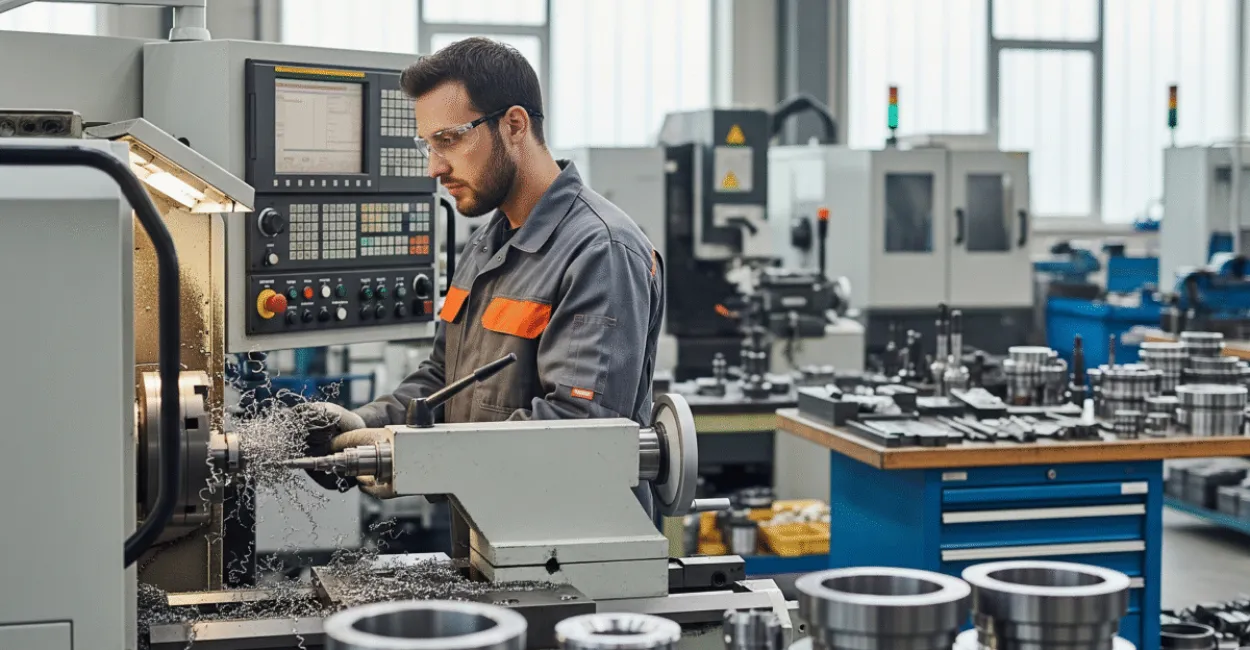
A poorly machined part can shut down an entire production line, cause rework, and drive up project costs within hours. That’s why the lathe machinist remains central to industry: they turn raw materials into components with precise dimensions, finish, and repeatability. In practice, the job involves much more than “running a lathe.” Machinists read engineering drawings, choose tools, set cutting parameters, and correct deviations that only become apparent once the metal starts turning. This article explains what a lathe machinist does, which skills matter most, where they work, and why the role remains so important in the metalworking industry.

The Essentials
- A lathe machinist makes parts on a lathe, removing material to meet the dimensions and finish specified in the design.
- Their value to industry comes down to precision: a small error in clearance, concentricity, or surface roughness can compromise how an assembly functions.
- Machinists who can read engineering drawings, use precision measuring tools, and select the right tools are better equipped to work efficiently without sacrificing quality.
- The job demands a strong focus on safety because lathes, metal chips, cutting fluid, and improper workholding all pose real risks.
- Technical training helps, but hands-on shop-floor experience and the ability to adjust machining in real time often make the biggest practical difference.
Lathe Machinists and Their Importance in Metalworking
Lathe machinists make parts on lathes, whether conventional models or computer numerical control (CNC) turning centers. Their role is to ensure that shafts, bushings, pulleys, flanges, and similar components have the correct geometry and fall within specified tolerances. Their work supports fields such as industrial maintenance, automotive parts, metal fabrication, tool and die making, and machine manufacturing. When a company needs a custom part with a tolerance of just a few microns, the machinist’s role is no longer just support—it becomes part of the production core.
What the job involves in practice
- Sets up the lathe and checks that the workpiece is secured.
- Reads engineering drawings and identifies dimensions, tolerances, and finish requirements.
- Selects the cutting tool, speed, feed rate, and depth of cut.
- Performs operations such as turning, facing, grooving, threading, and drilling.
- Checks dimensions with calipers, micrometers, bore gauges, and dial indicators.
In practice, a good result takes more than “knowing how to turn the machine on.” Anyone who does this work knows that unresolved vibration, a worn tool, or off-center clamping can change the final result. That’s why the trade calls for technical skill, good judgment, and operational discipline.
What separates an acceptable part from a truly good one isn’t just the final measurement—it’s the stability of the process that produces it.
How Machining Works on a Lathe
Machining is the controlled removal of material to shape a part. On a lathe, the workpiece rotates while the tool moves in a straight line or along a specific path. This motion makes it possible to produce cylindrical, conical, and threaded surfaces with precision. The concept sounds simple, but the process involves many variables. The material type and hardness, workpiece diameter, tool condition, and cutting fluid all directly affect finish and productivity. For example, the approach for carbon steel differs considerably from the one used for aluminum or stainless steel.
Common operations
- Facing: Smooths the end of the workpiece.
- Turning: Reduces the outside diameter while controlling dimensions.
- Grooving: Cuts grooves for fitting, clearance, or retention.
- Threading: Cuts internal or external threads.
- Drilling and reaming: Makes and finishes holes along the workpiece axis.
This process is especially common in corrective maintenance. I’ve seen cases where a broken-down machine needed a replacement bushing before the end of the shift. The difference between getting production back up and losing the entire day came down to making the part accurately without resorting to unsafe shortcuts.
Skills That Set a Good Machinist Apart

Not every lathe operator performs at the same level. What distinguishes an average operator from a good lathe machinist is a combination of technical reading skills, measurement control, and an understanding of how materials behave during cutting.
Essential technical skills
- Reading engineering drawings: Understanding views, sections, tolerances, and symbols.
- Metrology: Taking accurate measurements with calibrated instruments.
- Applied geometry: Recognizing concentricity, parallelism, and runout.
- Tool selection: Choosing the right inserts, drill bits, and tool holders.
- Parameter adjustment: Controlling spindle speed, feed rate, and depth of cut.
People skills that matter on the job
Beyond technical ability, staying focused under pressure matters a great deal. An out-of-spec part can be costly, and rushing tends to hurt the finish. Organization, patience, and a commitment to safety are just as important as hands-on shop skills.
There’s also a less-discussed factor: good communication with maintenance, the stockroom, and engineering helps prevent misunderstandings. When a work order is incomplete, an experienced machinist asks the right questions before clamping the part in the chuck.
In machining, rushing almost always leads to rework later—not higher productivity.
Read also: Industry automation: robots, AI, and emerging jobs
Where Lathe Machinists Work and Which Industries Need Them Most
Lathe machinists work in a wide range of settings, most commonly machine shops, metalworking companies, manufacturing plants, tool and die shops, and maintenance companies. In many cases, they also handle prototyping and custom manufacturing. The role is especially important in industries where downtime is costly, such as mining, pulp and paper, steelmaking, and food production. A replacement part made on time can prevent hours of downtime and a ripple effect across operations.
Industries where the profession is common
- Metalworking and machinery manufacturing
- Automotive parts
- Tool and die making
- Industrial maintenance
- Production and custom machining
- Mechanical prototyping
According to Brazil’s Ministry of Labor and Employment, industrial occupations remain closely tied to technical qualifications and adapting to new technologies. The Brazilian Classification of Occupations, a system for organizing occupations in Brazil, also helps explain how machining-related jobs are formally categorized in the labor market.
Training, Technical Courses, and Getting Started in the Profession
The most common path is to take a course in machining, industrial mechanics, or vocational training at an institution such as SENAI, Brazil’s National Service for Industrial Training. Students often start with the fundamentals: safety, engineering drawings, metrology, cutting theory, and supervised practice on a conventional lathe. This is one field where classroom theory alone won’t build a career. Reading engineering drawings is essential, but only structured repetition teaches you to anticipate burrs, vibration, tool wear, and dimensional variation across a production run.
What typically appears at the start of a training program
- Machine and equipment safety.
- Measuring instruments and calibration.
- Metallic materials and their properties.
- Reading mechanical drawings.
- Basic turning processes.
A useful safety reference is NR-12, a Brazilian regulation covering safety when working with machinery and equipment. To strengthen your training, consider exploring the technical programs offered by SENAI, which has a well-established track record in industrial training.
Safety, the Limits of the Role, and Costly Mistakes
Lathes demand respect. Sharp metal chips, poorly secured workpieces, unsuitable clothing, and adjustments made while the machine is powered on are real hazards—not just warnings in a manual. Safety depends on following procedures, staying alert, and using the right equipment.
There’s also an important limitation: not every machining job should be done on a conventional lathe. When a part requires high repeatability, multiple axes, or consistent production, a CNC turning center is usually a better fit. That doesn’t make the manual lathe less useful; it simply means each solution has its place.
Common mistakes on the shop floor
- Failing to check the condition of the cutting tool.
- Clamping the workpiece without checking alignment.
- Measuring only at the end instead of checking throughout the process.
- Ignoring thermal expansion in long or heat-sensitive metal parts.
- Using generic cutting parameters for different materials.
A lathe leaves no room for guesswork: a small mistake that goes unnoticed at first often becomes an obvious defect at the final stage.
Job Market and Growth Prospects
Employers value machinists who consistently deliver precision more than those who simply know the equipment. In industrial settings, productivity without rework matters as much as speed, and professionals who understand that tend to advance. There’s also demand for machinists who move beyond conventional lathes. CNC skills, program reading, indexable tooling, and advanced dimensional inspection expand job opportunities and reduce reliance on repetitive tasks.
What can help you advance your career
- Build experience with real parts and a variety of production runs.
- Learn to operate CNC lathes and understand their cycles.
- Master higher-precision measuring instruments.
- Learn about materials, heat treatments, and surface finish.
- Take part in safety and process training.
If you want to enter the field or move up, the best approach is to combine technical training with supervised practice and a solid understanding of standards. The career rewards people who build a strong foundation because precision can’t be improvised.
Next Steps for Getting Started
The smartest move isn’t to try to learn everything at once. Start with the fundamentals that support the work: engineering drawings, measurement, safety, and hands-on lathe practice. After that, the learning curve becomes much more manageable.
If you’re aiming to work in the field, compare courses, look at how much hands-on training they offer, check whether they cover metrology and safety, and find out if they have machines similar to those used in industry. For anyone looking for a practical career, becoming a lathe machinist can be a strong entry point into the world of machining.
Frequently Asked Questions
What’s the difference between a lathe machinist and a CNC lathe operator?
A traditional lathe machinist does a lot of manual setup, technical reading, and direct process control. A CNC lathe operator works with programs, controls, and more automation, but still needs to understand machining and metrology to correct deviations.
Do you need a course to work as a lathe machinist?
In practice, yes, because the job requires drawing interpretation, safety knowledge, and precise measurement. Some companies provide in-house training, but people with technical training usually advance faster and make fewer mistakes.
Are there still opportunities for lathe machinists with industrial automation?
Absolutely. Automation has changed the role, but it hasn’t eliminated the need for professionals who understand processes, tools, and dimensional tolerances. These skills remain valuable in maintenance and custom parts work.
What measuring tools do lathe machinists use every day?
The most common tools are calipers, micrometers, dial indicators, bore gauges, and specialized gauges. The choice depends on the required precision and the type of part being made.
Is working on a lathe dangerous?
It can be if safety procedures aren’t followed. The risk increases when a part isn’t secured properly, chips aren’t controlled, clothing is unsuitable, or someone works on the machine while it’s running.
Where do lathe machinists typically find jobs?
They work in machine shops, metalworking companies, automotive parts factories, industrial maintenance, tool and die shops, and machining companies. Demand tends to be higher where machine downtime is costly and custom parts make a difference.
%%AGPTRH10%%
Artigos Relacionados
 Pathologist: A Complete Guide to the Profession and Its Importance in Medicine
 Speech-Language Pathologist: A Complete Guide to the Profession and Its Importance
 Careers in Industry: Trends, Skills, and Future Opportunities
 The Importance of Play in Childhood for Whole-Child Development
 The Importance of Design in Digital Communication: How Design Turns Messages Into Impact
 Biotechnology: The Revolution Transforming the Food Industry
