
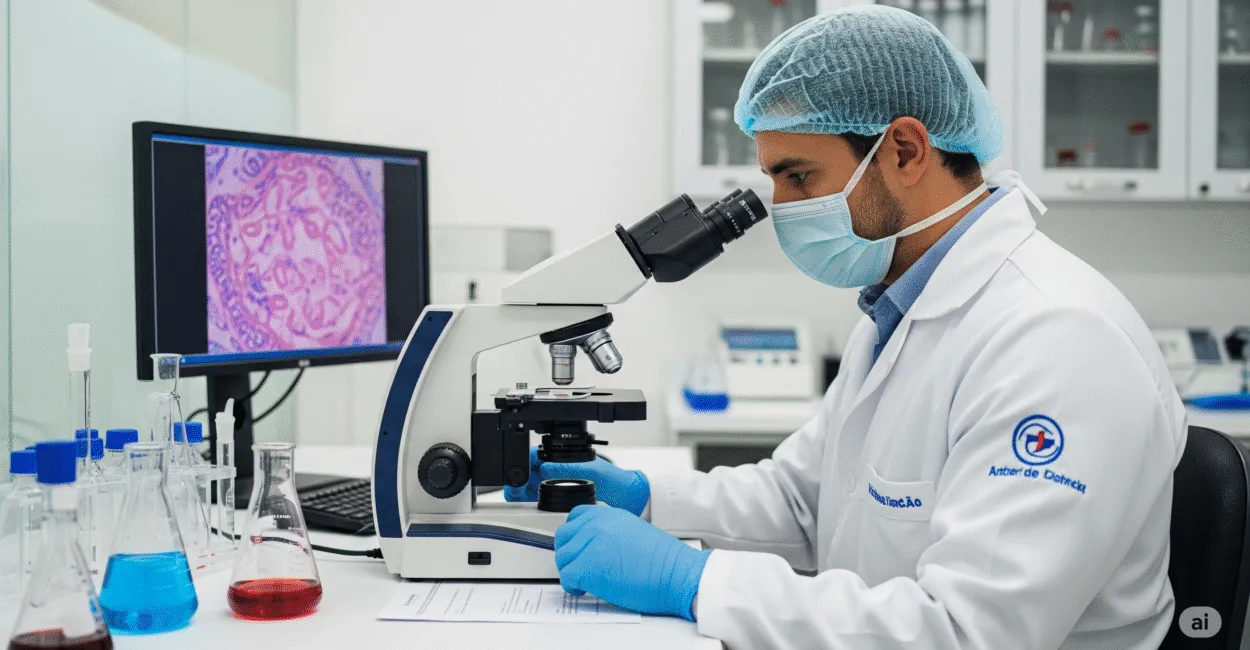
A biopsy can change the course of treatment, but decisions depend on knowing exactly what is in the tissue being examined. A pathologist is a physician who examines cells, tissues, and other biological materials to identify changes associated with disease and issue reports that support diagnosis and clinical decision-making. This work is part of different stages of care, from analyzing a sample removed during surgery to evaluating laboratory tests. Not every pathologist sees patients in an office or collects biopsy samples; daily work varies by specialty and health care setting.
Understanding this distinction can help people who have been referred for a test, are choosing a medical specialty, or want to learn about the profession. Read on to see how diagnosis works, what training paths are available, and how technology and the limits of the work fit in.

What does a pathologist do, and why does their report matter?
A pathologist is a physician who specializes in interpreting structural and functional changes associated with disease based on samples of tissue, cells, blood, and other materials. In simple terms, they look for signs that help explain what is happening in the body and communicate their findings in a report, which should be interpreted alongside the patient’s medical history and other test results. In cancer evaluation, for example, a pathology report can confirm whether a lesion is malignant, identify the tumor type, and describe features relevant to choosing treatment. However, the report alone does not determine the entire course of care: the treating physician considers it alongside imaging, symptoms, the patient’s clinical condition, and their preferences.
- Analyzes biopsies, surgical specimens, smears, and laboratory samples.
- Describes findings and, when the available data support it, establishes or contributes to a diagnosis.
- Orders or interprets additional tests, such as immunohistochemistry and molecular testing, as appropriate.
- Discusses results with clinical and surgical teams, including at multidisciplinary meetings.
One technical detail makes a difference: tissue must be properly identified and preserved. Improper fixation, insufficient material, or a mismatch between the label on the container and the test request can limit the analysis and require another sample. That is why the report also depends on the quality of the pre-analytical process, even before the sample reaches the microscope.
What does training in pathology involve?
To become a pathologist, you must earn a medical degree and then complete postgraduate medical training in the field, such as an accredited residency. The required degree is therefore in Medicine; degrees in Biomedical Sciences or Veterinary Medicine do not qualify someone to practice the medical specialty in humans. Residency combines classroom study with supervised work in diagnostic settings. Requirements and programs should be checked against the regulations of Brazil’s National Medical Residency Commission (Comissão Nacional de Residência Médica) and the specialty recognition rules of the Federal Council of Medicine (Conselho Federal de Medicina). Training length and structure depend on the current program, so outdated timelines should not be treated as universal rules.
Medical school in Brazil typically takes six years, but that does not include residency or any additional training. To check whether a higher education institution is accredited, also consult official information from Brazil’s Ministry of Education (MEC). The title of medical pathologist should not be confused with biomedical pathologist, a term used in laboratory settings for professionals with Biomedical Sciences degrees and relevant credentials. Their professional scope and permitted activities differ; the analysis and issuance of medical reports follow the rules governing the medical profession.
What are the different areas of pathology?

These areas differ in the types of materials they analyze and the diagnostic questions they address. Clinical pathology, anatomic pathology, and forensic pathology each have distinct workflows, although they may work together on the same case.
Area
Materials or cases
Primary role
Clinical pathology
Blood, urine, secretions, and other laboratory test samples
Interpreting laboratory results and supporting clinical evaluation
Anatomic pathology or surgical pathology
Biopsies, surgical specimens, cells, and tissues
Reporting cellular and tissue changes, including tumor diagnoses
Forensic pathology
Human remains and evidence related to medicolegal investigations
Forensic examinations to clarify cause and medicolegal circumstances
Medical pathologist refers to a physician who specializes in pathology. Clinical pathologist usually refers to a physician working in clinical pathology and laboratory medicine, while an anatomic pathologist mainly examines tissues and cells. The organization of specialties and credentials can vary according to current professional regulations. A veterinary pathologist has a degree in Veterinary Medicine and examines animal diseases. The term veterinary clinical pathologist refers to laboratory work in this field, not to a human medical specialty. Similarly, a forensic medical examiner may conduct forensic examinations, but their role and career path are not automatically equivalent to those of a pathologist specializing in anatomic pathology.
Read also: Radiologist: A Complete Guide to the Profession and Career
How does a pathologist analyze a biopsy or other test?
The process generally follows a sequence: sample collection and identification, technical preparation, analysis, interpretation of findings, and report writing. Pathologists may collect samples in some settings, but many biopsies are performed by surgeons, radiologists, or other qualified professionals.
- Receipt: The team verifies the sample’s identification, type, and the clinical information provided.
- Preparation: The material is processed to allow sectioning, staining, or other evaluation methods.
- Analysis: The specialist examines gross and microscopic features and determines whether additional tests are needed.
- Report: Findings are documented and the diagnostic question is answered within the limits of the sample and the information available.
Consider a sample from a lesion removed by a surgeon. The laboratory verifies the information and prepares tissue slides for microscopic examination. If the cells’ appearance does not reveal their origin, additional markers may be used. The result helps guide the care team, but a small sample or one altered by the procedure may leave questions that require clinical correlation or another sample.
Read also: Psychoanalyst: A Complete Guide to the Profession and Its Importance in Mental Health
That is why there is no single answer to the question “Does a pathologist perform biopsies?” Pathologists interpret samples and, in some settings, may take part in procedures or evaluations during surgery. Whether they collect the sample depends on the technique, the specialty involved, and local arrangements.
Where do pathologists work, and how much do they earn?
Pathologists may work in laboratories, hospitals, public health services, universities, research centers, and technical consulting roles. In some settings, patient contact is limited; in others, pathologists may discuss results directly or take part in diagnostic procedures. There is no single salary that represents the entire country. Compensation depends on public or private employment, location, hours, experience, responsibilities, test volume, and employment arrangements. On-call shifts, laboratory output, and academic work can also affect total earnings.
Anyone searching for “pathologist salary” or “medical pathologist salary” should compare recent job postings and public-sector hiring announcements, checking whether the stated amount is monthly, hourly, or productivity-based and whether it includes benefits. Salary averages on job sites may combine different schedules and employment arrangements; without that context, a number is not a promise of income. Choosing a career also means considering whether you enjoy analyzing evidence, paying close attention to detail, and communicating clearly with other teams. Pathologists rarely work in isolation: a question about a lesion’s location or the patient’s history can change how a slide is interpreted.
What technologies support diagnosis, and what are their limits?
Microscopy remains central, but different tools address specific questions. Immunohistochemistry uses antibodies to highlight proteins in tissue; molecular pathology looks for genetic changes or other markers that can refine disease classification and, in some cases, help guide therapy. Digitization converts slides into images for review, consultation among specialists, and remote workflows. Image analysis systems and artificial intelligence can flag patterns or areas of interest, but their results must be validated by professionals and depend on sample quality, system training, and clinical context.
Automation cannot fix a poorly collected sample or resolve every discrepancy between microscopic findings and the clinical picture. If the morphology, markers, and patient information do not align, responsible next steps may include requesting more information, discussing the case with the care team, or recommending another sample.
This work relies on laboratory practices and the communication of results, areas where communication must be precise: a report should distinguish what was observed from what remains uncertain. Systems tools also support recordkeeping and the flow of laboratory information without replacing medical interpretation.
How does pathology contribute to public health?
Laboratory and pathology results help health care teams recognize disease patterns, monitor cases, and guide prevention efforts. Epidemiologic surveillance and public policy are shared responsibilities among different professionals and institutions; pathologists contribute diagnostic data, but are not responsible for every part of a collective response.
In investigating infections, for example, test results can help identify pathogens and understand their distribution. In oncology, more thoroughly characterized diagnoses help organize care and provide useful information for planning health services. The relationship between testing, access to care, and continuity of treatment also affects the population’s health.
The four pillars of pathology are often presented as etiology (cause), pathogenesis (how a disease develops), morphologic changes (structural changes), and clinical manifestations (the disease’s effects and signs). This framework is a teaching tool for studying disease; it does not mean every diagnosis can be explained with four complete answers, since samples and clinical data have limitations.
For information about training and professional practice, consult the current rules of Brazil’s Federal Council of Medicine and National Medical Residency Commission. If you have questions about an individual test result, discuss the report with the physician who ordered the test and bring any imaging reports and relevant clinical information.
Frequently asked questions
Do pathologists see patients for office visits?
Some do see patients or speak with them directly, but this is not standard across all areas. In many cases, pathologists communicate with the team responsible for the patient’s care.
Are pathology and clinical pathology the same thing?
Pathology is the broad field that studies diseases and the changes they cause. Clinical pathology focuses on laboratory medicine, while anatomic pathology mainly examines cells and tissues.
Does an inconclusive report mean there is no disease?
No. It may mean the sample was insufficient, the findings do not support a reliable conclusion, or additional tests are needed. The treating physician should evaluate the result alongside the clinical picture.
Can a pathologist review a test performed at another laboratory?
Many facilities offer second opinions, but the process varies. A review may require slides, tissue blocks, previous reports, and authorization to transfer the material, depending on the laboratory’s rules.
What is the difference between a medical pathologist and a veterinary pathologist?
A medical pathologist has a medical degree and diagnoses human diseases within their specialty. A veterinary pathologist has a Veterinary Medicine degree and works with animal diseases; the training and scope of practice are distinct.
Artigos Relacionados
 Speech-Language Pathologist: A Complete Guide to the Profession and Its Importance
 Gardener: The Complete Guide to Mastering the Profession and Advancing Your Career
 Psychologist: A Complete Guide to the Profession
 Pharmacist: A Complete Guide to the Profession and Career Opportunities
 Insurance Broker: A Complete Guide to the Profession
 Photographer: The Complete Guide to Mastering the Profession
