
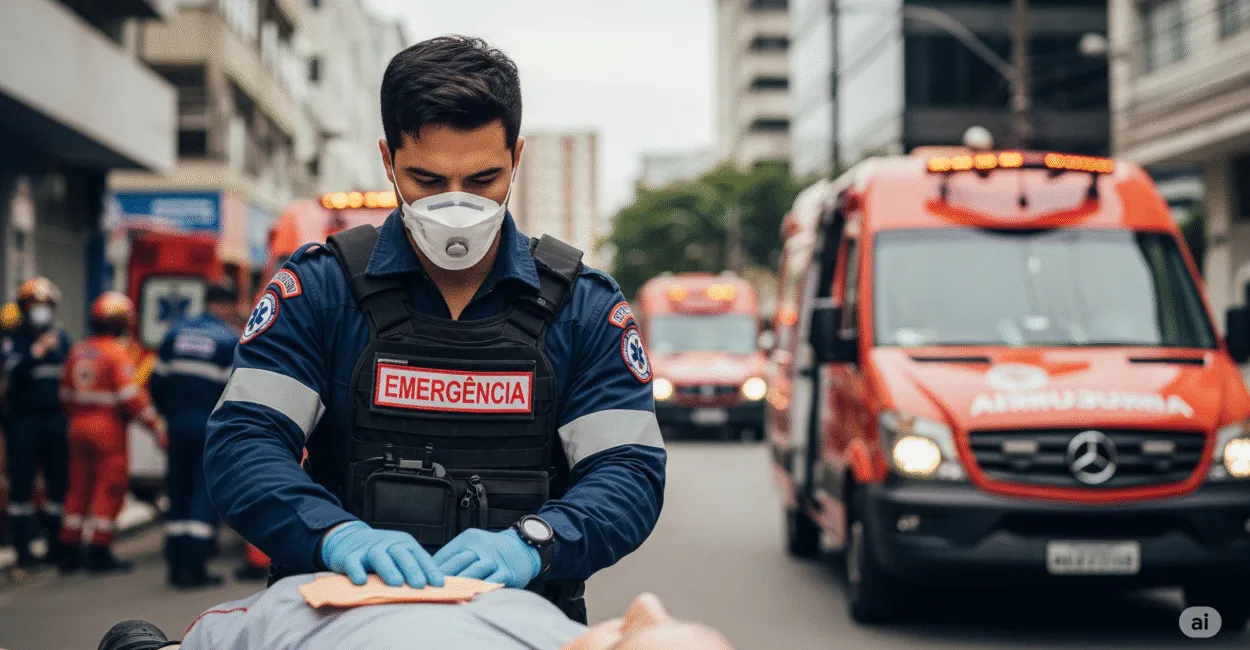
When every minute counts, the difference between life and death is rarely made at the hospital—it’s made before the patient gets there. That’s where the paramedic comes in: a trained professional who assesses, stabilizes, and transports patients in critical situations, often in chaotic environments with limited resources.

The job takes technical skill, composure, and the ability to quickly assess a scene. In practice, prehospital care professionals must decide within seconds what to check first, what to treat immediately, and when to call for advanced support.
Here’s what you need to know about what paramedics do, how they train, where they work, and why they play such an important role in emergency care.
What You Need to Know
- Paramedics provide prehospital care, focusing on rapid assessment, stabilization, and safe patient transport.
- The role combines clinical reasoning, trauma protocols, basic life support, and, in some systems, advanced life support.
- The job involves more than driving an ambulance. It includes triage, communication with medical control, and decision-making under pressure.
- Training requirements vary by country and healthcare system, which can significantly affect a paramedic’s scope of practice and responsibilities.
- Paramedics play a critical role in accidents, cardiac arrest, stroke, heart attack, and other time-sensitive emergencies.
Paramedics and Prehospital Emergency Care
Technically speaking, a paramedic is a healthcare professional trained to provide immediate care outside a hospital, with the goal of reducing risk, preventing a patient’s condition from worsening, and getting them to definitive care. Put simply, paramedics bridge the gap between the scene of an emergency and the hospital system.
It’s easy to underestimate this part of the job. Many people think the work begins when the ambulance arrives, but assessment starts at the scene: checking for hazards, determining the mechanism of injury, and assessing consciousness, breathing, circulation, and signs of serious illness. Anyone in the field knows that a patient who seems “stable” can deteriorate within minutes.
Where paramedics work
Common settings include rescue operations, basic or advanced life support ambulances, large public events, highways, disasters, and teams integrated with SAMU, Brazil’s Mobile Emergency Care Service, or private emergency services. In well-organized systems, paramedics also work with medical control and dispatch centers.
Good prehospital care isn’t about rushing to the hospital. It’s about getting the patient there alive and more stable than when you found them.
Training, Skills, and Scope of Practice
Paramedic training depends on the country. In some places, the profession is regulated and requires a specific technical or college-level program; elsewhere, the term is used more broadly for emergency and rescue personnel. Brazil’s system differs from the U.S. model, which can cause confusion even among people considering a career in the field.
That’s why it helps to distinguish the general concept from the career itself. Training typically covers anatomy, physiology, pharmacology, basic life support, airway management, immobilization, trauma, medical emergencies, and crisis communication. Resources such as FEMA in the United States and emergency care guidelines from the World Health Organization can help explain international emergency response standards.
Skills that make a difference
- Primary and secondary patient assessment.
- Bleeding control and initial immobilization.
- Recognizing signs of shock, stroke, and heart attack.
- Clear communication with medical control and hospital staff.
- Following protocols while exercising sound clinical judgment.
Where protocols fall short
Not every situation follows the manual to the letter. In a mass-casualty incident, for example, the best care isn’t necessarily the most comprehensive care—it’s the care that prioritizes those most likely to die first. In hazardous environments, the crew’s own safety may also limit what they can do. That’s a real constraint of the job: the skills are there, but the circumstances matter.
What Paramedics Do at an Emergency Scene

A well-managed emergency follows a sequence. First, the team assesses the scene. Then they identify immediate hazards, conduct a clinical assessment, and decide whether to stabilize the patient on-site or transport them urgently. It sounds simple on paper. On the street, it rarely is.
An example makes this easier to understand. Imagine a motorcycle and car collision on a busy urban road. The victim is conscious, has visible bleeding, and complains of chest pain. The priority isn’t to “check everything.” It’s to control the bleeding, assess the airway, breathing, pulse, and neurological signs, then prepare for rapid transport while notifying the receiving hospital in advance.
Common prehospital emergency care procedures
- Assess scene safety and use appropriate PPE.
- Apply triage protocols and identify the severity of the patient’s condition.
- Stabilize vital functions using available resources.
- Monitor for signs of clinical deterioration during transport.
- Document findings and hand off information in a standardized format.
In practice, prehospital care is at its best when the team can do what matters most under pressure, without wasting time on procedures that won’t change the outcome.
Paramedics, Nursing Assistants, and First Responders: What’s the Difference?
These terms are often used interchangeably, but they don’t mean the same thing. In systems where the role is formally established, paramedics have a distinct scope of practice, specific protocols, and training focused on prehospital response. Nursing assistants work within a different care model, generally under nursing regulations and with different responsibilities. “First responder,” meanwhile, can be a broader and less technical term, depending on local usage.
| Role | Primary focus | Common settings |
|---|---|---|
| Paramedic | Prehospital care and stabilization | Ambulances, rescue operations, and emergency response |
| Nursing assistant | Nursing care and clinical support | Hospitals, clinics, and some transport services |
| First responder | Initial care and support | Events, businesses, rescue operations, and emergency response teams |
This distinction matters because it helps set realistic expectations. Anyone considering this career should check local regulations before investing in training. The job title doesn’t guarantee the same skills or legal authority in every country.
When Emergency Care Can Change the Outcome
Some conditions can’t wait. Cardiac arrest, stroke, sepsis, hemorrhagic shock, and multiple trauma require a rapid response, and prehospital care can dramatically affect the patient’s prognosis. The American Heart Association publishes widely used guidelines for resuscitation and cardiovascular support, underscoring how much timing and the order of interventions matter.
The same is true when treating patients in remote areas. On highways, in rural communities, and in hard-to-reach locations, paramedics often work with less support, less technology, and more uncertainty. That doesn’t make their role less important; if anything, it makes it more important.
When paramedic care is critical
- Cardiac arrest requiring immediate CPR and defibrillation.
- Trauma with severe bleeding and a risk of hypovolemic shock.
- Suspected stroke requiring rapid recognition of symptoms.
- Respiratory distress requiring oxygen and monitoring.
- Mass-casualty incidents where triage determines who gets care first.
The Real Challenges of the Job and Its Emotional Toll
There’s a side of the job you don’t often see in videos and TV shows: the emotional impact. Responding to pain, death, panicked families, and violent scenes takes a toll. Burnout, compassion fatigue, and acute stress are real risks for emergency crews, and ignoring them can undermine clinical performance over time.
There’s also the ongoing operational challenge of small teams, limited resources, and high expectations. In many services, the difference between good and poor care comes down to repeated training, clear protocols, and quality supervision. That’s one reason continuing education isn’t a luxury; it’s part of the job.
The best paramedic isn’t the one who performs the most procedures. It’s the one who knows what to prioritize, keeps the scene safe, and quickly recognizes what truly threatens a patient’s life.
Study and continuing education resources
To keep up with best practices, consult reference materials such as the CDC for emergency response and prevention topics, along with public health protocols and publications. In emergency care, staying current isn’t just about your resume: it shapes how your team makes decisions under pressure.
How to Decide Whether This Career Is Right for You
If you’re drawn to this field, look beyond the romantic idea of saving lives. The job requires discipline, physical stamina, emotional maturity, and a willingness to follow protocols. It also calls for comfort with unpredictable situations and a commitment to regularly studying anatomy, physiology, and decision-making.
If you’re motivated to work in emergency care, the smartest path is to compare how the profession is regulated in your country, understand what training is required, and talk with prehospital care services. That’s the only way to avoid entering the field with the wrong expectations. In Brazil, this matters because job titles and responsibilities don’t always match the international model.
What to consider before choosing this field
- Professional laws and regulations in your state or country.
- The amount of hands-on training in the program and the quality of its simulations.
- Whether the training covers trauma, advanced life support, and team communication.
- Realistic job opportunities in rescue, ambulance, or private services.
- Your ability to handle repeated exposure to emergencies.
If you’re considering this path, the best next step is to confirm local regulations, compare accredited programs, and decide whether emergency work suits your strengths. A good career isn’t one that looks heroic on paper; it’s one you can sustain with skill, composure, and ongoing preparation.
Frequently Asked Questions About Paramedics
Are paramedics and first responders the same thing?
Not necessarily. In many contexts, “first responder” is a broader term for someone who provides initial care, while paramedics have more specialized training and a defined scope of practice in prehospital care. The exact distinction depends on each country’s laws and healthcare system.
Can paramedics work inside a hospital?
Their primary focus is prehospital care, including ambulances, rescue operations, and field response. In some systems, paramedics may have roles integrated into emergency departments, but that isn’t universally the case. Most often, they bridge the gap between the scene and the hospital.
How long does paramedic training take?
It varies widely by country and certification type. Some programs are short and cover basic life support, while others provide more extensive training for advanced practice. Before enrolling, check whether the program is recognized by the appropriate authority.
What skills matter most in this profession?
Quick thinking, emotional control, clear communication, and a strong command of protocols are at the top of the list. Clinical observation, teamwork, and the ability to prioritize without getting lost in less important details also matter.
Is this a high-risk profession?
Yes. The job involves traffic, violent scenes, unstable environments, and critical situations. Risk varies by service and region, but exposure to accidents, acute stress, and emotional strain is real. That’s why operational safety and training are essential.
Is a career in this field worth pursuing?
It can be a good fit for people who enjoy emergency work, can handle an intense routine, and want to provide fast, decisive care. It’s not a career for anyone looking for predictability. It’s a strong choice when you have the motivation, preparation, and a clear understanding of the work.
%%AGPTRH9%%
Artigos Relacionados
 Nursing Assistant: A Complete Guide to This Essential Profession
 Paid Traffic Manager: A Complete Guide to This Essential Digital Marketing Career
 Speech-Language Pathologist: A Complete Guide to the Profession and Its Importance
 Gardener: The Complete Guide to Mastering the Profession and Advancing Your Career
 Psychologist: A Complete Guide to the Profession
 Pharmacist: A Complete Guide to the Profession and Career Opportunities
