
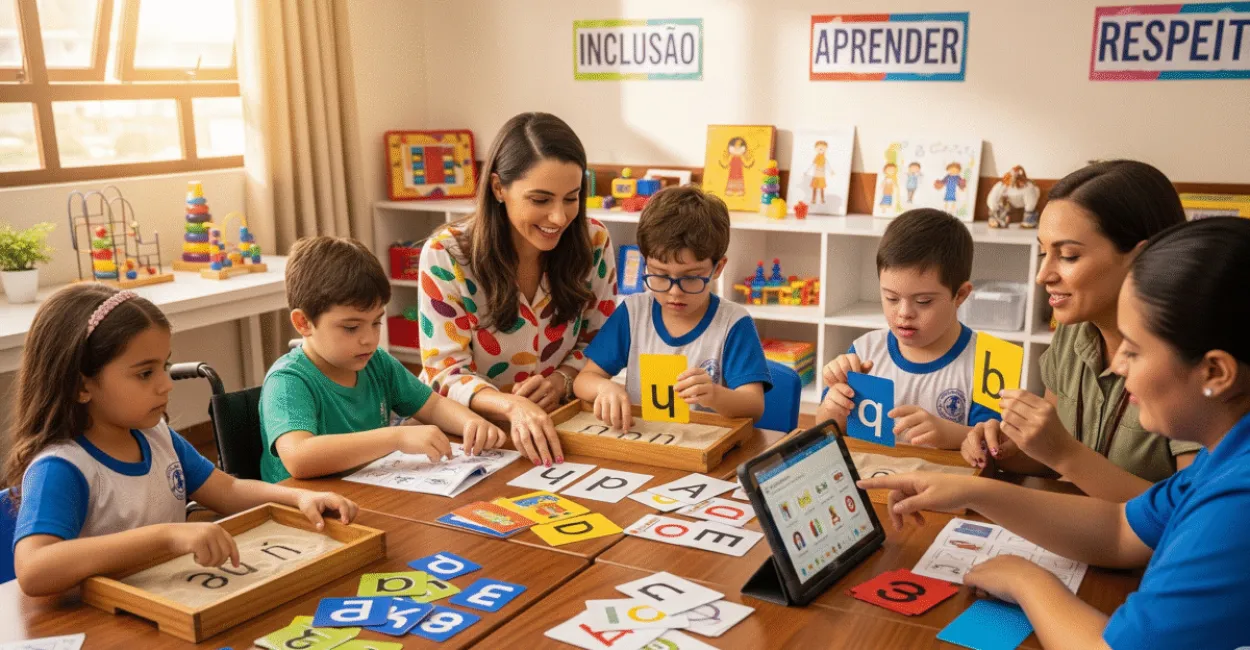
Literacy instruction for children with special needs doesn’t start with a method; it starts with the child’s individual profile. When reading and writing are taught without considering communication, attention, motor skills, language, vision, hearing, and cognitive processing, the result is often frustration all around. The most effective approach is to adapt goals, routines, materials, and assessments to what the child can actually do today.

That doesn’t mean “lowering the bar.” It means teaching with precision. In this guide, you’ll learn how to make literacy instruction truly inclusive: how to assess before getting started, which strategies work best, what materials can help, how to adapt instruction for different needs, and how families, schools, and support teams can work together.
The Essentials
- Inclusive literacy instruction works best when diagnostic assessment comes before activities, because every child learns in different ways.
- Multisensory materials, explicit instruction, and short-term goals reduce overload and make steady progress more likely.
- There’s no single literacy method that works for everyone; adapting instruction is central to the process, not an “extra.”
- Families, schools, and specialized educational support staff need to share the same plan, with simple agreements and regular check-ins.
- In most cases, what holds progress back isn’t a lack of effort from the child, but activities that don’t work well for their individual profile.
Literacy for Children With Special Needs: What Changes in Practice
Literacy instruction for children with special needs is the process of teaching reading and writing in ways that are adapted to each student’s development, communication, perception, and independence. In practice, this means adjusting goals, pace, language, visual supports, task formats, and ways to respond rather than expecting the child to follow the same path as the rest of the class.
The main difference is the starting point. In a general education classroom, instruction may follow a relatively standardized sequence. With adapted literacy instruction, the school needs to observe how the child recognizes sounds, symbols, words, images, and directions. Anyone who works in this area knows that the same activity can be very helpful for one child and completely ineffective for another, even when both are at the “same grade level.”
The difference between standardized instruction and inclusive literacy isn’t the amount of content; it’s the ability to adapt how students access knowledge.
This is where terms like inclusive education, inclusive teaching materials, specialized educational support, and multisensory learning come in. The idea isn’t to create “easier” materials, but to provide a clearer way in so the child can participate, respond, and make progress with dignity.
How to Conduct a Diagnostic Assessment Before Teaching
Diagnostic assessment should happen before setting the first formal reading and writing goals because it shows what the child can do independently, with help, and not yet at all. Without this information, the school risks insisting on activities that require skills the child hasn’t developed yet—and that can be just as exhausting as it is counterproductive.
What to observe first
- How the child understands short and long directions.
- Whether they recognize letters, sounds, rhymes, names, or familiar words.
- How they point, hold a pencil, cut, fit pieces together, and organize materials.
- Whether they can manage routines, wait times, and transitions between tasks.
- Which response mode works best: oral, visual, gestural, written, picture selection, or assistive technology.
Useful assessment tools
A good observation doesn’t require a sophisticated form. It can combine a writing sample, reading familiar words, phonological awareness games, matching activities, analysis of responses with support, and behavior notes from real-world settings. For children with limited communication, it’s also worth observing how they use pictograms, communication boards, and assistive technology.
The goal is to establish a realistic baseline: what the child recognizes, what they can copy, what they identify through visual memory, what they understand with contextual support, and under what conditions they perform best. The BASICS and materials from public inclusive education systems often emphasize this functional approach to assessment, rather than relying only on formal testing.
Literacy Methods That Work Better in Inclusive Education

The literacy methods that are most useful for children with special needs combine explicit instruction, meaningful repetition, and multisensory support. Rather than relying on unguided discovery, children need to see, hear, touch, name, and practice the relationships between letters, sounds, and words in an organized way.
Strategies that tend to work well
- Explicit, step-by-step instruction: Teach one skill at a time, with clear models and little ambiguity.
- Predictable routines: Start, practice, and finish in a consistent way to reduce anxiety and distraction.
- Short, frequent practice: Ten focused minutes are better than 40 minutes of fatigue.
- Generalization: Practice the same skill with cards, books, signs, classmates’ names, and everyday situations.
- Immediate feedback: Show right away what the child got right and what needs adjustment.
Among the best-known approaches, phonological awareness, grapheme-phoneme correspondence, and work with syllable families can be useful when adapted to the child’s profile. For some students, visual support speeds things up; for others, too much stimulation gets in the way. Specialists disagree on the ideal order for teaching some skills, but there’s consensus on one point: without an individualized plan, progress tends to be inconsistent.
In practice, a good method is one the child can use beyond the worksheet—not one that just looks good in a lesson plan.
If a student learns to identify a letter on cards but doesn’t recognize the same letter in their own name, the skill hasn’t been mastered yet. The real test of inclusive literacy is whether the skill transfers to concrete situations.
Inclusive Teaching Materials and Adapted Literacy Activities
The best materials aren’t the most expensive; they’re the easiest to read, handle, and use consistently. In adapted literacy instruction, materials should reduce cognitive load and make tasks more predictable. This applies to children with autism spectrum disorder (ASD), attention-deficit/hyperactivity disorder (ADHD), intellectual disabilities, dyslexia, and hearing, visual, or motor disabilities.
Materials that often help
- Cards with letters and high-frequency words.
- Pictograms and visual schedules.
- Modeling clay, sandpaper, movable alphabets, and raised letters.
- Books with high contrast and just a few words per page.
- Communication boards and apps with synthesized speech.
- Large-print alphabets, bold-lined paper, and pencil grips.
Activities that make sense
Replace long exercises with short tasks that have a single goal. For example, match a picture to a word, complete a child’s name with movable letters, build words with visual support, put syllables in order, find letters on product packaging, or identify rhymes in familiar songs. When the child needs to write, offer different ways to do it: copying, building words, selecting letters, dictating to an adult, or using a keyboard.
Read also: The Family’s Role in Children’s Literacy Development
A brief example helps illustrate this. A child with motor coordination difficulties struggled with worksheets full of lines. The same skill was taught using magnetic letters, then a keyboard, and only later a pencil. The child made progress because writing stopped being a barrier to access and became the focus of learning. This kind of adjustment keeps children from being assessed with the wrong tool.
How to Adapt Literacy Instruction for Autism, ADHD, Intellectual Disabilities, and Other Needs
Adaptations depend on the child’s needs, but some principles apply across the board: reduce noise, organize how information is presented, offer concrete support, and respect processing time. The most common mistake is treating different diagnoses as if they all called for the same teaching response.
| Profile | What tends to work | What often gets in the way |
|---|---|---|
| Autism spectrum disorder (ASD) | Visual schedules, the child’s interests, clear language, predictability | Vague directions, unexpected changes, too much stimulation |
| ADHD | Short tasks, clear goals, purposeful movement, quick feedback | Long activities, mechanical repetition, extended waiting |
| Intellectual disability | Small steps, concrete instruction, frequent review, generalization | Introducing abstract content too early, rushing through stages |
| Dyslexia | Systematic work with sounds and letters, guided reading, functional vocabulary | Assuming reading will improve through exposure to text alone |
| Hearing disability | Visual support, Libras (Brazilian Sign Language) when needed, lip-reading, attention to written language | Oral explanations alone and directions without visual support |
| Visual disability | Braille, high contrast, tactile materials, assistive technology | Printed materials without accessibility adaptations |
| Motor disability | Keyboards, communication boards, pencil grips, alternative response methods | Requiring handwriting as the only way to demonstrate learning |
For example, children with ASD often make progress when reading is connected to genuine interests—characters, signs, lists, names, and everyday topics. For children with ADHD, the key is to reduce friction: less time sitting still, one clear goal per activity, and more clarity about when a task ends and what comes next.
For children with hearing disabilities, the relationship between spoken language, Libras, and written text needs to be carefully planned. For children with visual disabilities, it’s not just a matter of “having Braille materials”; they also need tactile access, time to explore, and appropriate support. And literacy instruction for children with dyslexia calls for systematic, ongoing phonological instruction—not an occasional activity.
Brazil’s National Education Council and inclusive education policy emphasize that specialized educational services should supplement, not replace, general education. See the guidelines from the Ministry of Education and the guidance from the CNE (Brazil’s National Education Council).
The Role of Families, Schools, and Specialized Educational Support
Literacy develops faster when the adults involved use consistent forms of support. Families reinforce routines and functional language; schools set goals and keep educational records; specialized educational support staff adapt instruction and help remove specific barriers. When everyone does something different, the child receives mixed signals.
What families can do
- Read together for short periods at home, often, without turning it into a source of pressure.
- Use the child’s name, simple lists, labels, and real notes.
- Reinforce letters, sounds, and words in context, not only on worksheets.
What schools need to provide
- Clear goals for each stage.
- Records of what has and hasn’t worked.
- Adaptations to timing, response methods, and materials.
- Regular communication with the family and the professionals involved.
One thing that often goes unnoticed: communication among adults matters just as much as the method. A progress notebook, a routine for sending home short activities, and a check-in every two weeks can make a big difference. When these are in place, adapted literacy activities stop being isolated tasks and become part of a real plan.
The greatest benefit of inclusive education comes when schools and families stop looking for someone to blame and start tracking what the child can do with support, without support, and after repeated practice.
Common Mistakes That Slow Progress in Inclusive Literacy
Some mistakes happen so often they start to seem routine. The biggest is confusing inclusion with improvisation. Inclusion isn’t just “letting a child participate”; it’s providing the conditions they need to learn.
What to avoid
- Assigning the same activity as the rest of the class without adapting it.
- Replacing instruction with coloring, cutting, and pasting that has no educational purpose.
- Ignoring fatigue, sensory sensitivities, and response time.
- Requiring written work before the child has reliable access to the content.
- Changing the plan every week without looking at the evidence.
It’s also common to put too much faith in a “miracle” material. There’s no such thing. A resource helps when it matches the goal, the child’s stage of development, and the way they process information. Otherwise, it’s just decoration. Literacy instruction for children with special needs requires a combination of method, support, and consistency—not the latest trendy app.
Another common mistake is focusing only on challenges and overlooking strengths. Children with special needs learn better when instruction builds on what they already do well: visual memory, interest in specific topics, pattern recognition, functional vocabulary, imitation, music, movement, or support from peers.
How to Track Progress and Adjust the Plan Over Time
Progress monitoring needs to be simple, objective, and frequent. If a school waits months to review the plan, it can miss important signs. Ideally, progress is tracked in small steps: letter recognition, vocabulary growth, sound-letter correspondence, reading functional words, writing attempts, and independence with tasks.
Practical signs of progress
- The child understands what to do with fewer repeated directions.
- They can stay focused longer during short activities.
- They recognize words from their own vocabulary with less help.
- They apply a skill in a different context.
- They show less resistance when the task is predictable.
If a resource doesn’t lead to progress after a reasonable period of consistent use, it needs to be reconsidered. This doesn’t apply to every case in exactly the same way—it depends on the child’s needs, developmental stage, and the quality of support. For some children, adapting the environment solves half the problem; for others, the biggest gains come from changing how they respond.
To guide progress monitoring, it’s worth consulting materials from universities and public organizations on inclusive education and specialized support. One useful resource is UNESCO’s work on inclusive education, which emphasizes the need to remove barriers and monitor participation, not just attendance.
Next Steps for Putting the Plan Into Action
The best place to start is to stop asking, “Which method works for everyone?” and start asking, “What support will help this child make progress right now?” When inclusive literacy becomes part of everyday practice—with diagnostic assessment, adapted activities, inclusive teaching materials, and regular review—progress no longer depends on trial and error.
If the goal is to improve reading and writing instruction, the next step is to create a simple plan with three items: what the child can already do, what they need to learn first, and which support will remove the biggest barrier right now. Then track progress using concrete evidence, not impressions.
Frequently Asked Questions
What is the first step in literacy instruction for children with special needs?
The first step is diagnostic assessment. It shows how the child understands directions, responds to tasks, recognizes letters or words, and which supports help them perform best. Without this initial picture, instruction tends to be generic.
Does inclusive literacy require a specific method?
There’s no single method that works for every child. The most effective approach combines explicit instruction, predictable routines, multisensory support, and adaptations based on each child’s profile. In some cases, instruction should focus more on phonics; in others, it should be more visual and functional.
How can reading and writing be adapted for children with motor disabilities?
Offer alternative ways to respond, such as a keyboard, communication boards, movable letters, or assisted writing. The focus should be on learning written language, not on fine motor skills as a barrier to access. Handwriting can be developed later, without rushing.
Which resources are most helpful for literacy instruction for children with ASD?
Visual schedules, pictograms, the child’s interests, clear language, and short tasks often work well. Many students with ASD respond better when an activity has a very clear beginning, middle, and end. Sudden changes and too much stimulation can get in the way.
Do families and schools need to use the same strategies?
They don’t need to repeat everything, but they do need to be consistent. If the school uses pictures and functional words, the family can reinforce them with notes, lists, names, and everyday objects. Consistency across settings helps children generalize what they learn.
When should a literacy plan be reviewed?
The plan should be reviewed whenever the child shows no observable progress after a consistent period of instruction or when strategies begin to cause fatigue and resistance. The review should consider concrete evidence, such as performance, independence, and whether the child can apply the skill in other contexts.
Artigos Relacionados
 The Family’s Role in Children’s Literacy
 Educational best practices: A complete guide to transforming teaching
 Literacy Difficulties and Early Intervention: How to Identify Them
 How to Introduce Literacy in Early Childhood Education
 Child Psychology: A Complete Guide to Understanding Children’s Emotions
 Big Data in Education: Turning Data Into Better Teaching Practices
