
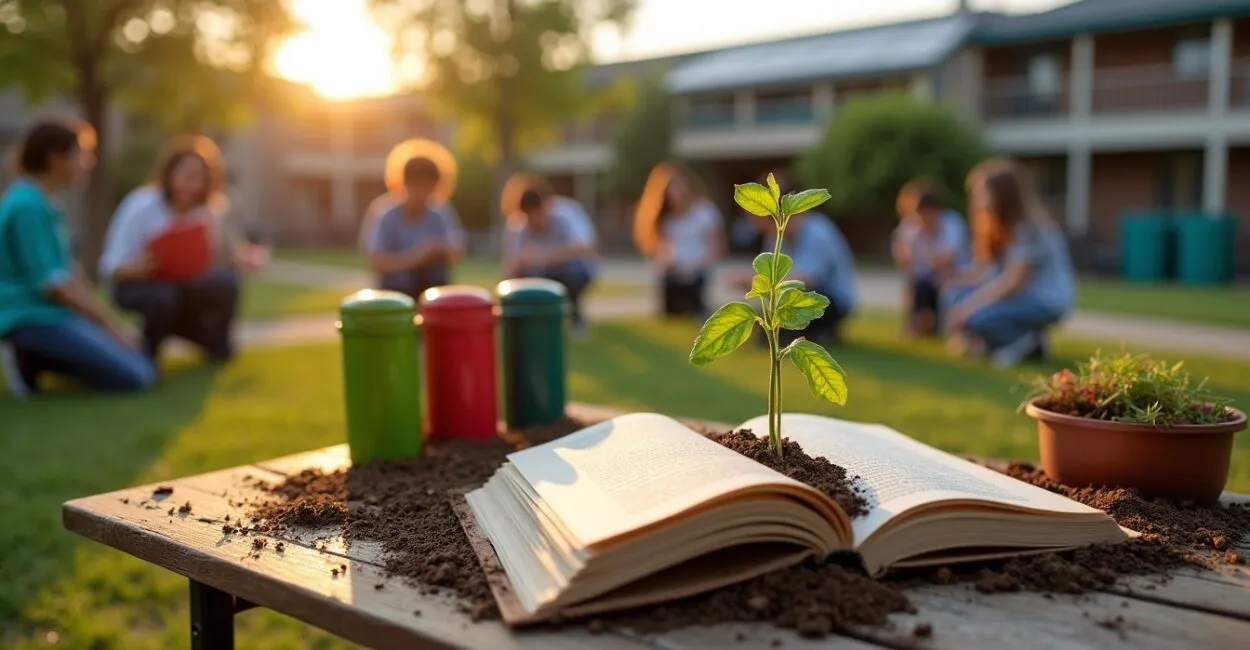
When a school reduces waste, saves energy, and empowers students to take the lead, it’s doing more than “doing the right thing”: it’s changing how the community learns to live with finite resources. Sustainability in schools means integrating educational, administrative, and infrastructure practices to use water, energy, materials, and space responsibly while promoting social justice and environmental awareness.

In practice, this goes far beyond sorting trash in the classroom. It involves the curriculum, waste management, energy efficiency, smarter purchasing, school meals, transportation, and community participation.
This article shows how to move sustainability beyond talk and into everyday school life, with practical steps, real-world examples, and often-overlooked considerations.
The Essentials
- School sustainability isn’t a standalone project; it works best when it’s incorporated into both educational planning and daily operations.
- The actions that deliver the biggest returns are often the simplest: reducing waste, tracking consumption, rethinking purchases, and involving students in clear goals.
- Without leadership from administrators and participation from teachers, most initiatives become one-off campaigns and lose momentum within a few months.
- Schools benefit most when they treat sustainability as an institutional culture, not an occasional extracurricular activity.
- Consistent results come when the community understands why change is needed and can see its impact in everyday life.
How Sustainability in Schools Goes Beyond the Classroom
Technically speaking, sustainability in schools is the application of environmental, social, and governance principles to how an educational institution operates. This includes responsible consumption, reducing impacts, equitable access to opportunities, and preparing citizens to address shared challenges.
In practical terms, a school fulfills its educational mission by teaching through both its curriculum and its example. If students learn about the environment but see water being wasted, lights left on in empty hallways, and paper used carelessly, the message loses credibility.
Those who work in this area know that real change starts on three fronts: behavior, processes, and physical space. A presentation can raise awareness.
But it’s the school’s systems—its routines, rules, infrastructure, and monitoring—that make change last.
What sets a sustainable school apart from one that is merely “aware” is its ability to turn good intentions into measurable routines.
The Three Pillars That Support Change
- Education: Sustainability is integrated into classes, projects, and assessments rather than limited to special occasions.
- Administration: Purchasing, contracts, maintenance, and consumption targets take social and environmental criteria into account.
- Infrastructure: Lighting, ventilation, recycling, accessibility, and resource reuse support the school’s educational message.
Initial Assessment: Where Schools Waste Resources Without Realizing It
Before implementing any initiative, it’s worth identifying the most common sources of waste. At many schools, the problem isn’t a lack of good intentions—it’s a lack of assessment.
Without measurement, schools make decisions in the dark and invest energy in initiatives that deliver little return.
A simple review can reveal a lot: water and electricity bills, waste volume, paper use, maintenance frequency, and how spaces are used. If the school has a cafeteria, kitchen, or lab, the assessment should cover those areas too, since they account for a large share of its environmental impact.
In practice, a school that reviews only its classrooms and ignores the cafeteria, playground, and office is seeing only half the picture. Ideally, create a consumption map by department and establish a baseline to compare results throughout the year.
Without a baseline, every improvement looks like a success—and every problem is just a hunch.
What to Measure First
- Monthly water consumption, broken down by department.
- Electricity use and peak usage times.
- Amounts of recyclable and organic waste.
- Use of paper, plastic, and office supplies.
- Ventilation, lighting, and building maintenance conditions.
A Living Curriculum: Bringing Sustainability Into the Classroom

Sustainability gains traction when it stops being the theme of a single awareness week and starts connecting with real subject matter. Science classes can cover the water cycle, biodiversity, and energy. Math classes can explore graphs, averages, percentages, and consumption data. Geography can look at the relationship between land, climate, and urban development. English language arts can focus on persuasive writing and critical analysis of campaigns.
This kind of integration matters because it shows that environmental issues don’t exist in separate compartments. Students see how consumption data can become a written piece, how writing can become a campaign, and how a campaign can lead to changed habits. That makes learning meaningful. One important point: not every activity needs to be ambitious. Sometimes, a project tracking trash during lunch teaches more about shared responsibility than an entire fair with no follow-up. A common mistake is to turn sustainability into a symbolic gesture and forget to track what happens next.
A Concrete Example of an Interdisciplinary Project
An elementary school class began weighing food waste from school lunches over two weeks. With their math teacher’s help, students created graphs; with their science teacher, they discussed decomposition and composting; and with the kitchen staff, they adjusted portions and food reuse. By the end, the amount of waste had fallen because the school changed its process, not just what it said.
This kind of experience tends to work well because it makes the impact visible. Students stop being spectators and become observers with a sense of responsibility. That’s when learning sticks.
For curriculum references and educational guidelines, consult the official MEC website (Brazil’s Ministry of Education) and UNESCO materials on education for sustainable development.
Managing Waste, Water, and Energy Without Resorting to Symbolic Gestures
Sorting waste matters, but it doesn’t make a school sustainable on its own. Real impact comes when an institution reduces waste at the source, improves sorting, and ensures each material goes to the right destination. The same goes for water and energy: asking people to conserve isn’t enough—the system needs to be improved.
Read also: Sustainability Tips for Apartments: A Practical Guide
For waste management, schools need to distinguish recyclables, organic waste, landfill waste, and special items such as batteries, light bulbs, and electronics. For water conservation, well-maintained faucets, conservation campaigns, and rainwater reuse can make a difference. For energy, sensors, LED bulbs, and changes to everyday habits often pay off quickly.
This approach works well in schools with basic infrastructure and an engaged team, but it falls short when administrators treat sustainability as one employee’s job. Without shared responsibility, the effort can fall apart when shifts or administrators change.
Leia também: Entrepreneurial Education: A Complete Guide for Schools
| Area | Practical Step | Expected Impact |
|---|---|---|
| Waste | Clearly labeled recycling bins | Less mixed waste and more materials actually recycled |
| Water | Repair leaks promptly | Fewer hidden losses and a lower monthly bill |
| Energy | Switch to LED lighting and review usage schedules | Lower consumption without disrupting daily routines |
| Purchasing | Choose durable materials | Fewer replacements and less waste |
School Infrastructure: The Environment Teaches, Too
A school’s architecture communicates its values. Poorly lit hallways, stuffy classrooms, and inaccessible spaces send a message of neglect. Well-ventilated spaces with natural light, green areas, and appropriate furniture create better learning conditions and reinforce the idea of shared responsibility.
This isn’t about luxury. Many improvements are inexpensive: using light-colored paint to brighten rooms, positioning windows to encourage cross-ventilation, placing water fountains in strategic locations, and clearly labeling trash and recycling bins. For larger renovations, consider a cool roof, rainwater collection, and universal accessibility.
Public and private institutions can look to leading programs and guidance from IPEA (Brazil’s Institute for Applied Economic Research) on public policy and sustainability, as well as technical documents from universities and environmental agencies. Details vary by building, but the principle is the same: spaces should reduce waste and encourage responsible use.
Engaging Students, Teachers, and Families
Without people’s buy-in, a project looks good only on paper. School sustainability calls for clear communication, simple goals, and ongoing participation. Students need to understand what to do; teachers need to see the educational value; and families need to see how these practices matter beyond the school gates.
With students, short challenges, visible goals, and shared responsibilities work best. With teachers, the key is collaborative planning, since no one can sustain another standalone project on an already packed schedule. With families, the most effective approach is to show concrete results: less waste, better organization, and learning put into practice.
Experts differ on how effective standalone awareness campaigns are. They can get the conversation started, but rarely change behavior on their own. Habits change through a combination of information, example, and supportive systems.
How to Keep the Project From Becoming Window Dressing
- Set measurable goals, such as reducing paper use or improving waste sorting.
- Create a monitoring schedule and assign an owner to each area.
- Share results on bulletin boards, at meetings, and through internal channels.
- Involve students in committees, student government, or environmental teams.
Community Projects and Partnerships That Expand Impact
A sustainable school’s influence doesn’t end at its gates. When it connects with recycling cooperatives, community gardens, universities, municipal departments, and local organizations, learning becomes more far-reaching and useful. The surrounding community becomes an extension of the classroom.
Partnerships with recycling cooperatives help ensure recyclables are handled properly and, in some cases, create income for waste pickers. School gardens connect food, biology, and social responsibility. Initiatives with local government and health centers can broaden discussions about sanitation, transportation, and quality of life.
There are limits: not every partnership can last without coordination and consistency. Projects that depend too heavily on volunteers tend to fluctuate. That’s why it’s best to start small and formalize what works.
How to Plan, Implement, and Sustain the Effort
The biggest mistake isn’t starting small. It’s starting without a governance plan. A school needs a plan with an assessment, goals, assigned owners, timelines, and metrics. Without one, the initiative depends on momentary enthusiasm and disappears when things get busy.
A good plan usually has four stages: assess the current situation, choose priorities, carry out high-impact actions, and review what has changed each month. This applies to small schools and large districts alike. The scale changes; the approach doesn’t.
If an institution wants real results, it needs to accept an uncomfortable truth: school sustainability requires operational discipline. It’s not just about what you say; it’s about maintaining good practices over time.
A sustainable school isn’t the one that runs the most campaigns; it’s the one that can keep good practices going without relying on heroics.
Practical Implementation Checklist
- Appoint a committee or team to lead the effort.
- Set short- and medium-term goals.
- Measure consumption and waste before taking action.
- Choose two or three priority actions for the first cycle.
- Review results and adjust the plan every two months.
To support evidence-based decisions, reports from IBGE (Brazil’s Institute of Geography and Statistics) provide context on consumption habits and social data in Brazil, while UNESCO publications reinforce the connection between education and sustainability.
Next Steps to Turn the Project Into Action
The best place to start is by looking inward: measure what the school consumes, where it wastes resources, and what practices are already in place. Then choose an area where results can be seen within a few months—water, energy, waste, or food. When the community sees tangible benefits, buy-in grows.
If the goal is real implementation, create a plan with a metric, an owner, and a deadline. Sustainability in schools stops being an abstract idea when it becomes a monitored routine. Here’s a simple, honest test: six months later, has anything changed in people’s behavior, resource consumption, and the institution’s culture?
Frequently Asked Questions
What does a sustainable school look like in practice?
It’s a school that incorporates sustainability into its curriculum, management, and infrastructure. That means reducing waste, using resources responsibly, and preparing students to take action in everyday life. It’s not just about planting trees or sorting waste on special occasions.
Which actions deliver results fastest?
Fixing leaks, switching to LED bulbs, organizing recycling, and reviewing paper use often deliver quick results. These actions are visible, easy to track, and help build confidence in the project.
Can a school get started with a limited budget?
Yes. Many changes depend more on organization than on major spending. Adjusting routines, setting goals, and involving the team can make an impact before any major renovation.
How can we keep the project going after a few months?
The key is to make the initiative an institutional process, not a temporary campaign. When responsibilities are assigned, metrics are tracked, and progress is reviewed regularly, the effort is much more likely to continue.
What role do families play in this process?
Families can reinforce sustainable habits at home and recognize the value of the school’s efforts. Consistency between home and school helps build sustainable habits faster.
Do sustainability projects work in small schools?
Yes, and sometimes they work even better than in larger schools because communication is quicker. A school’s size affects the scale, not the approach: assess, prioritize, and monitor.
%%AGPTRH9%%
Artigos Relacionados
 Active Learning Methods for Elementary School: A Practical Guide
 School Bullying: A Complete, Practical Guide
 Circular Economy: A Complete, Practical Guide
 Sustainability: The Complete Guide to Building a Greener Future
 BIM in Construction: Benefits and Practical Implementation
 A Practical Guide to Stocks for Beginner Investors in 2025
