
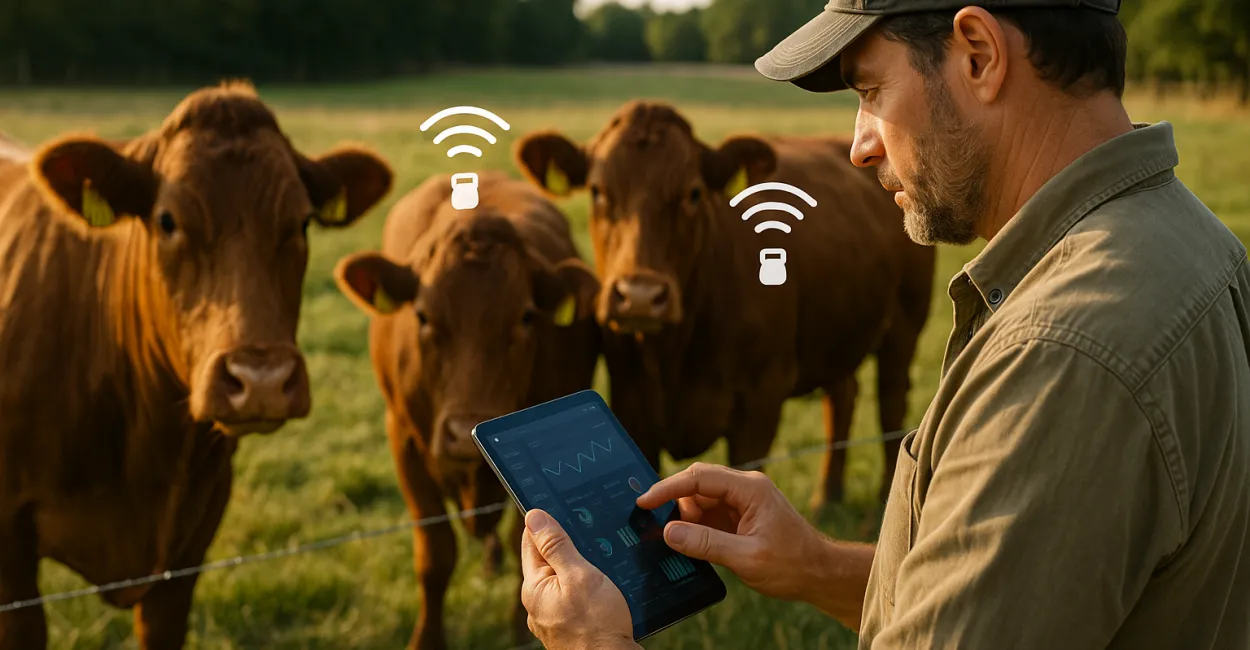
When tight margins meet unpredictable weather, livestock farming stops being an activity based on intuition and starts relying on technical decisions. Producers who regularly track weight gain, supplement intake, stocking rates, and reproductive performance can often adjust course before losses appear.

Technology has stepped in to do just that—not to decorate the farm with equipment, but to reduce errors, improve predictability, and make herd management more efficient. Sensors, electronic scales, management software, drones, and data analysis already help producers make more precise decisions about where to invest, when to sort animals, and what to adjust in their management practices.
What You Need to Know
- In modern livestock farming, good technology turns observations into useful data for day-to-day decisions.
- Real-time monitoring of weight, health, reproduction, and pasture reduces losses that would otherwise show up only at the end of the production season.
- Automation without a process won’t solve anything: expensive equipment without a routine for reviewing data and taking action becomes a stranded cost.
- The best returns often come from simple tools, such as electronic scales, individual animal identification, and well-maintained farm management software.
- Productivity grows more sustainably when management responds to what the herd shows, rather than what someone assumes from observation alone.
Livestock and Technology: How to Measure Better, Produce More, and Make Fewer Mistakes
Defining technology in livestock farming is simple: it means using tools, systems, and data collection and analysis methods to improve decisions about animal production. In practice, this ranges from electronic animal identification to platforms that combine weight, reproduction, feeding, and health data in a single dashboard.
The real benefit isn’t the equipment itself. It comes when the farm starts identifying patterns: which groups gain weight faster, which cows conceive on schedule, where pasture quality is declining, and when the cost per arroba—a Brazilian unit equal to 15 kilograms of carcass weight—starts climbing too high.
What separates a productive farm from one that’s merely busy is the ability to turn routine work into reliable data, and data into quick decisions.
What changes day to day
In practice, producers no longer have to rely solely on staff memory or scattered notes. When information is entered consistently and regularly, it’s easier to act before a problem turns into a financial loss.
This applies to both beef and dairy operations.
Where technology makes a real difference
The biggest gains usually come in four areas: reproduction, nutrition, animal health, and pasture management. These are areas where small mistakes can quickly add up.
For example, a delay in detecting heat can push the entire breeding season back.
Tools Already Part of the Daily Farm Routine
Not every innovation has to look futuristic. Some of the most useful solutions are built on long-established ideas, but offer more precise results. What matters is reliable measurement and ease of use for the team.
Electronic scales and individual identification
Without weight data, fine-tuning is impossible. An electronic scale shows whether animals are gaining weight as expected and helps producers sort groups more carefully. Combined with electronic ear tags or RFID, it makes it possible to track each animal’s progress, not just the group’s.
Farm management software
These systems organize purchasing, groups, vaccinations, reproduction, inventory, and production metrics. The problem is that many producers buy the software without building the discipline to enter the data. Without a routine, the reports lose their value.
Sensors, collars, and IoT
Internet of Things (IoT) solutions help monitor behavior, rumination, temperature, and movement. In dairy herds, this can provide early warning of heat stress and reproductive problems. In extensive systems, behavioral monitoring can also help identify sick animals before a person would notice.
Technical resources from Embrapa, Brazil’s agricultural research corporation, show how rural digitalization is becoming connected to genetics, management, and sustainability. IBGE, Brazil’s national statistics agency, publishes official data on livestock, production, and the structure of the country’s agricultural sector. For market and innovation context, it’s also worth following Embrapa Digital Agriculture, a division of Brazil’s agricultural research corporation.
Productivity Doesn’t Come from Equipment Alone

A common mistake is thinking that buying technology is enough to solve a production bottleneck. It isn’t. If basic management practices are poor, the equipment will only record the problem more precisely.
Technology works when there’s a routine for collecting and interpreting data and responding to it. Without that cycle, it just creates more data that gets forgotten.
What needs to be in place before you buy
- A clear production goal for each group, animal category, or system.
- Staff trained to record and interpret the data.
- A defined process for responding when a metric falls outside the normal range.
- Someone responsible for reviewing the information every week.
Where automation falls short
It falls short when a farm expects immediate results without changing the way it operates. It also falls short on properties without basic connectivity, preventive maintenance, or staff prepared to use the system. It’s not a one-size-fits-all solution: in very remote areas, offline or hybrid tools may still make more sense than fully connected platforms.
People who work in this field know the biggest waste isn’t just buying the wrong thing. It’s leaving an investment unused because no one takes responsibility for interpreting what was measured.
Read also: Drone Spraying: Revolutionary Technology or Passing Trend?
How Technology Supports Nutrition, Pasture Management, and Weight Gain
In beef production, feed is often the biggest expense. That’s why adjusting diets, forage, and supplements based on data is one of the most direct ways to improve margins. Instead of treating every group the same, the farm can respond to actual performance.
Precision nutrition
Frequent weighing, body condition scoring, and intake analysis help fine-tune protein, energy, and minerals. A group can be eating well and still not be converting feed efficiently enough. Without data, that can go unnoticed for weeks.
Pasture management
Drone imagery and satellite monitoring help identify degraded areas, gaps in ground cover, and the need to adjust stocking rates. This is especially valuable in rotational grazing systems, where the timing of moving animals into and out of a paddock determines the results of the cycle.
A real-world example
I saw a case where a feedlot’s weight gains were dropping because the group supposedly had “no appetite.” Once the data was compared, the problem turned out to be inconsistent feed delivery and delays in feeding during the hottest parts of the day. The solution wasn’t to replace the entire diet. It was to adjust management, timing, and feed delivery controls.
Better Control of Animal Health, Reproduction, and Traceability
Technology can pay off quickly in one area in particular: preventing losses from animal health problems. Delayed diagnosis is costly. And when it comes to reproduction, one missed cycle can throw off the breeding season and the sale of an entire group.
Near-real-time health monitoring
Monitoring temperature, behavior, and intake helps detect illness before clear symptoms appear. In larger herds, this shortens the time between the first sign of a problem and intervention—which can make the difference between treating one animal and containing an outbreak within a group.
Data-supported reproduction
Timed artificial insemination (TAI) protocols, bull use, pregnancy, and calving intervals are easier to track when records are centralized in one system. For dairy producers, this has a direct impact on production volume and consistency. For beef producers, it affects weaning rates and revenue predictability.
Recommendations from Brazil’s Ministry of Agriculture and Livestock, the federal agency responsible for the sector, help explain the industry’s health and regulatory requirements. Academic studies on traceability and animal welfare published by universities and research centers also reinforce that transparency has become part of competitiveness, not just compliance.
Sustainability and Efficiency Go Hand in Hand When You Measure
Today, talking about increasing production without discussing environmental impact means looking at only half the problem. The good news is that technology and sustainability aren’t at odds. When farms measure more accurately, they tend to waste less water, feed, time, and land.
What changes in the environmental equation
With greater efficiency per acre, pressure to clear new land decreases. This doesn’t eliminate environmental challenges, but it reduces waste. Data helps show where emissions, resource use, and poor feed conversion are actually occurring.
An important caveat
Experts disagree about the ideal pace of digitalization in agriculture. Some advocate rapid adoption; others warn of the risk of depending on platforms the farm hasn’t yet learned to manage. Both sides have a point. The best approach is usually to start with the most costly bottleneck and expand only after the routine demonstrates a return.
How to Choose the Right Technology for Your Farm
The right criterion isn’t “the most advanced.” It’s the tool that solves the right problem with the least disruption to daily operations. Integrated solutions may make sense on a highly organized farm. On another, a simple, reliable system may deliver better results.
| Need | Most useful tool | When it makes sense |
|---|---|---|
| Track weight gain | Electronic scale | When groups have uneven performance |
| Organize herd data | Management software | When information is scattered across notebooks and spreadsheets |
| Detect illness or heat earlier | Sensors and collars | When losses from delayed detection are recurring |
| Map pasture and the environment | Drones and satellite imagery | When the property is large and visual monitoring isn’t enough |
Practical decision-making criteria
- Start with the farm’s biggest economic bottleneck.
- Choose technology that matches the team’s skill level.
- Confirm maintenance, support, and connectivity requirements.
- Test the return on one group before expanding.
The Next Step Is Less About Buying and More About Measuring
Transformation in livestock farming doesn’t happen when producers fill the farm with screens and sensors. It starts when the operation uses information to quickly adjust management. Those who measure better negotiate better, plan better, and make fewer mistakes.
The smartest next step is to pick a specific problem—weight, reproduction, animal health, or pasture—and implement a solution that generates reliable data within 90 days. If the technology doesn’t shorten the path from observation to decision, it still isn’t doing its job.
Frequently Asked Questions
What’s the main advantage of technology in livestock farming?
The main advantage is turning routine work into reliable information for decision-making. This reduces waste, improves production oversight, and helps catch problems that might otherwise surface too late. On farms with tight margins, this benefit is often more valuable than automation itself.
Is it worth starting with expensive systems?
Not always. On many farms, the best return comes from simple solutions, such as electronic scales, individual animal identification, and well-used management software. The technology needs to match the farm’s operational maturity.
How can you tell if a digital tool is delivering results?
Compare metrics before and after implementation: average daily gain, pregnancy rate, mortality, cost per arroba, or production per cow. If the data isn’t changing management, the system is becoming just a record-keeping tool. Returns come when the team starts acting on the measurements.
Is digitalization suitable for every type of herd?
Yes, but to varying degrees. Intensive systems tend to make greater use of sensors and automation, while extensive operations may prioritize pasture monitoring, weighing, and group management. The strategy depends on the goals and available infrastructure.
What are the most common mistakes when adopting agricultural technology?
The most common mistakes are buying without first assessing the problem, failing to train the team, and not establishing a routine for reviewing the data. Another frequent mistake is trying to solve every problem at once. The safest approach is to start with the most costly bottleneck and expand later.
%%AGPTRH6%%
Artigos Relacionados
 Technology in Agriculture: Innovation Transforming Modern Farming
 Educational Innovation: Transform Learning With New Technology
 Agricultural Machinery: Technology and Modernization on the Farm
 AI in Agriculture: A Revolution Transforming Global Food Security
 Education and Artificial Intelligence: Transforming Learning in the 21st Century
 Healthcare Careers: Innovations, Challenges, and Opportunities
