

Women’s leadership in education encompasses women serving in leadership, coordination, and instructional management roles, with the ability to influence decisions and teaching conditions. It matters because it expands participation in decision-making and can bring different perspectives to school priorities. Its impact, however, depends on working conditions, autonomy, and available resources.
Women make up a large share of teaching teams in many settings, but their presence in decision-making roles is not guaranteed at the same rate. That’s why discussing women’s school leadership involves both individual skills and promotion policies, the division of responsibilities, and institutional support. The approach below organizes the topic into practical steps: understand the context, strengthen management practices, and create conditions that allow more women to lead without shouldering the cost of change alone.

Before planning changes
- Identify who participates in instructional and administrative decisions.
- Review how the institution selects, promotes, and evaluates its leaders.
- Look at how tasks, schedules, and caregiving responsibilities are distributed.
- Choose a specific school problem to guide the first steps.
Women’s leadership in education: definition and relevance
Women’s leadership in education means women participating in the management of teams, resources, and instructional decisions at educational institutions. In practice, it means influencing what a school prioritizes, how it supports students and staff, and how it monitors learning. Gender alone does not determine a leadership style; experience, training, delegated authority, and context all matter.
This definition includes principals, coordinators, university presidents, education secretaries, and women leading school projects or networks. Representation can broaden who takes part in decisions, but it does not, by itself, guarantee equitable management. To achieve that, institutions must give leaders meaningful access to budgets, information, and decision-making forums.
Equity in school leadership depends both on who holds positions and on the rules and resources that come with them.
Skills that support instructional decisions
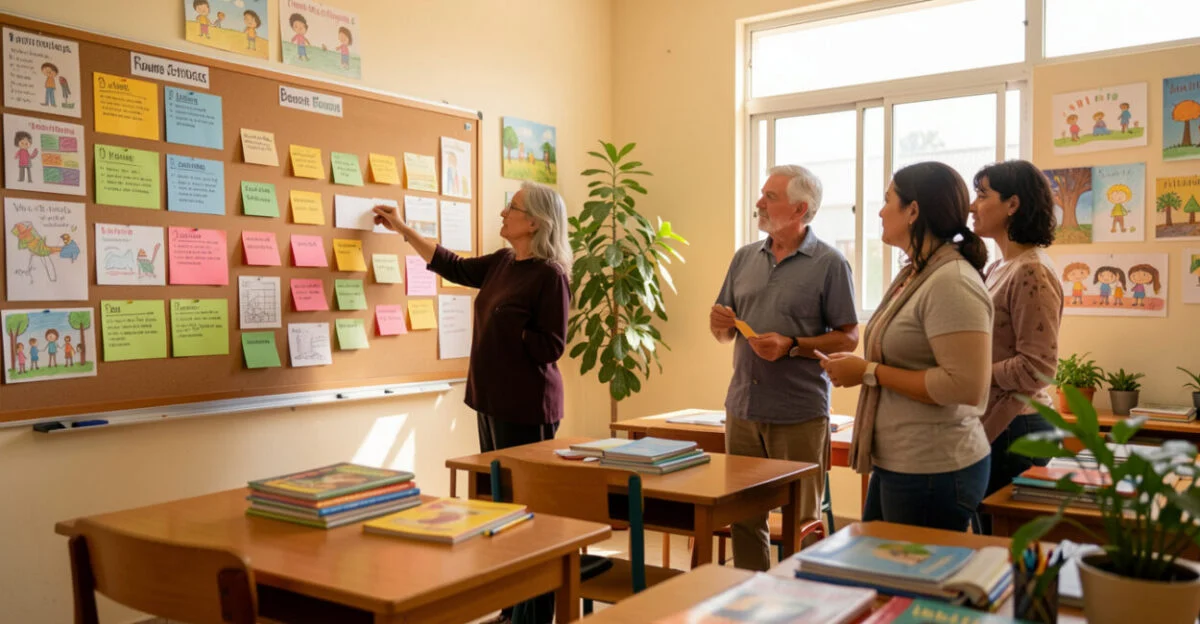
An effective educational leader combines an instructional vision with the ability to listen, set priorities, and be accountable. Listening and empathy can help leaders understand the needs of students, families, and staff, but these are skills people of any gender can develop—not natural traits shared by all women. One useful routine is to set aside time to hear from the team and then document what decision was made, what information informed it, and who is responsible for next steps. Without that follow-up, listening sessions can lead to frustration: people speak up but don’t know what happened to their input. Planning should also account for each class’s needs and the resources the school can actually mobilize.

Effects on staff, students, and learning

Management that gives people a voice and addresses barriers to access can make a school more responsive to different student groups. This may foster participation and belonging, but it does not mean that having a woman principal will necessarily improve grades or learning outcomes. Leadership shapes conditions that affect teaching, including how time is organized, teacher support, instructional monitoring, and resource use. Assessing students’ development can help a team revisit its practices, as long as it interprets the data alongside attendance information, learning conditions, and class profiles.
Read also: High mortgage rates: strategies for tackling the challenge
Consider a school where girls participate less in technology activities. School leaders can talk with students and teachers, review how groups are formed, and observe who gets opportunities to present projects. They can then monitor participation over time and adjust the approach if the gap persists. This does not assume there is a single cause; it investigates what is happening in that specific context.
UNESCO’s Global Education Monitoring Report on gender in education brings together analyses of inequalities and participation in the sector. Its data help put the topic in context, but they do not replace local investigation or, on their own, demonstrate a causal relationship between a leader’s gender and a class’s performance.


Barriers that limit women in educational leadership roles
Challenges for women in education include bias in how competence is assessed, unequal access to influential networks, excessive workloads, and limited representation in senior leadership. The mix of challenges varies by school system, grade level, and local conditions; policies that work in one institution may not solve the problem in another.
Barrier Effect on management Institutional response Unclear promotion criteria Appointments may depend on informal networks and repeatedly favor the same profiles. Publish requirements, selection steps, and evaluation criteria. Excessive caregiving and support duties Reduces time available for training and strategic decisions. Review how tasks are distributed and provide appropriate working conditions. Bias in judgments of authority The same assertive approach may be judged differently depending on who uses it. Apply consistent criteria and document performance evidence. Limited representation in decision-making forums Some community members’ experiences may be left out of school priorities. Expand participation in councils, committees, and planning processes.
Excessive workloads also affect work-life balance. Institutions should not treat this as an individual failure to stay organized: schedules, accumulating responsibilities, and a lack of coverage are management decisions that can be revisited.

Leadership practices that build team trust
Trust grows when a team understands how decisions are made and sees consistency between what management says and what it does. To sustain that trust, leaders can adopt regular practices rather than relying on one-off initiatives.
- Set a small number of instructional priorities and explain why they were chosen.
- Assign responsibilities with a clear scope, timeline, and level of autonomy.
- Document decisions and tell the team what has progressed, what has changed, and why.
- Use learning data alongside classroom observations and input from the community.
- Make the case for resources and timelines based on instructional needs.
A common mistake is asking for input without clarifying which decisions are open to change. This leads to token consultation and wears down the team. When inviting input, explain what can be decided collectively, who has the final say, and how proposals will be considered.
Mentorship and conditions for developing new leaders
Educational institutions support future women leaders when they combine training with real opportunities to take on responsibility. Courses and events can broaden their knowledge, but mentorship for women leaders is most valuable when it includes guidance on budgeting, negotiation, conflict management, and understanding internal policies.
Support networks provide a space to share experiences and discuss concrete problems without treating every difficulty as an individual failing. A mentor can help analyze a conflict or prepare a proposal, but the institution remains responsible for providing fair working conditions and promotion opportunities.
The OECD’s Education at a Glance 2024 report brings together comparable indicators on education systems and professionals in the sector. When interpreting these data, it is important to consider differences between countries and education levels; an international comparison does not automatically explain practices at a specific school.
How to advance gender equity in educational leadership
To advance equity, school systems and schools need to examine who moves into leadership roles, who gets opportunities to prepare for them, and who stays in them. Tracking only the number of women in leadership positions misses the quality of their participation: it matters whether they have authority, resources, and access to strategic decisions.
A good starting point is to audit selection processes, task assignments, and committee membership. If promotion criteria are already transparent, the priority may be reviewing workloads or expanding mentorship. If the rules are vague, it makes sense to document them before creating new programs. This helps avoid well-intentioned initiatives that fail to address the root cause of inequality.
The absence of women from decision-making roles may reduce the range of perspectives represented in school policy development, but it does not predict a single outcome for students. The effect depends on who participates, the actual authority attached to those roles, and whether the institution is open to considering different needs.
Frequently asked questions
How can you tell whether an equity initiative is working?
First, define what the initiative is meant to change, such as access to promotion processes or the distribution of responsibilities. Then track those factors over time and talk with the people affected. Observed changes do not, on their own, prove that a single action caused the outcome.
Can mentorship replace changes to promotion policies?
No. Mentorship supports individual development, while transparent criteria and fair processes address institutional barriers. The two measures can complement each other, but neither replaces the other.
What topics are useful in training for school leaders?
In addition to instructional management, training can cover budgeting, data analysis, negotiation, assertive communication, and leading meetings. The topics should reflect the role’s actual responsibilities and gaps identified by the institution itself, rather than assumptions about what women need to learn.
Artigos Relacionados
 Women’s Day in Education: Celebrating Progress, Challenges, and the Future of Empowerment in the Classroom
 Women’s Day Cards for Early Childhood Education: Creative Ideas, Inspiring Messages, and Fun Activities to Celebrate Gender Equality
 Entrepreneurship Education Transforms Schools and Communities
 Rural Education: Transforming Lives and Driving Development in Rural Communities
 International Women’s Day Coloring Pages: Inspiring Creativity and Artistic Expression Through Women’s Empowerment Themes
 Women’s Day Cards in Early Childhood Education: Celebrating Equality and Women’s Empowerment Through Art and Creativity
