
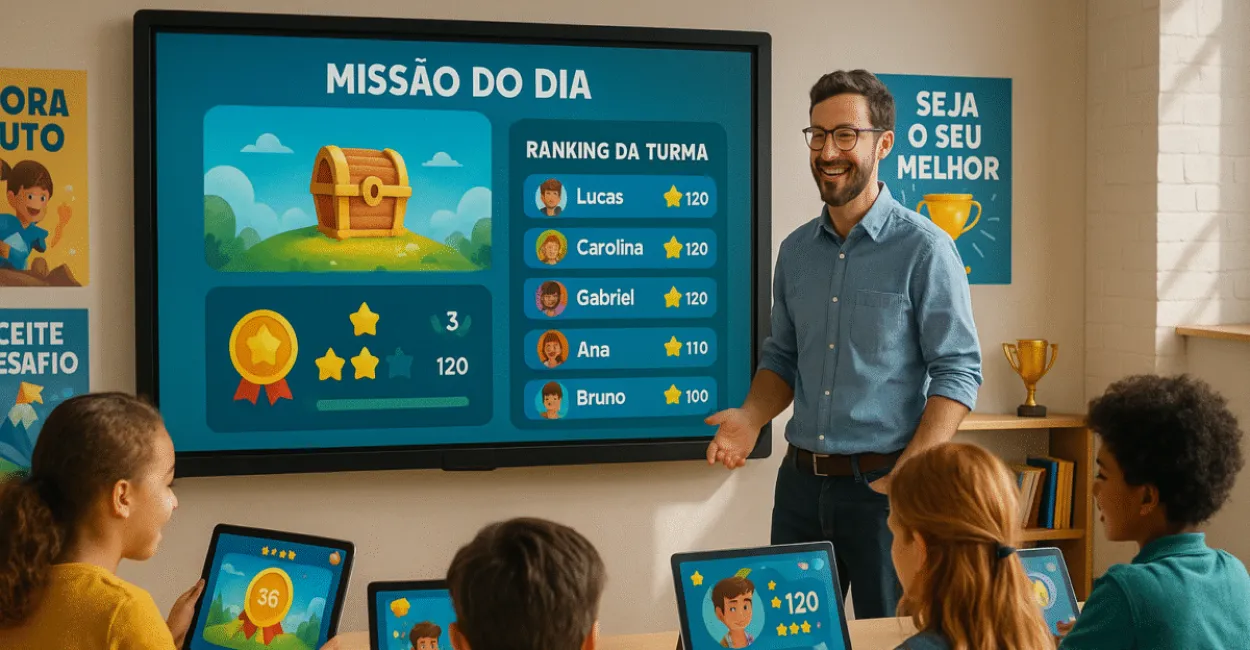
When a student takes part in an activity because they want to keep going—not because someone is making them—there’s a teaching strategy at work at the heart of the experience. Gamification uses game elements—such as goals, points, visible progress, challenges, and quick feedback—to increase engagement, persistence, and a sense of progress in non-game settings.

In education, that matters because the problem is rarely a lack of content; more often, it’s a lack of momentum. Attention wanes, students drop out, and learning loses pace. This article explores what educational gamification really is, where it works, where it falls short, and how to use it more thoughtfully in the classroom, online courses, and corporate training.
The Essentials
- Gamification isn’t about “making class fun”; it’s about shaping learning behaviors through goals, progress, and meaningful rewards.
- It works best when game elements support the learning objective—not when they’re just decoration that distracts from the content.
- Elements such as missions, immediate feedback, levels, and badges are more helpful when students can see real progress.
- The classic pitfall is rewarding empty participation: students rack up points but learn very little.
- In low-engagement settings, gamification can improve initial participation; for complex tasks, it needs to be paired with good instruction.
Gamification in Education: What Changes When Games Become Part of Learning
Technically, gamification is the use of game mechanics, dynamics, and design elements in non-game environments to influence behavior, engagement, and outcomes. Put simply, it turns learning into a journey with clear progress, well-paced challenges, and quick feedback.
That doesn’t mean making instruction childish. It means structuring the experience so students can see their progress. Instead of simply receiving a to-do list, they see missions, levels, checkpoints, and goals. In practice, this reduces the feeling of “I’m studying but getting nowhere,” which causes many people to lose steam along the way.
Common Elements
- Points: Track progress, but they need a teaching purpose—not just decorative value.
- Badges: Recognize specific milestones, such as completing a module or mastering a skill.
- Leaderboards: Encourage competition, but can discourage some students if used poorly.
- Missions: Organize tasks into sections with a beginning, middle, and end.
- Immediate feedback: Helps students adjust course quickly and reinforces learning.
What makes gamification effective isn’t the presence of points; it’s clear progress tied to a real learning goal.
The difference may seem subtle, but it changes everything. A point system without a purpose is just decoration. A system that shows tangible progress helps students sustain their effort, which is crucial for content that requires repetition, practice, and review.
Why Gamification Works—and When It Falls Short
The brain responds well to near-term goals, predictable rewards, and a sense of progress. That’s why gamification often boosts initial participation: it shortens the gap between effort and payoff. In just a few seconds, students can understand what they need to do and what they’ll get for completing it.
But there’s a limit. When external rewards become more important than learning, the system loses its effectiveness. This effect is well known in educational psychology: if students act only for the prize, their performance tends to drop when the prize disappears. That’s why extrinsic motivation needs to make room for autonomy, mastery, and purpose.
A useful reference on engagement and active learning can be found in studies and resources from the U.S. Department of Education, which link structured participation to improved retention in educational settings. The UNESCO has also long discussed the importance of strategies that make learning more inclusive, interactive, and meaningful.
Where It Tends to Work
- Reviewing content in short cycles.
- Training with clear goals and step-by-step progression.
- Classes with low initial participation.
- Online learning platforms that need to reduce dropout rates.
Where It Tends to Fall Short
- When content is already complex and cognitively demanding, but the system adds unnecessary layers.
- When leaderboards single out students who are struggling and create embarrassment instead of motivation.
- When the game becomes an end in itself.
Experts disagree on how much gamification actually affects final performance. In some settings, it improves attendance and completion; in others, the gains show up more in motivation than in grades. That doesn’t invalidate the strategy. It just means the goal needs to be defined before the design.
The Most Important Components of a Well-Designed Project

Anyone who works in this field knows that many initiatives fail because they rely on too much “flash” and not enough structure. The system needs to start with a simple question: What behavior do I want to encourage? Without that answer, points, badges, and leaderboards become window dressing.
A strong design usually combines three layers: a learning objective, an engagement mechanic, and evidence of progress. When all three align, students see the logic. When they don’t, students feel manipulated.
1. Learning Objective
This is the skill you want students to develop: problem-solving, concept review, deliberate practice, collaboration, or independence. This layer determines everything else.
2. Engagement Mechanic
This is the tool used to shape behavior: points, levels, timed challenges, storylines, missions, item collection, or a lives system.
3. Feedback and Progress
Students need to see where they are, what they’ve accomplished, and what they need to do to move forward. Without that, the experience loses its impact.
| Element | Purpose | Risk if used alone |
|---|---|---|
| Points | Track progress | Become meaningless tallying |
| Badges | Recognize milestones | Lose value if handed out too freely |
| Missions | Organize tasks | Feel mechanical without a real challenge |
| Leaderboards | Encourage competition | Discourage those at the bottom of the list |
In practice, the best design usually uses fewer elements, not more. A streamlined, coherent system almost always outperforms a platform packed with visual effects but lacking a learning strategy.
A Realistic Example for the Classroom or Online Learning
Imagine a math class with a high dropout rate. Instead of assigning unrelated exercises every week, the teacher organizes the course into five missions: assessment, basic practice, an intermediate challenge, practical application, and a final exam.
Each mission unlocks brief feedback, a completion badge, and a visual progress path. Students know exactly what they’ve done, what’s left, and what comes next. In this kind of setup, the class no longer feels like a series of disconnected tasks; it becomes a journey.
By the end of the semester, it’s not just the look of the course that has changed. The student’s attitude toward mistakes changes, too. They understand that making mistakes is part of the process and that every attempt counts as progress. This kind of structure is what sustains genuine engagement.
Educational gamification doesn’t replace teaching methods; it structures the experience so students can understand and follow those methods through to the end.
Here’s something few people admit upfront: this takes planning. If the teaching team doesn’t map out the objectives, timeline, class profile, and assessment methods, the project becomes expensive window dressing. Sites such as eLearning Industry offer practical analyses of course design and highlight this very problem in poorly structured initiatives.
How to Measure Whether the Strategy Is Working
Engagement can’t be treated as a feeling. If the approach is serious, it needs to be measured using objective indicators. Otherwise, the team may decide it “worked” just because students found it interesting during the first few weeks.
Metrics Worth Tracking
- Activity completion rate.
- Average time spent on the platform or task.
- How often students return to the content.
- Quality of responses, not just quantity.
- Dropout reduction over the course.
If the numbers go up but learning doesn’t improve, the format and content aren’t aligned. This happens more often than you might think. I’ve seen classes earn badges with ease but struggle to apply what they learned to new situations. The system encouraged activity, not mastery.
If you’re looking for scientific evidence, academic databases such as Google Scholar and reviews in education journals are worth consulting. A critical reading of these studies can help separate real effects from short-lived enthusiasm.
Best Practices to Keep Gamification from Becoming a Distraction
The golden rule is simple: the game should serve learning, never compete with it. If students remember the interface but forget the content, something has gone off track.
What to Do
- Use only a few elements at a time.
- Link every reward to a specific skill.
- Show progress clearly with visual cues.
- Adjust the challenge level to the class.
- Emphasize collaboration when competition starts to dominate.
What to Avoid
- Automatic rewards for every action.
- Permanent leaderboards that single out students who are struggling.
- Long missions with no feedback along the way.
- Childish themes in settings that call for a more mature visual style.
This method works well for ongoing learning and during the initial engagement phase, but it falls short when the goal requires uninterrupted, deep reflection. In that case, the mechanics need to be subtle—almost invisible.
The Next Step: Applying Gamification Thoughtfully
If you want to use gamification effectively, start small. Choose one class, one module, or a single behavior that needs more participation. Then design the journey from beginning to end, and only then add points, badges, or challenges.
The best approach is to test, measure, and adjust. Teams that try to roll out a complete system all at once often get bogged down in complexity. Those who start with a simple path quickly learn what drives real progress and what only grabs attention for a few days.
If the goal is to improve engagement, the smartest move is to test the strategy on a small scale before expanding it. In education, consistency matters more than an impressive first impression.
Frequently Asked Questions
Is gamification the same as making class fun?
No. A fun class may use humor or lighthearted activities, but gamification requires a structure built around goals, progress, and feedback. The aim isn’t to entertain; it’s to boost participation and keep students moving forward.
Does gamification work for every age group?
It works across many age groups, but the design varies considerably. Children respond well to storylines and visual rewards; teens and adults tend to respond better to autonomy, clear goals, and relevant challenges.
Which game elements are most helpful in education?
The most useful elements tend to be missions, immediate feedback, progress levels, and recognition of milestones. Leaderboards can work, but they need to be used carefully so they don’t discourage some students.
Does gamification automatically improve grades?
No. It can increase participation, consistency, and task completion, but any improvement in grades depends on the quality of the content, the teaching method, and the way students are assessed.
What’s the biggest mistake when using gamification?
The most common mistake is adding points and badges without tying them to a real skill. When that happens, students collect rewards but don’t develop what the activity was meant to teach.
Is gamification worth using in online courses?
Yes, and it can be especially useful in online learning because it helps reduce dropout rates and gives students a sense of progress. The key is to keep the experience simple, clear, and aligned with the content.
Artigos Relacionados
 Assessing Learning: Modern and Innovative Methods for Students
 Personal Routine: 12 Powerful Strategies to Boost Daily Productivity
 The Colleges of the Future: Preparing Students for Careers in an AI-Driven World
 Educational Metaverse: A New Frontier for Interaction and Collaboration in Learning Environments
 Business Intelligence Analyst: How to Turn Data Into Winning Strategies
 New AI and Its Innovative Applications
