
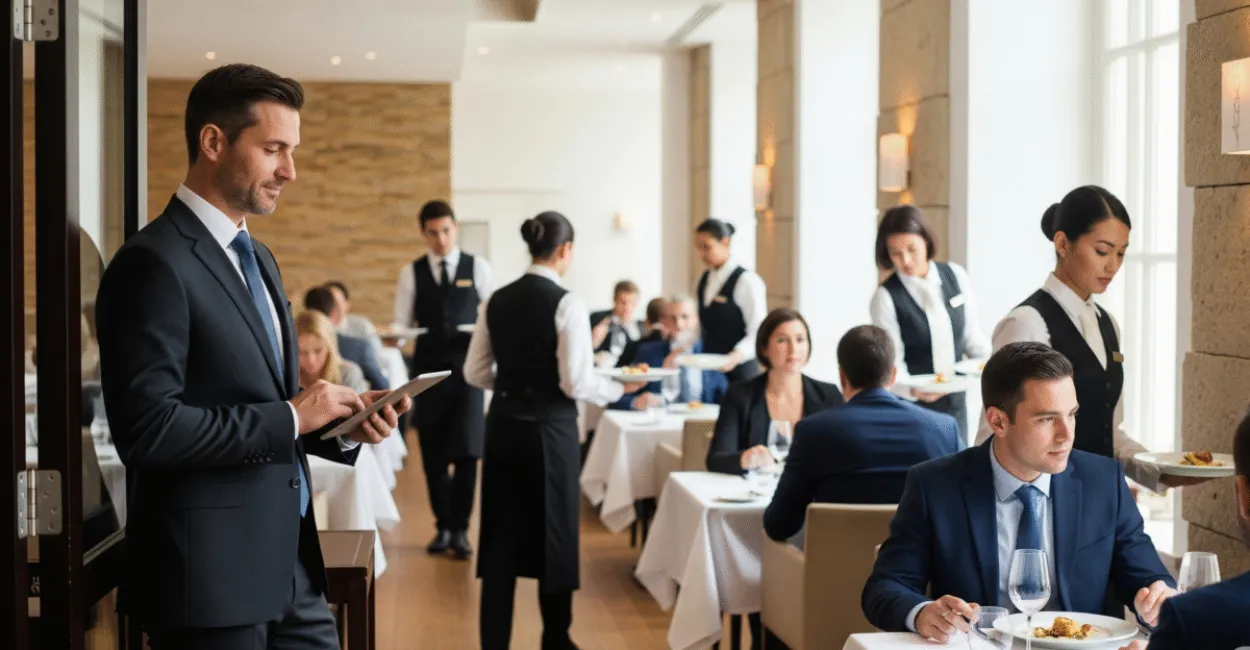
What makes a restaurant run well isn’t luck—it’s routine, leadership, and close attention to detail. The restaurant manager keeps the operation running smoothly, balancing customer service, staff, costs, inventory, and quality standards all at once.

In practice, the role calls for an operational mindset and business savvy. When management falls short, customers notice at the table; when it gets things right, hardly anyone does—because everything runs smoothly.
Below, you’ll get a clear picture of the duties, responsibilities, and qualities that define a good manager in the day-to-day work of running a restaurant.
Quick Summary
- A restaurant manager is responsible for daily operations, not just customer service.
- Staff management, inventory control, and financial oversight are inseparable parts of the job.
- A good manager reduces waste, organizes processes, and protects the customer experience without relying on improvisation.
- The role requires quickly spotting problems, communication that gets to the point, and a solid grasp of operational metrics.
- In restaurants with high employee turnover, leadership matters as much as technical skill—and sometimes even more.
Restaurant Manager: Day-to-Day Roles and Responsibilities
Technically speaking, a restaurant manager is responsible for coordinating front-of-house and kitchen operations, as well as administrative processes, to ensure consistent service, operational efficiency, and financial results. Put simply, they make sure the restaurant runs from end to end without letting quality slip along the way.
What’s Part of the Daily Operation
The workday often starts before opening and ends after closing. Checking reservations and staff schedules, receiving deliveries, inspecting cleaning, reviewing orders, and monitoring sales are all part of the job.
In many cases, the manager also serves as a link between the front of house, kitchen, cashiers, and suppliers.
Anyone who works in the industry knows that operations don’t break down because of one major mistake; they break down because of a string of small failures. A late order can lead to an item running out of stock. Poor training can lead to a complaint. A poorly planned schedule can create a crowded dining room and long waits.
Good restaurant management isn’t about constantly putting out fires; it’s about building processes that prevent them from starting.
Responsibilities That Can’t Be Overlooked
Core responsibilities include maintaining service standards, controlling costs, supervising staff, analyzing metrics, and ensuring the restaurant meets health and labor requirements. This means communicating with the accountant, staying aligned with the owner or business partner, and following local health department rules.
For more information on regulations and best practices in Brazil, consult sources such as the Anvisa portal, Brazil’s national health regulatory agency, which covers health regulations, and Gov.br, the Brazilian government’s portal for official services and guidance. For labor and business registration matters, the Ministry of Labor and Employment is also a useful resource.
How Leadership Shapes Operational Results
A restaurant can’t run well with a hands-off manager. Managers need to lead from the floor, correcting issues at the right time and preventing small conflicts from turning into ongoing friction. Here, leadership isn’t about what you say; it’s about being present, using good judgment, and being consistent.
Managing People in Practice
Creating schedules, assigning tasks, and giving staff feedback may seem simple on paper, but things can go wrong quickly when expectations aren’t clear. A new employee needs straightforward guidance. An experienced server needs autonomy with clear boundaries. The kitchen needs direct communication, without confusion or conflicting instructions.
I’ve seen restaurants where the problem wasn’t the food or the price, but the constant turnover in leadership. When every shift comes with a different set of instructions, the team loses its bearings. And without clear direction, there’s no consistency.
Training, Work Environment, and Retention
Training means more than teaching the menu. It covers professional conduct, service flow, response times, complaint-handling procedures, and even how to relay orders to the kitchen. A workplace with clear rules is more likely to retain good employees because it feels less chaotic.
One important nuance: not every leadership style works for every type of operation. A fine-dining restaurant calls for more formality and precision; a high-volume restaurant needs speed and discipline. The management approach should fit the business model, not the manager’s ego.
Financial Control Without Being Fooled by a Full Cash Register

High sales don’t necessarily mean a profit. It’s one of the most overlooked truths in the restaurant industry. A restaurant manager needs to track revenue, food cost (cost of goods sold, or COGS), average check, waste, and contribution margin to know whether the business is truly healthy.
| Metric | What It Shows | Why It Matters |
|---|---|---|
| COGS | Cost of ingredients sold | Shows whether menu prices can support the operation |
| Average check | Average amount spent per customer | Helps measure sales effectiveness and the sales mix |
| Waste rate | Losses from preparation, spoilage, or mistakes | Reveals problems with purchasing, inventory, or production |
| Staff productivity | Output relative to the number of employees | Helps prevent excessive labor costs during peak hours |
Where Money Commonly Slips Away
In day-to-day operations, money tends to disappear in predictable ways: unchecked purchases, inconsistent portioning, poorly tracked beverage inventory, promotions that haven’t been properly costed, and inventory losses. When the manager tracks these numbers consistently, the restaurant can build room to grow without relying on “good months.”
Data on Brazil’s food service industry can help put decisions in context. The IBGE, Brazil’s national statistics agency, publishes economic data that helps explain consumer spending and service-sector activity, while trade groups such as Abrasel, Brazil’s bar and restaurant association, offer industry-specific insights.
A restaurant can be packed and still lose money; the difference comes down to managing costs, waste, and pricing at the same time.
Processes, Standards, and Routines That Prevent Rework
A restaurant that relies on memory is always operating on the edge. Processes keep operations running: opening checklists, preparation standards, expiration-date checks, inventory counts, cleaning, and closing procedures. Without them, every shift starts from scratch.
Documenting the Basics Changes Everything
A good manager organizes the tasks that need to be repeated. This includes recipe and costing sheets, standard operating procedures, cleaning schedules, order checks, and problem-solving workflows. It may seem bureaucratic until the first day when someone calls out, demand is high, and everything still needs to keep moving.
When the Rules Don’t Work
Not every restaurant can apply strict processes in the same way. Smaller restaurants with lean teams need to adjust the level of formality to the size of the operation. Add too much complexity, and the process becomes paperwork no one uses. Simplify too much, and improvisation gets disguised as efficiency.
The Customer Experience Starts Before They Sit Down
Customers don’t judge only the food. They notice wait times, room temperature, staff tone, menu clarity, and how complaints are handled. The restaurant manager is responsible for the entire experience, even when a problem seems limited to a single interaction.
What Customers Notice Without Saying
- Long waits to be greeted in the dining room.
- Repeated order errors.
- Poor coordination between the front of house and kitchen.
- Inconsistent cleanliness in restrooms and common areas.
- Complaints met with defensiveness instead of a solution.
Here’s a real-world example: At a busy lunch spot, the team served good food but lost tables because the host stand became chaotic during the lunch rush. Simply reorganizing the entry flow, assigning someone to greet guests, and improving internal communication helped tables turn over faster without changing the menu. The problem wasn’t the food; it was the experience leading up to it.
Professional Profile and Skills That Make a Difference
Not every management skill matters equally. In a restaurant, three abilities tend to distinguish an average manager from an excellent one: making decisions under pressure, communicating clearly, and understanding operational numbers. Without them, the role becomes little more than overseeing the daily routine.
Technical and Interpersonal Skills
- Knowledge of service flow and customer service.
- Ability to interpret metrics such as COGS, average check, and waste.
- Proficiency in scheduling, training, and giving staff feedback.
- Ability to negotiate with suppliers and provide administrative support.
- A firm but courteous approach.
Education Helps, but It Doesn’t Solve Everything
Courses in culinary arts, hospitality management, business administration, and people management can be very helpful. Still, hands-on experience on the floor and in daily operations often carries a lot of weight. Employers value people who understand the reality of a busy restaurant, with pressure, noise, and little time to make decisions.
How to Tell Whether Management Is on the Right Track
Good management doesn’t need constant improvisation to look effective. You can see it in the results: less waste, fewer conflicts, more predictability, and returning customers. If the restaurant is always putting out fires, the problem is probably with the management structure, not an isolated incident.
Use a simple checklist to assess operations: Does the team know what to do without asking all the time? Do the numbers consistently add up? Do customers come back and recommend the restaurant? If the answer is “no” to more than one question, the manager needs to review processes, leadership, and controls together.
Next Steps
If you manage or work in a restaurant, the best next step is to assess three areas: people, processes, and money. Without all three, every improvement is just an isolated attempt. Start with the area causing the biggest losses today—usually scheduling, inventory, or service—and standardize it before expanding.
To improve in practice, review one metric each week, document one critical routine, and observe where operations most often get stuck. This kind of discipline is more valuable than making major changes without first identifying the problem.
Frequently Asked Questions
What does a restaurant manager do day to day?
They coordinate front-of-house operations, supervise staff, monitor inventory, track metrics, and make sure service meets established standards. They also help solve problems involving the kitchen, front of house, cashiers, and suppliers.
What’s the difference between a restaurant manager and a supervisor?
The manager is responsible for the operation as a whole and typically makes decisions with financial and strategic impact. The supervisor works closer to the front line, overseeing shift routines and addressing immediate issues.
Which metrics should a restaurant manager track?
The main ones are COGS, average check, waste, staff productivity, and revenue by time period. These numbers show whether the restaurant is selling well, spending too much, or losing efficiency.
Do you need specific education to become a restaurant manager?
There’s no single requirement for every situation, but education in culinary arts, business administration, hospitality management, or management can be very helpful. In practice, operational experience and leadership skills often matter as much as a degree.
What’s the biggest mistake a restaurant manager can make?
Trying to solve everything on the fly without processes. That leads to rework, friction with the team, and a loss of control over costs and service.
%%AGPTRH6%%
Artigos Relacionados
 Telemarketing Operator Roles and Responsibilities
 Key Responsibilities of an E-commerce Manager
 SEO Analyst: Roles and Responsibilities
 Digital Marketing Manager: The Complete Guide to Mastering the Role
 Purchasing Manager: Duties, Daily Work, Salary, and Job Openings
 Project Manager: A Complete Guide to Leadership and Success
