
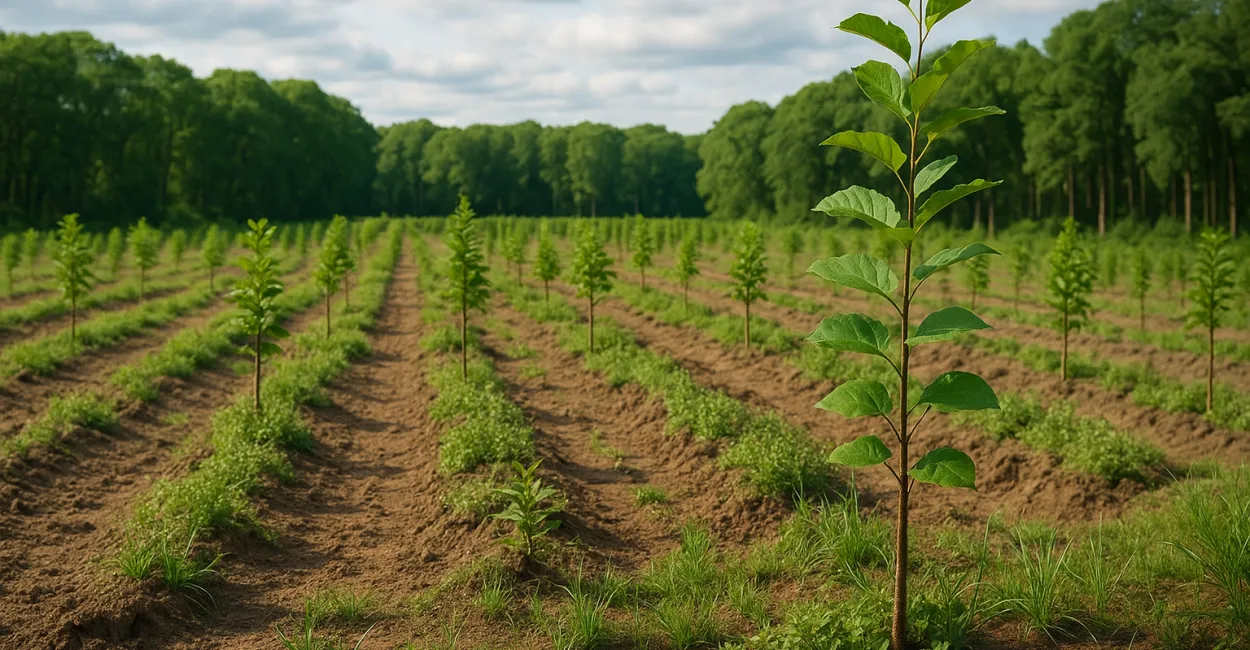
When an area loses its vegetation cover, it doesn’t simply “rest” on its own: the soil becomes compacted, water runs off faster, and biodiversity declines in a chain reaction. Reforestation is the planned reestablishment of native or adapted vegetation in degraded areas to restore ecological functions, reduce erosion, improve water cycles, and bring habitats back to life.

In practice, it involves much more than planting seedlings. A serious project requires site assessment, careful species selection, soil preparation, invasive grass control, and monitoring for years—not weeks.
This article explains how to plan, carry out, and evaluate a restoration program using technical criteria and measurable goals.
What You Need to Know
- Effective reforestation starts with assessing the site; without it, planting can become a recurring expense with low seedling survival.
- Heavily degraded areas call for active restoration with pioneer species, while less damaged areas may respond well to assisted natural regeneration.
- Soil, water, and control of plant competition matter more to early success than the raw number of seedlings planted.
- Well-designed projects help sequester carbon, reconnect ecological corridors, and reduce sediment loss in watersheds.
- Those who measure survival, growth, and canopy cover make better decisions than those who simply count plantings.
Reforestation and Degraded Land Restoration: What Changes in Practice
The key idea is simple: restoring vegetation means restoring ecological processes. Tree shade lowers soil temperatures, roots increase water infiltration, and leaf litter returns organic matter to the system. This matters on slopes, around springs, in Permanent Preservation Areas (APPs, protected areas under Brazilian law), and on land depleted by mining or intensive agriculture. Anyone who works in restoration knows that appearances can be misleading at first. An area may look green and still be in trouble if the species are unsuitable, the soil is still eroding, or natural regeneration has not been protected. That’s why a project needs to move beyond “planting trees” and focus on “restoring functions.”
A restoration project’s success depends not only on the number of seedlings, but on whether the area can once again sustain soil, water, wildlife, and ongoing regeneration.
Forest Restoration Does Not Mean Mass Planting
In many cases, the best solution is not to fill an area with seedlings. If the soil seed bank is still active and pressure from grasses and fire is moderate, assisted natural regeneration can produce better results at a lower cost.
But in mined or compacted areas, or where the topsoil has been removed, more intensive and carefully planned intervention is needed.
Site Assessment: The Step That Prevents Rework
Before digging holes, take stock of what’s there. The assessment guides planting density, species selection, soil amendments, and the risk of failure.
Without it, the project relies on guesswork and often pays for mistakes through replanting, high mortality, and poor vegetation cover.
What to Look for in the Initial Assessment
- Type of degradation: compaction, erosion, contamination, fire, sedimentation, or complete vegetation removal.
- Soil condition: texture, structure, pH, organic matter, and whether the topsoil is intact.
- Water sources and connectivity: proximity to springs, waterways, and forest fragments.
- Ongoing pressures: livestock, leaf-cutter ants, exotic grasses, and wildfire risk.
A good assessment combines a field visit with geospatial analysis. Tools such as satellite imagery, drones, and GPS help map small-scale variations across a site. Technical resources from Embrapa, Brazil’s agricultural research agency, are a useful reference for understanding the relationship between soil, vegetation cover, and restoration across different Brazilian biomes.
If the assessment overlooks compaction, competition from grasses, and drainage, planting is likely to fail even when the seedlings are high quality.
Native, Pioneer, and Successional Species: How to Choose Wisely

Species selection determines much of the outcome. In ecological restoration, the safest rule is to use species native to the biome and follow ecological succession: pioneer species create the conditions for others, early and late secondary species build structure, and late-successional species help create a more stable environment over the long term.
The Role of Each Group
- Pioneer species: grow quickly, tolerate sun and exposed conditions, and provide initial shade.
- Early secondary species: help close the canopy and increase structural diversity.
- Late secondary and climax species: establish once the microclimate has become milder.
A common mistake is choosing species based only on what’s available at the nursery. That may work on small projects with low environmental pressure, but it fails when the site requires species truly adapted to the local climate, rainfall patterns, and soil type. The right species for the Cerrado aren’t the same as those for the Atlantic Forest, and they shouldn’t be.
For guidance on species and planting systems, consult technical resources from Brazil’s Ministry of the Environment and Climate Change, a federal government agency, and studies by public universities on biome-specific restoration. The guiding principle should be ecological, not commercial.
Soil Preparation, Irrigation, and Early Protection: Where Projects Save or Lose Money
Early on, what undermines survival most isn’t “bad luck”—it’s poor management. Compacted soil restricts root growth, poorly installed seedlings suffer water stress, and exotic grasses compete for light and nutrients. In dry climates, the first 90 days determine much of a project’s success.
Measures such as targeted subsoiling, mulch, clearing vegetation around seedlings, supplemental irrigation, and protection from animals make a real difference. On smaller sites, emergency irrigation can save a project. For larger areas, the plan should reduce reliance on artificial watering from the start.
Measures That Improve Seedling Establishment
- Plant at the start of the rainy season.
- Control grasses and invasive vines in advance.
- Protect individual seedlings from ants and browsing animals.
- Apply fertilizer or soil amendments when soil tests indicate they’re needed.
- Replace failed seedlings in specific spots after the first field assessment.
The difference between an expensive project and an efficient one usually shows up in first-year maintenance, not on planting day.
Restoration Models: Natural Regeneration, Full Planting, and a Mosaic Approach
Not every site calls for the same strategy. There are three main approaches: assisted natural regeneration, active planting, and mixed models. The choice depends on the severity of degradation, the site’s land-use history, and whether nearby natural vegetation remains.
| Model | When It Makes Sense | Practical Limitation |
|---|---|---|
| Assisted natural regeneration | Seed banks and seed dispersers are present, and degradation is moderate | Requires strong control of fire, livestock, and invasive species |
| Full planting | The area is severely degraded, the soil is bare, or natural resilience is low | Higher cost and a longer maintenance period |
| Mosaic approach | Different sections of the same area respond in different ways | Requires more detailed technical planning |
There’s no one-size-fits-all formula. On some farms, letting nature take the lead with minimal support does the job. On others, especially after mining or landfill work, waiting for spontaneous regeneration wastes time and money. The best plan reflects the site’s history, not the latest trend.
Monitoring, Indicators, and Maintenance: How to Tell Whether It Worked
A project without monitoring produces a story, not results. The most useful indicators include seedling survival, growth in height and diameter, ground cover, canopy closure, natural regeneration, and reduced erosion. Along streams, it’s also worth tracking bank stability and the return of seed-dispersing wildlife.
Indicators Worth Tracking Regularly
- Survival rates at 3, 6, and 12 months.
- Percentage of ground covered by vegetation.
- Regrowth of native species on its own.
- Presence of invasive grasses and leaf-cutter ants.
- Need for replanting in each planting block.
A common field scenario illustrates why this matters: a crew installs a thousand seedlings on a hillside, photographs everything on planting day, and considers the job done. Three months later, most losses are along the drier edges and in compacted soil. When maintenance starts early—with clearing around seedlings, selective replanting, and runoff control—the project moves to a new level.
For data and public policies on vegetation, biomes, and environmental restoration, it’s also worth following publications from IBGE, Brazil’s national statistics agency, which help put land cover and land-use change into context.
Carbon, Biodiversity, and Connectivity: Benefits Beyond the Landscape
Reforestation’s value isn’t just about looking green. A well-restored area can capture carbon, reduce urban heat islands, protect waterways, and reconnect forest fragments. At the landscape scale, this improves gene flow, supports pollinators, and makes ecosystems more resilient to extreme events.
Ecological corridors play a decisive role in fragmented biomes such as the Atlantic Forest. They reduce isolation between wildlife populations and improve the chances that sensitive species will persist. In projects with climate goals, forest quality matters more than the raw number of trees.
Not every planted acre delivers the same climate benefits; diversity, permanence, and survival matter more than the initial number of seedlings.
Next Steps: From Plan to Fieldwork
If the goal is to truly restore an area, the next step isn’t buying seedlings. It’s putting together a plan with a site assessment, a clear objective, species selection, a maintenance schedule, and success indicators. Without that sequence, the risk of rework increases and the investment becomes less efficient.
The safest approach is to start small, measure results, and adjust the method before scaling up. For larger projects, that means dividing the area into planting blocks, testing species combinations, and using the response of the soil and vegetation as a guide. Those who validate a strategy in the field make better decisions than those who rely on spreadsheets alone.
Frequently Asked Questions
Is reforestation the same as ecological restoration?
Not exactly. Reforestation usually refers to restoring tree cover, while ecological restoration is broader and aims to recover ecosystem functions, including soil, water, wildlife, and natural processes. The two concepts overlap in many projects, but ecological restoration has a more comprehensive technical goal.
How long does it take for a reforested area to show results?
The first signs appear within months, such as seedlings taking hold and less exposed soil. A more stable ecological structure usually takes years to develop, depending on the biome, the degree of degradation, and management. Severely altered areas may require long-term monitoring.
Is it better to plant many species or a few carefully chosen ones?
The best approach usually combines diversity with ecological function. A few species may work in simple settings, but greater diversity improves the chances of withstanding pests, climate variation, and planting failures. The key is to use species suited to the site and its stage of succession.
Can degraded land be restored through natural regeneration alone?
Yes, but only under favorable conditions. When a seed bank is still present, forest fragments are nearby, and invasive species pressure is low, assisted natural regeneration can be effective. On highly exposed, compacted, or mined land, it’s often too slow to deliver consistent results.
What’s the biggest mistake in reforestation projects?
The costliest mistake is treating planting as the final step. In practice, success depends on maintenance, monitoring, and correcting problems during the first year and often beyond. Without that, mortality rates rise quickly.
%%AGPTRH10%%
Artigos Relacionados
 People Manager: 7 Effective Strategies
 Mental Health for Rising Professionals: Effective Strategies for Managing Stress
 Data Engineer: Strategies to Advance Your Career
 How to Write an Effective Argumentative Essay: A Complete Guide
 Educational Gamification: Innovative Strategies to Boost Student Engagement
 Business Intelligence Analyst: How to Turn Data Into Winning Strategies
