
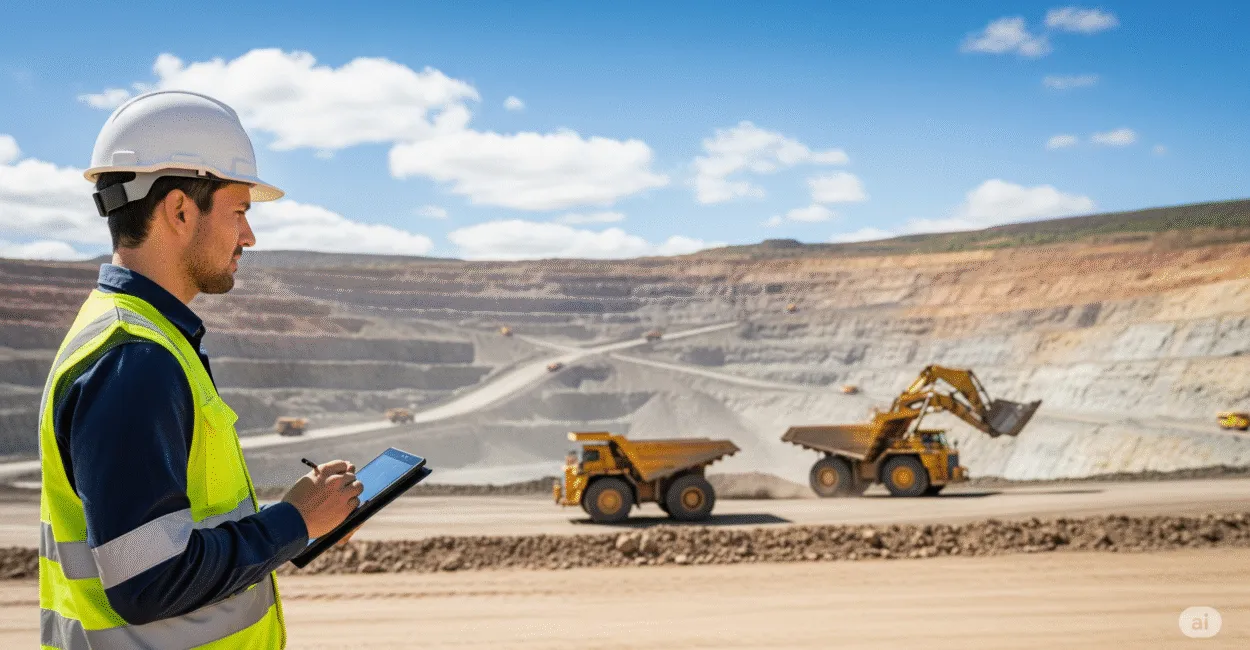
A well-run mine depends on more than powerful equipment and favorable geology. It takes technical decisions that balance production, safety, cost, and environmental impact—and that’s where the Mining Engineer comes in. This professional turns a mineral deposit into a viable, carefully planned, and safe operation. The career may be less visible than other engineering fields, but it is central to mine planning, mineral processing, ore transportation, land reclamation, and risk management. Here, you’ll learn what mining engineers do, what their education involves, where they work, how the job market values the role, and which career paths make a practical difference.

What You Need to Know
- Mining engineers determine how to extract resources safely, efficiently, and economically—not just how to “get ore out of the ground.”
- The work combines geology, mine planning, geotechnical engineering, mineral processing, and environmental management.
- The market rewards professionals who know technical software, can interpret operational data, and make decisions within real-world constraints.
- The profession requires a systems-level perspective: a change to the mine plan can affect costs, productivity, slope stability, and permitting.
- Not every mine needs the same skill set; surface mining, underground mining, and industrial minerals call for different expertise.
Mining Engineers and the Education Needed for Mining, Processing, and Planning
Technically, a mining engineer is an engineering professional who studies, designs, operates, and optimizes the extraction of mineral resources. In everyday terms, they determine how to extract resources from a deposit without compromising safety, productivity, or regulatory compliance.
What the Degree Covers
Coursework typically includes calculus, physics, chemistry, geology, surveying, rock mechanics, mine ventilation, drilling and blasting, mineral processing, and mineral economics. Many universities also introduce students to topics such as sustainable mining, mine waste, and environmental regulations.
CREA Registration and Professional Responsibility
Professionals in the field must manage professional registration and technical responsibility, generally through CREA, Brazil’s Regional Councils of Engineering and Agronomy. This is more than a bureaucratic formality: in mining, a design error can cause an accident, production losses, or a regulatory shutdown.
In mining, a mine plan isn’t just a pretty design in software; it’s the difference between controlled production and improvising in the field.
For an institutional overview of the profession, see the Brazilian government’s official portal for undergraduate engineering programs and the education guidelines published by MEC, Brazil’s Ministry of Education. It’s also useful to follow industry references at institutions with a strong track record in the field, such as UFMG, the Federal University of Minas Gerais, which has a significant body of research in engineering and geosciences.
Key Areas of Work in Modern Mining
The field goes far beyond the traditional image of a mine. In practice, professionals move between field sites, offices, processing plants, and planning rooms. People in the industry know that the biggest challenge isn’t “knowing the theory”; it’s combining data on the deposit, operations, and safety to make sound decisions.
Surface and Underground Mining
In surface mining, the focus is on benches, slopes, sequencing, and haulage. Underground mining involves ventilation, ground support, access, ore dilution, and geomechanical controls. These environments follow very different principles, and the wrong approach can be costly.
Mineral Processing
After extraction, the ore still needs to be concentrated or separated. This is where crushing, grinding, flotation, classification, and thickening come in. In many projects, a small improvement in processing is worth more than expanding the mining face.
Mine Waste Management and Environmental Reclamation
This area has taken on enormous importance following accidents and regulatory changes in Brazil. Professionals may work on waste piles, tailings dams, dry stacking, drainage, and mine closure plans. It’s no longer a secondary concern: today, it affects a company’s reputation, permits, and ability to keep operating.
What separates an efficient operation from an expensive one isn’t just the amount of ore moved—it’s the quality of technical decisions at every stage of the process.
Skills Employers Actually Look For

A degree helps, but it isn’t enough. Employers value people who can interpret grade variability, slope stability, production curves, and plant bottlenecks without getting lost in abstractions. In mining, a good spreadsheet can be just as valuable as sound judgment in the field.
Essential Technical Skills
- Mine planning with a short-, medium-, and long-term perspective.
- Ability to read maps, geological cross-sections, and drilling data.
- Knowledge of software such as Deswik, Datamine, Vulcan, Surpac, or similar tools.
- Understanding of geotechnical engineering, ventilation, and operational safety.
- Knowledge of costs, CAPEX, OPEX, and productivity.
Interpersonal Skills That Make a Difference
Clear communication, consistent work habits, a strong sense of priorities, and the ability to work through issues with multidisciplinary teams all matter. Mining engineers rarely work alone; they need to communicate with geologists, safety technicians, operators, metallurgists, and managers.
Professionals with advanced Excel skills, the ability to interpret performance indicators, and data analysis experience can advance quickly. The same goes for those who know how to document decisions and maintain an audit trail, because in mining, technical justification matters as much as results.
What a Typical Day Looks Like in the Field, Office, and Plant
There’s a big difference between the romanticized image of mining and the reality of the job. On a typical day, a professional might start by reviewing production metrics, head out to inspect a mining face, and finish by discussing the operating sequence with the planning team. It’s not always glamorous; there’s pressure, deadlines, and responsibility.
Read also: Geologist: A Complete Guide to the Career, Education, and Job Market
I’ve seen cases where a simple mismatch between the geological map and the active mining face affected plant output for weeks. That happens because mining is a connected system: if mining delivers ore that’s out of specification, processing suffers; if geotechnical controls fail, production stops.
A Brief Operations Story
At a crushed-stone mine, the team was losing production without realizing why. The problem wasn’t the primary crusher, but the particle size produced during blasting. After adjusting the drill pattern and explosive charge, output increased again without a major investment. Gains like this are common in the field: a good technical decision often costs less than a rushed expansion.
Leia também: Desarrollador Full Stack: guía completa
For more on regulation and oversight, see the National Mining Agency (ANM), Brazil’s mining regulator, which publishes regulations and data for Brazil’s mineral sector. This is essential because mining cannot operate without permits, authorizations, and operational controls.
Job Market, Salaries, and Where the Opportunities Are
The job market for mining engineers follows the mining cycle, which fluctuates with global demand for iron ore, gold, copper, phosphate, nickel, and other mineral resources. In general, regions with a strong mining presence have more technical openings and competitive salaries, but they may also require greater flexibility for field rotations and travel.
| Area | Type of Work | Most Valued Profile |
|---|---|---|
| Mining | Planning and operations | Spatial reasoning and production control |
| Mineral processing | Industrial processes | Ability to interpret metrics and optimize plants |
| Geotechnical engineering | Stability and risk | Knowledge of rock mechanics and monitoring |
| Environment | Permitting and closure | Regulatory knowledge and liability management |
The highest salaries tend to be found at larger operations and in roles involving technical responsibility or leadership. Still, experts disagree about how quickly compensation grows: at some points, field experience matters more than credentials; at others, graduate education and specialization in software or geotechnical engineering can make an immediate difference.
For occupational trends and a broader view of the job market, a useful source is IBGE, Brazil’s national statistics agency, especially its data on extractive industries and related occupations.
Specializations That Can Accelerate Your Career
Not every mining engineer follows the same path. Some move closer to operations, while others shift into consulting, research, asset management, or environmental compliance. The key is to choose a specialization that solves a real industry problem, rather than simply accumulating certificates.
Fields That Can Open Doors
- Geotechnical engineering applied to mining.
- Mine planning and block modeling.
- Mineral processing and process optimization.
- Tailings dam and mine waste management, and mine closure.
- Mine safety and risk analysis.
When Graduate Education Pays Off
Graduate education makes the most sense when it fills a specific technical gap. For example, a recent graduate who wants to work in mine planning can benefit from training in modeling and software, while someone interested in environmental management can benefit from courses in permitting, land reclamation, and environmental liability audits.
A common mistake is pursuing a specialization without a clear strategy. The industry recognizes education, but puts more value on professionals who can demonstrate operational improvements: less dilution, better metallurgical recovery, lower costs per ton, or reduced exposure to geotechnical risk.
Real Challenges of the Profession—and What People Don’t Always Tell You
This work involves variables that can change quickly: ore quality, weather, equipment wear, fleet availability, regulatory pressure, and relationships with nearby communities. That’s why the profession requires the confidence to make decisions under uncertainty. The manual doesn’t cover every situation; sometimes data is incomplete, deadlines are tight, and the best solution needs to be technically justified.
The Most Common Challenges
- Working with incomplete geological data or limited sampling.
- Balancing production with safety and environmental requirements.
- Responding quickly to slope stability issues, rain, or mechanical failures.
- Explaining technical decisions to nontechnical leaders.
The Less Visible Side of the Profession
There’s also the human pressure. In mining, a bad decision doesn’t just cause financial losses; it can put people at risk. That changes the weight of every choice. Professionals learn early that “making it work” isn’t always acceptable when operations depend on slope stability, ventilation, explosives, and tailings controls.
In mining, trust doesn’t come from talk; it comes from reliable data, regular inspections, and decisions that stand up to an audit.
How to Enter the Field and Build Credibility
The best way to get started is to combine a strong academic foundation with hands-on experience. An internship at a mine, mineralogy lab, consulting firm, or industrial plant can make a real difference. A résumé without field experience often carries less weight than a record of supervised work and problems solved.
It also helps to study mining regulations, safety standards, and real technical reports. Knowing the concepts isn’t enough; you need to see how they appear in a feasibility study, operations report, closure plan, or internal audit. Credibility in this career comes from the ability to do the math, understand risk, and communicate clearly.
Next Steps
If you’re serious about considering this career, the best next step is to assess your fit with three areas: fieldwork, technical analysis, and operational responsibility. Then look for an internship, talk with people in the field, and follow data from ANM, CREA, and universities with a strong geosciences program. This will help you avoid romanticizing the profession and see clearly whether mining is a good fit for you.
Frequently Asked Questions About Mining Engineers
What is the primary role of a mining engineer?
The primary role is to plan and coordinate the extraction of mineral resources safely, efficiently, and economically. This includes selecting mining methods, overseeing processing, managing risks, and supporting technical decisions throughout the operation.
Is mining engineering very different from geology?
Yes. Geology studies the formation, composition, and structure of a mineral deposit; mining engineering turns that knowledge into a project and an operation. The fields complement each other, but their focus is different.
Where can mining engineers work?
They can work for mining companies, consulting firms, engineering companies, regulatory agencies, processing plants, and environmental reclamation projects. There are also opportunities in planning, geotechnical engineering, safety, and tailings management.
Do you need to enjoy math to work in this field?
Yes, because the degree program and day-to-day work involve calculus, statistics, modeling, and data analysis. But the most important thing is knowing how to apply math to real-world challenges involving production, risk, and cost.
Which regions have the strongest job markets?
Regions with a strong mining presence tend to have more opportunities, particularly areas associated with iron ore, gold, copper, nickel, and phosphate production. Still, consulting firms and mining technology companies also hire in urban hubs.
Is graduate school worth it?
It’s worth it when the specialization aligns with the kind of job you want. For mine planning, geotechnical engineering, mineral processing, or environmental work, a well-chosen graduate program can help you move into more technical or leadership roles faster.
%%AGPTRH8%%
Artigos Relacionados
 Systems Engineer: A Complete Career and Job Market Guide
 Naval Engineer: A Complete Guide to the Career and Job Market
 Forest Engineer: A Complete Career Guide and Job Outlook
 Complete Guide to Becoming a Laboratory Technician: Career, Training, and Job Market
 Software Engineer: A Complete Guide to Building a Successful Career
 Physical Education Teacher: A Complete Guide to Training and Career Paths
