
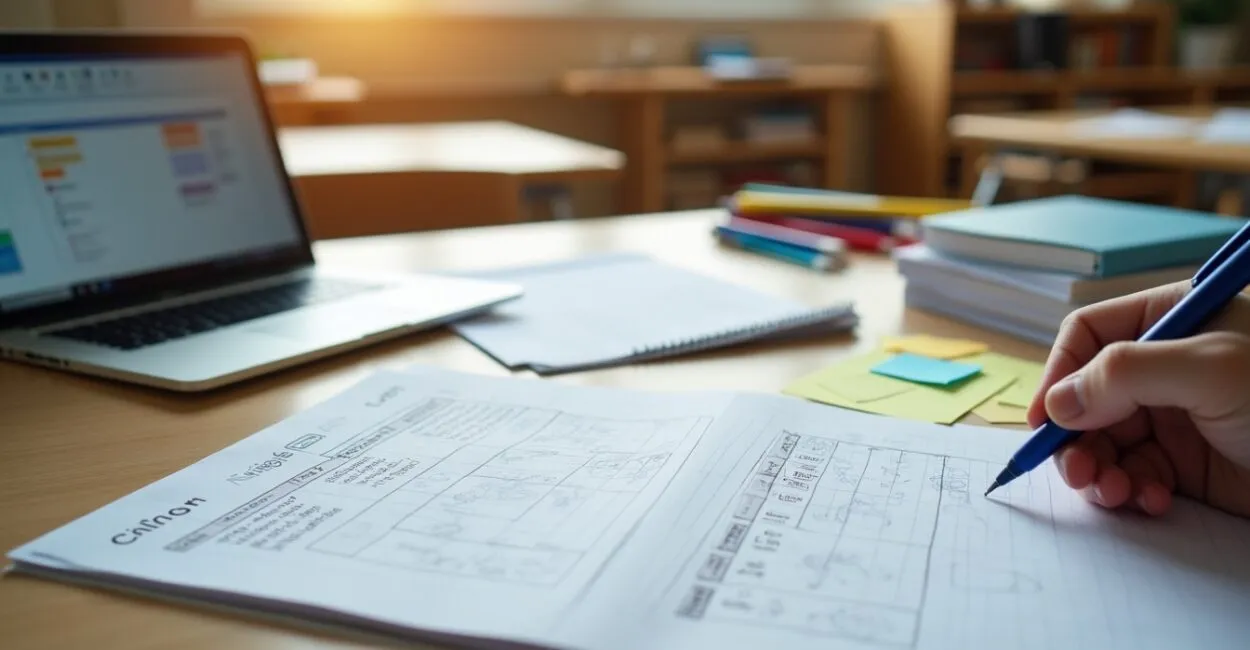
Lesson planning is the strategic organization of goals, content, teaching methods, and assessments to ensure instruction is coherent, effective, and focused on student learning. It matters because it turns intentions into measurable outcomes and makes the best use of instructional time. To get started, identify learning goals, success criteria, and available resources for each class session. In this article, you’ll find key concepts, practical steps, comparisons of teaching methods, tools, benefits, limitations, tips, and a comprehensive FAQ about lesson planning.
Without a clear plan, activities and assessments can become misaligned and content can feel scattered, reducing student retention and progress. By structuring learning sequences, teachers set clear goals, choose appropriate methods, and track progress using objective indicators. We’ll cover how to build learning sequences, use active learning methods, measure results, and adjust plans based on learning data.

Essential Concepts in Lesson Planning
Definition and Key Elements
Lesson planning involves combining goals, content, teaching strategies, and assessment criteria to support learning. Goals are observable, measurable targets; content covers the knowledge and skills students will work on; strategies explain how instruction will be delivered; and assessment checks whether the goals have been met. Bringing these elements together ensures curricular and practical coherence for each class session.
A good plan takes into account students’ needs, available time, and resources, including technology, materials, and spaces. It also allows for flexibility to address unexpected situations or special educational needs. Clear success criteria make it easier to communicate expectations to students and their families.
Documenting plans makes reflection and continuous improvement easier. Digital tools such as LMS platforms and spreadsheet templates streamline planning and progress tracking, making plans easy to reuse and share with colleagues.
Related Terms and Practical Vocabulary
Lesson-planning vocabulary includes terms such as learning objective, skills, competencies, learning sequence, assessment activities, and differentiated instruction. Understanding these terms helps connect goals to practice: for example, an “objective” describes what students should demonstrate, while an “assessment criterion” explains how that demonstration will be evaluated.
Using consistent language in lesson plans makes it easier for teachers to collaborate and align their work with official documents, such as curricula and competency frameworks. It also helps with documenting evidence and reporting on learning.
Incorporating educational technology terms such as “LMS integration,” “multimedia resources,” and “synchronous/asynchronous activities” expands the options available and makes it possible to plan more varied and inclusive learning experiences.
Essential Components for Every Class Session
Each class session should include a topic title, specific objectives, planned activities, required resources, estimated time, and assessment criteria. This basic outline ensures that someone else can teach the lesson, even if they didn’t create it. Including opening prompts, opportunities to build understanding, and formative assessment makes the session more meaningful.
It’s essential to plan alternatives for students with different learning needs and paces. The plan should include tasks at varying levels, individualized support, and accessible resources. It’s also helpful to set performance targets for each time block.
Recording observations after class lets teachers adjust upcoming sessions based on evidence, closing the planning-action-assessment cycle. This habit improves effectiveness and supports continuous improvement.
- Clear, measurable objectives
- Structured learning sequence
- Defined assessment criteria
- Allocated resources and time
- Differentiation for diverse needs
Practical Steps for Lesson Planning
Identify Objectives and Success Criteria
Start by defining what students should know or be able to do by the end of the lesson. Well-written objectives are specific, observable, and measurable. Then determine the success criteria: indicators that show whether the objective has been met, such as performance levels or simple rubrics.
This step guides the choice of activities and assessment tools, preventing a mismatch between content and assessment. Aligning objectives with the curriculum and students’ needs ensures relevance and steady progress.
Document objectives and criteria in the plan so students understand what’s expected and can assess their own performance, promoting independence.
Plan Activities and Resources
Select teaching methods and activities that help students meet the stated objectives. Vary your approach with short lectures, hands-on exercises, group work, case studies, and digital activities. Choose appropriate resources, such as texts, videos, slides, and interactive tools.
Allocate time to each stage—opening, development, and wrap-up—and list the materials you’ll need. Plan accommodations for students with disabilities and alternatives in case resources aren’t available.
Consider the progression of learning: start with activities that activate prior knowledge, move on to building new knowledge, and finish with application tasks and formative assessment.
Teach the Lesson and Monitor Progress
During the lesson, look for signs of learning and adjust the pace as needed. Use brief formative assessments—quizzes, targeted questions, and observations—to gauge understanding in real time. This information helps you decide whether to review concepts or move on.
Record performance evidence and feedback to guide future instruction. Digital tools make it easier to collect data and track individual and group progress.
At the end, take a moment to reflect on what worked and what needs to change for the next class. This iterative cycle makes lesson planning more effective throughout the semester.
- Set clear, measurable objectives
- Choose activities aligned with the objectives
- Select resources and materials
- Monitor progress and make adjustments
Comparing Lesson Planning Methods

Traditional vs. Active Learning Models
Traditional models favor a teacher-centered sequence of lectures and exercises, while active learning methods—such as flipped classrooms and problem-based learning—put students at the center of the process. Each approach affects planning time, required resources, and the types of assessment used.
Active learning methods often take more time to plan and require more materials, but they can boost engagement and retention. Traditional models require less initial preparation, but may result in less student participation if they aren’t adapted.
The right choice depends on the objectives, available resources, and class profile. Combining elements of both approaches can maximize results by balancing efficiency and engagement.
Competency-Based Planning
Competency-based planning focuses on observable performance and combines knowledge and skills to solve real-world problems. This method requires clearly defined criteria and contextualized activities that help students apply what they’ve learned in real-life settings. In practice, it calls for authentic assessments and longer projects.
When planning around competencies, teachers connect cross-cutting goals, such as communication and critical thinking, with subject-area content, supporting interdisciplinary learning. Tracking progress by competency also makes reporting and instructional accountability easier.
This approach tends to make instruction more relevant, though it requires more coordination among teachers and time for ongoing professional development.
Adapting Plans for Remote and Hybrid Learning
For remote learning, plans need to specify synchronous and asynchronous formats, deadlines, platforms, and accessible resources. Hybrid learning requires balancing in-person activities with online assignments while ensuring consistency across both settings. Clear instructions and effective time management are essential.
Video conferencing tools, online quizzes, and content repositories should be built into the plan, along with accessibility guidance. Monitor digital engagement using platform metrics to identify students who may be falling behind.
Flexibility and backup resources—for example, materials available as both PDFs and videos—help address technical problems and maintain continuity of instruction.
| Method | Pros | Cons |
|---|---|---|
| Traditional lecture | Easy to implement, minimal preparation | Less active student engagement |
| Flipped classroom | More participation and application | Requires advance materials and student accountability |
| Problem-based learning | Develops critical thinking | More complex to plan and assess |
| Competency-based planning | Focuses on real-world performance | Requires interdisciplinary coordination |
Benefits of Lesson Planning
Improved Coherence and Learning Sequences
Lesson planning ensures that objectives, content, and assessments align, reducing detours and repetition throughout the semester. This creates a logical progression of concepts and makes it easier to connect class sessions, helping students build learning cumulatively and securely.
With well-structured sequences, teachers can anticipate prerequisites and create activities that reinforce prior knowledge before introducing new material. The result is better retention and greater clarity for students.
Curricular coherence also makes instructional adaptations and collaboration among teachers easier, strengthening teaching practice as a whole.
More Efficient Use of Time
A well-designed plan makes better use of class time by avoiding delays caused by poorly planned transitions or unclear instructions. Setting time limits for each stage helps teachers cover essential content without sacrificing opportunities to reinforce learning.
According to the Brazilian Ministry of Education (MEC), well-planned classes have up to 15% more effective learning time than improvised lessons (Source: MEC). Effective time management also reduces teacher stress and improves the classroom environment.
Planning ahead also helps teachers prepare materials and logistics, reducing unexpected problems and making lessons more productive.
Promotes Formative Assessment
When objectives and criteria are clearly established, formative assessment becomes part of the routine and helps guide immediate instructional adjustments. Frequent feedback helps students refine their study strategies and teachers personalize instruction.
According to OECD studies, consistent use of formative assessment improves scores on standardized tests by an average of 10–12% (Source: OECD). This points to a direct impact on learning when plans include regular check-ins.
Formative assessment also strengthens students’ ability to evaluate their own learning and improves communication between schools and families, increasing engagement in the educational process.
- Improves curricular alignment
- Makes better use of class time
- Supports ongoing feedback and timely interventions
- Provides greater clarity for students and families
- Makes collaboration among teachers easier
Limitations and Challenges in Lesson Planning
Time Constraints and Workload
Teachers often report not having enough time for in-depth planning because of administrative workloads and the number of classes they teach. Creating detailed plans and materials requires extra hours, which may not be feasible without institutional support.
Time constraints can affect the quality of planning and lead to ready-made solutions or repeated activities, limiting instructional innovation. School policies that set aside time for collaborative planning can help address this issue.
Using standardized templates and shared repositories reduces preparation time without sacrificing the quality of lesson plans.
Infrastructure and Unequal Access to Resources
Limited infrastructure, including classrooms, devices, and internet access, can restrict activities that rely on technology. This creates disparities between classes and means plans need to include non-digital alternatives to ensure inclusion.
Without investment and maintenance policies, many innovative strategies remain on paper. Reviewing available resources in advance is essential for realistic, workable planning.
When resources are limited, prioritize activities that require few materials and focus on transferable skills, such as critical thinking and problem-solving, which don’t depend entirely on technology.
Resistance to Change and Insufficient Training
New teaching methods require ongoing training and support. Without it, teachers may resist change because they lack confidence or time to learn new practices. This limits the use of more effective approaches.
Investing in professional development, mentoring, and communities of practice encourages the gradual adoption of new ideas and improves results. Training should be practical, relevant to teachers’ contexts, and supported by concrete resources.
A realistic plan includes training and pilot phases, reducing friction and increasing the chances that instructional changes will succeed.
- More time required for preparation
- Unequal access to technology
- Need for ongoing professional development
| Approach | Advantages | Disadvantages |
|---|---|---|
| Detailed planning | Greater coherence and predictability | More preparation time |
| Flexible planning | Adapts to unexpected situations | Less documentation detail |
| Collaborative planning | Shares effective practices | Requires coordination and time |
Practical Tips and Best Practices for Lesson Planning
Create a Reusable Template
Create a standard template with fields for objectives, duration, activities, resources, assessment criteria, and accommodations. A template reduces planning time and ensures that essential items aren’t overlooked. Store digital versions that are easy to access and update.
Use clear categories and predefined items to speed up writing the plan. For example, divide lessons into 10–15-minute blocks to make it easier to manage class time. Templates also support collaboration among instructional team members.
Review and improve your template based on evidence gathered after lessons so it becomes more efficient and better aligned with students’ needs.
Use Data to Guide Adjustments
Track performance using formative assessments and engagement indicators. Objective data can reveal which topics need to be revisited and which students need support. Digital tools can generate automatic reports, making analysis faster.
According to UNESCO research, schools that regularly use learning data see improvements of up to 8% in average performance (Source: UNESCO). Use this information to adjust content and strategies in future plans.
Schedule regular review periods to analyze collected data and systematically update learning sequences.
Encourage Collaboration and Peer Review
Share plans with colleagues to get feedback and adapt successful practices. Collaborative planning broadens teachers’ instructional toolkit and reduces individual workloads. Regular peer observations and co-planning strengthen teaching practices and support curricular alignment.
Set aside time for regular professional learning meetings and use shared platforms to store materials and plans. A collaborative culture also encourages innovation and support among teachers.
Encourage teachers to share assessments and results so instructional adjustments are based on evidence rather than subjective impressions alone.
- Standardize reusable templates
- Base decisions on learning data
- Encourage co-planning and peer review
- Include accommodations and alternative resources
- Document and review each cycle
Conclusion
Lesson planning is essential for turning instructional goals into concrete results by aligning objectives, activities, and assessment. Following a clear process—setting objectives, choosing strategies, monitoring progress, and making adjustments—helps teachers improve efficiency, equity, and educational impact. Invest in templates, data, and collaboration to reduce preparation time and improve the quality of instruction.
Start today by identifying objectives and success criteria for next week and trying a quick post-lesson review. Purposeful planning leads to more engaging lessons and more consistent learning.
Frequently Asked Questions About Lesson Planning
What is lesson planning?
Lesson planning is the advance organization of objectives, content, strategies, resources, and assessment methods for each class session. Its purpose is to ensure that what teachers intend to teach aligns with how they’ll check that learning has taken place. An effective plan includes measurable objectives, aligned activities, and clear success criteria, making it easier to track progress and make adjustments.
What does the lesson-planning process involve?
The process starts by defining objectives and assessment criteria, then selecting activities and resources, allocating time, and planning accommodations. It ends with teaching the lesson and monitoring progress. Formative assessment supports ongoing adjustments. Documentation and post-lesson analysis complete the cycle, enabling evidence-based improvements.
What’s the difference between a learning sequence and a lesson plan?
A learning sequence is a series of connected lessons designed to develop competencies over time, while a lesson plan is the outline for a specific class session. The sequence organizes curricular progression; the lesson plan details the objectives, activities, and assessment for one session. They complement each other: the lesson plan fits within the sequence.
When should you use active learning methods in lesson planning?
Use active learning methods whenever the objective calls for participation, problem-solving, or developing skills such as critical thinking and collaboration. They’re especially effective for application-based lessons and projects. Consider available resources and students’ preparation; include lecture segments when needed to support understanding.
How much does it cost to implement effective lesson planning?
Costs vary. Basic materials, such as printouts and books, may be inexpensive, while investments in technology and training can require significant resources. According to studies, teacher training programs cost between $200 and $1,000 per teacher per year, depending on the format (Source: World Bank). Many improvements can be made by setting aside planning time and sharing resources.
How can you adapt lesson plans for classes with diverse needs?
Set objectives at different levels, offer tasks with varying degrees of complexity, and plan support resources and extra time for some students. Use formative assessment to identify needs and group activities by level. Differentiation and peer tutoring can help meet diverse needs while maintaining shared goals.
What are the most common lesson-planning problems, and how can you avoid them?
Common problems include misalignment between objectives and assessment, poorly allocated time, and a lack of backup resources. Avoid them by setting measurable objectives, allocating time to each stage, planning accommodations, and testing materials in advance. Regular reviews and colleague feedback reduce errors and improve quality.
What tools can help with lesson planning?
Useful tools include LMS platforms such as Moodle and Google Classroom, shared spreadsheets, resource libraries such as Khan Academy and the National Library of Brazil, and quiz creation apps such as Kahoot! and Quizlet. These tools make it easier to organize plans, communicate, and collect data on student performance, making lesson planning more efficient and interactive.
Artigos Relacionados
 Active Learning in Lesson Planning: Strategies and Examples
 Formative Assessment: Integrating It Into Lesson Planning
 Effective Teaching: Practical Strategies for Better Results
 A Practical Study Plan for Moms With Kids
 An Effective Study Routine for Busy Moms
 School Management: Effective Practices for Principals
