

At a business expo in 2026, leave with contacts—not freebies—and you’ll come home with results.
The secret isn’t just “showing up.” It’s leaving with real validation, clear next steps, and people ready to buy or refer you. In two days, a good conversation can be worth more than months of scattered social media posts.

If you treat the expo like a storefront, you’ll lose money. Treat it as a testing ground, and it becomes a shortcut.
What Really Makes a Difference at a Business Expo in 2026
A good expo isn’t one that fills your booth; it’s one that shortens the path to the right conversation. That matters even more in 2026, when attention is scarce and everyone is overwhelmed with offers. What pays off is a qualified lead: someone who makes decisions, refers others, or buys.
In practice, what separates sellers from people who merely “attend” is the question they ask in the first 30 seconds. You’re not there to explain everything. You’re there to uncover pain points, urgency, and budget. That approach works at a business expo in 2026 just as well as it does in any business setting.
- Validation: Find out whether the problem is real.
- Contacts: Leave with a name, context, and next step.
- Sales: Close on the spot or schedule a follow-up with a real chance of converting.
This method works best at B2B and industry-specific expos; at broad events, you’ll encounter more casual browsers. Even so, the right filter helps you avoid wasting time. According to Sebrae, Brazil’s small business support agency, relationships and clear positioning remain essential for small businesses. Data from IBGE, Brazil’s national statistics agency, are a reminder that the market is large, but attention is limited.
Read also: Business Expo Booths: Visual Mistakes That Drive Visitors Away
How to Gauge Interest Without Sounding Desperate
The costliest mistake at a business expo in 2026 is talking too much and listening too little. Anyone who’s done this knows that validation doesn’t come from compliments; it comes from specifics. When someone asks about price, timing, use cases, or integration, that’s a strong signal.
Use a simple mini-script: problem, current solution, pain point, and decision. Instead of asking “What do you think?”, try “How do you handle this today?” and “What would make you switch?” Good questions can save you weeks of guesswork.
Read also: Business Expo Pitch: How to Sell in 40 Seconds
A good expo isn’t measured by reach. It’s measured by intent.
Here’s a realistic example: a cosmetics brand showed up thinking its packaging would drive sales. During the first two time slots, all it heard was “That’s nice.” When the team shifted the conversation to skin type, routine, and pain points, they discovered the biggest demand was for smaller kits and quick trials. By the end of the day, they’d adjusted their offer and collected more orders than they had in three months on social media.
That’s the difference between an opinion and a market signal. One is nice to hear. The other pays the bills.
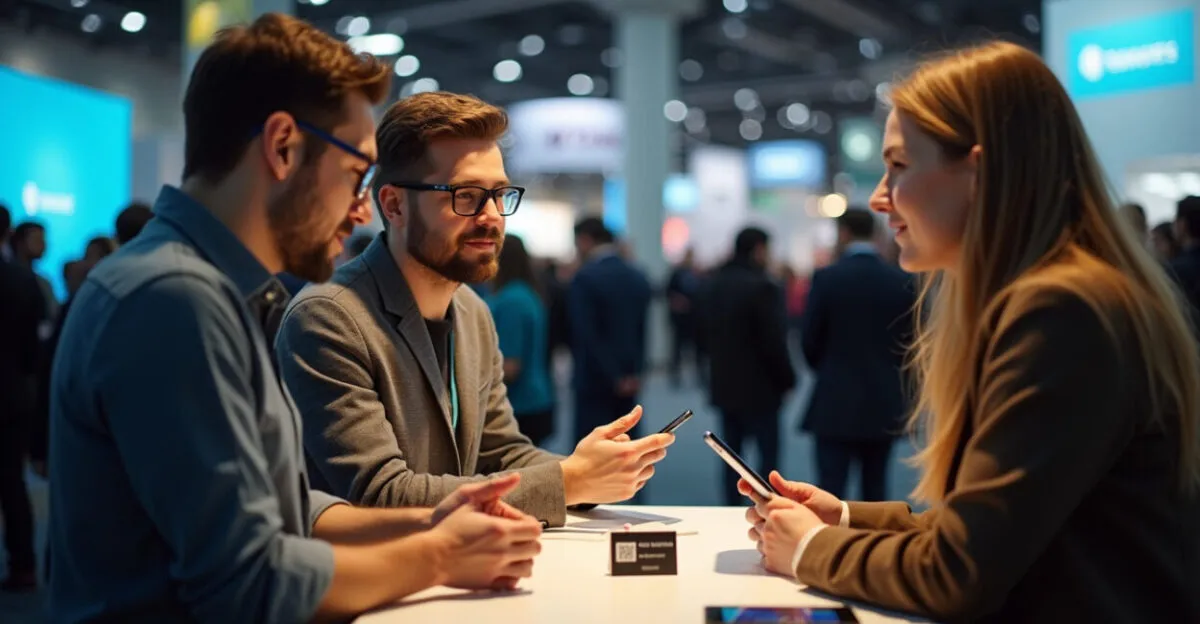
The Short Script for Making Sales and Booking Follow-Ups

At a business expo in 2026, selling isn’t about pushing a catalog. It’s about reducing friction. The easier the next step, the more likely someone is to convert. Have three options ready: buy now, try a pilot, or schedule a meeting.
- Opening: A clear sentence about the problem you solve.
- Proof: A statistic, case study, or quick demo.
- Close: A QR code, WhatsApp, or a calendar booking with a specific time.
Avoid three pitfalls: talking to everyone, relying only on flyers, and leaving without recording who showed interest. The best lead is someone you can follow up with the next day without having to guess who they are. That matters more than having a big booth.
If the event allows it, test your offer on the spot with expo pricing, a closing bonus, or a special deal for first-time customers. Not every situation calls for this, but when the offer is simple, it can speed up results. The expo stops being just a setting and becomes a sales funnel.
Frequently Asked Questions About Business Expos in 2026
Is It Worth Going Without a Booth?
Yes, if your goal is to make contacts and validate your offer. Sometimes, networking effectively is more valuable than paying for a poorly prepared booth. The key is to bring a list of people to connect with, a short pitch, and a practical way to record who shows interest.
What Should I Bring to Look Professional?
Bring a short presentation, a QR code, a business card or digital contact card, and a clear offer. Most importantly, have a 20-second explanation that makes sense without having to wing it. At a business expo in 2026, clarity comes across as more professional than expensive materials.
How Do I Know Whether the Expo Delivered Results?
Track qualified leads, meetings booked, orders, and product feedback. If all you measured was “booth traffic,” you missed key metrics. Real results show up when conversations continue after the event.
Is It Better to Sell on the Spot or Collect Contacts?
It depends on the product, but usually the best approach is to do both. An immediate sale proves value; a well-captured contact can generate revenue later. For higher-priced products, an expo usually works better as a qualification step.
What Most Often Hurts an Expo’s ROI?
Going in without a goal. Many people show up just to “be there” and leave with photos, not opportunities. Those who set goals for contacts, validation, and sales before the event usually come away with much more to show for it.
A good expo isn’t the one that fills your bag with paper. It’s the one that changes your week ahead.
Artigos Relacionados
 UFMG Career Fair: What to Expect and How to Make the Most of It
 Women’s Entrepreneurship on the Rise: 5 Proven Strategies to Build a Successful Business, Attract Investment, and Make an Impact
 Networking: A Tool for Finding Opportunities
 How to Validate a Business Idea: A Proven Method
 Entrepreneurship: How to Spot Business Opportunities
 Profitable Rural Business Ideas: Real-World Examples
