
A table blocking the entrance can stop a conversation before it even begins. An entrepreneurship trade show booth is the physical and visual space that introduces a brand, its products or services, and its value proposition to visitors.
To be effective, it needs to make the message easy to understand, allow people to move around, and offer a clear next step, such as trying a product, starting a conversation, or asking for information.

An appealing offer loses its impact when it’s hidden behind text, displays, or cables. At entrepreneurship events, the space also communicates how a business is organized and how it engages with the public.
Planning starts before setup: you need to choose a goal, understand who you want to stop by, and adapt your display to the space available. Here’s how to turn those decisions into an inviting, easy-to-read environment that fits your budget.
Before you start
- Define the outcome you want: introduce a solution, demonstrate a product, collect leads, or start sales conversations.
- Identify your priority audience and the question they’re likely to have as they pass your booth.
- Check the booth dimensions, trade show rules, power outlets, and setup requirements.
- Take stock of the materials you already have and set a budget for the structure, printing, lighting, and transportation.
What to consider in an entrepreneurship trade show booth
A booth is an in-person touchpoint between a business and its audience. Its purpose is to present the value proposition clearly and support an action aligned with the company’s objectives. That calls for a visible main message, an organized display, and enough room for the team to talk without blocking the aisle.
Start with your business priority. A brand that needs to explain a service might use a short tagline and a visual example; a business selling a physical product may need to let visitors see or try it up close. The messaging should connect what the company offers to the problem it solves, without turning every surface into an ad.
People tend to notice the largest, highest-contrast elements first. A hidden logo, small lettering, or lighting that changes how a product looks can make the display harder to understand. Visitors also scan their surroundings while on the move: long blocks of text high up on a booth are unlikely to get the same attention as a short message placed at eye level.
The space should invite people in, not make them ask permission to enter. Accessibility and circulation guidance is available from Brazil’s National Secretariat for the Rights of Persons with Disabilities, the federal office responsible for disability rights. Specific requirements depend on the event rules and venue, so confirm the organizer’s requirements before finalizing your design.
When the main message is easy to spot, the conversation can start with the business—not with visitors trying to figure out the booth.
How to plan and set up your booth
Plan in this order: goal, audience, space, and display. This sequence lowers the risk of buying structures or printing materials that take up space without helping you meet your goal. The first decision can be simple: if your priority is a demonstration, reserve space for the product; if it’s a conversation, keep the team’s area accessible.
- Choose a measurable goal. “Introduce the solution to companies in the industry” is a better guide for your setup than “get attention.” For a social impact project, validating an idea first can also help you decide what question the booth needs to answer.
- Map out foot traffic. Mark the entrance, table, displays, and team area on paper. Leave a natural path to the conversation area without creating a barrier with counters, chairs, or signage stands.
- Choose what to feature. Show a representative selection rather than putting your entire catalog on display. If you have items in different sizes, group complementary products and keep the main item within view.
- Prepare your marketing materials. Use business cards, brochures, or QR codes only when there’s a clear purpose, such as directing visitors to a demo page or enabling follow-up. Make sure the destination works on a phone and the instructions are easy to read.
- Do a practice setup. Look at the display from a distance and from the perspective of someone approaching from the aisle. A logo hidden by a light fixture or a cable crossing the entrance can easily go unnoticed when you’re planning on a screen.
For example, a small business might bring a piece of equipment and a long list of services. If the goal of the trade show is to demonstrate the equipment, the business can put it front and center, add a brief explanation beside it, and save the full catalog for conversations. That way, the display highlights one choice instead of asking visitors to make sense of everything at once.
To organize team preparation, time blocks can help set aside separate periods for setup, checks, and visitor support, as described in this article about the time-blocking method.
Creative ways to present your business

A creative activation works when it helps visitors understand or experience your value proposition. If an activity requires a long explanation, competes with the main message, or has nothing to do with the product, it can become a distraction.
- Quick demonstration: Show a task the product can help with and explain what to look for. This is useful when the solution’s value is easier to see in action than to describe.
- Sample or guided trial: Invite people to try it, with clear instructions and without creating a line that blocks foot traffic.
- Diagnostic question: Ask a simple question related to the problem you solve. The answer can start a conversation, as long as it doesn’t feel like a disguised form.
- Choice board: Show options, steps, or service applications visually. Visitors can take part while learning how the offer is organized.
- Brief use case: Show an everyday situation that makes the solution’s usefulness clear, without promising results you can’t substantiate.
The right format depends on the product, the audience, and the trade show rules. An experience that requires silence, for example, may not work in a noisy aisle; a simple visual demonstration might communicate the idea better.
Read also: Pitching at an Entrepreneurship Trade Show: How to Sell in 40 Seconds
Those exploring entrepreneurship, education, and the job market can turn a service into a short activity, such as a customer-service simulation or a comparison of two ways to complete a task. It’s also worth avoiding common mistakes that undermine understanding, such as ambiguous instructions or low-contrast text.
How to adapt your booth to the space and budget
In a small space, prioritize the message, access, and a single focal point. A compact booth doesn’t need to replicate every feature of a larger setup; it needs to help people recognize the business and know how to approach.
Allocate your budget based on what each item needs to do. If your offer depends on a demonstration, set aside money for product support and lighting; if it depends on conversation, prioritize team visibility and foot traffic. Reusing an existing structure can free up funds to fix what actually makes the display harder to read, such as faded printing or hard-to-see signage.
Don’t try to make up for limited space by cramming in more content. Too many banners, giveaways, and promotional materials compete for attention and reduce open space. A company that provides solar energy for small businesses, for example, can feature one specific application and make technical details available through a QR code.
There are practical limits to adapting a booth: trade show rules, product format, accessibility needs, and setup conditions may require different choices. Before approving the structure, check the floor plan and exhibitor manual. A cost-effective design won’t work if it blocks access or violates venue requirements.
Visual mistakes and pre-show checklist
The most common problems are too much text, a hard-to-see logo, lighting that obscures details, products with no visual hierarchy, and a table used for storage. These issues often stem from trying to show everything at once. To fix them, choose one main message and remove anything that doesn’t help people understand it or start a conversation.
Finishing touches also affect how trustworthy a booth seems: visible cables, wrinkled materials, makeshift price tags, and crooked displays can make it look disorganized. That doesn’t mean you need expensive materials. It means simple components should look intentional, be clean, and serve a purpose.
Before opening, ask someone who doesn’t know the brand to review the booth. The same test applies whether you’re presenting a youth entrepreneurship proposal or other business ventures: if the person can’t understand what you’re offering without a lengthy explanation, revise the message.
- Readability: Can people read the main message from the aisle? Are the letter size and contrast effective under the venue’s lighting?
- Accessibility: Is the walkway clear, and are materials within reach of your intended audience? If you use QR codes or digital content, also review the W3C Web Accessibility Initiative guidelines.
- Traffic flow: Can someone approach without walking around the table or behind the team? Are cables and boxes out of the way?
- Clarity: Can someone unfamiliar with the brand explain in their own words what it offers and what the next step would be?
- Condition: Are prices, materials, samples, and equipment in good shape? Does the team know where replacement items are stored?
If the test reveals confusion, don’t immediately add more explanations to the display. Try removing elements, moving the message, or opening up the entrance. Sometimes turning a table 45 degrees, clearing a side aisle, or moving a sign that blocks the team’s faces is enough to make the booth more inviting.
Review supporting text, too: short phrases work better when they say something specific instead of using slogans that could apply to any business.
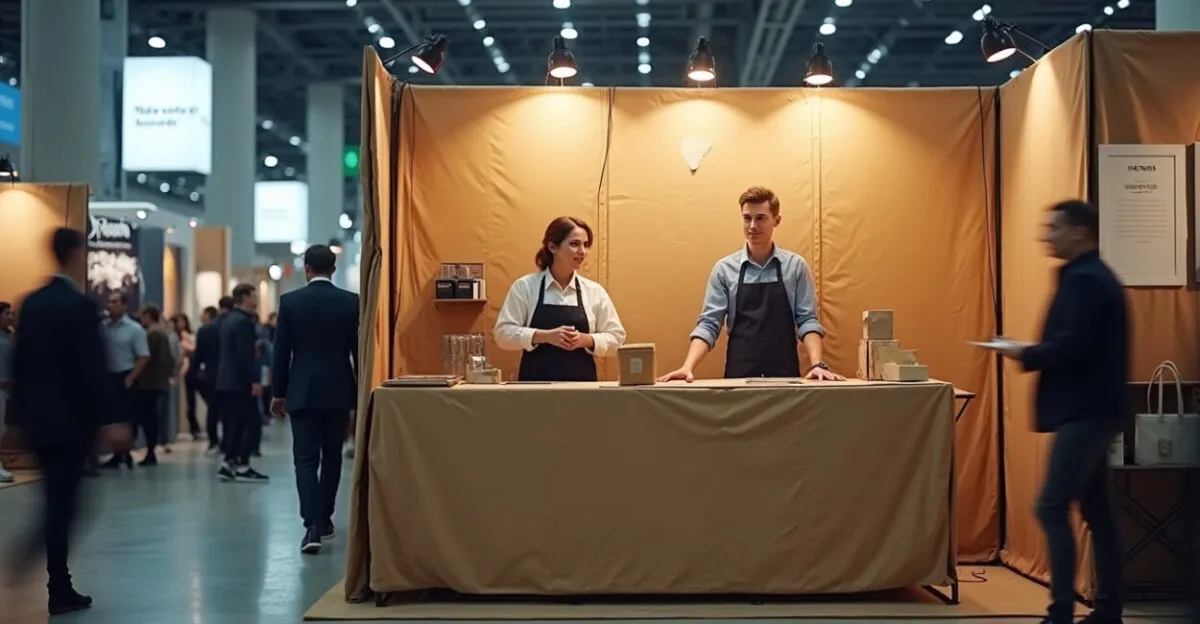
The next step is to sketch the booth layout using the dimensions provided by the organizer and test the message with someone outside the business. If that person can identify the offer, find a clear entrance, and understand how to continue the conversation, the booth is ready for a final materials and setup review.
Frequently asked questions
What is an event booth?
It’s an area set aside for a brand or organization at an event to introduce its work to the public. Depending on the goal and trade show rules, it may include signage, products, demonstrations, and a space for conversation.
How can you tell if a booth communicates the business’s value proposition clearly?
Ask someone who doesn’t know the brand to look at the booth for a few seconds and explain what they understood. If they can’t identify the offer or don’t know where to get more information, adjust the message, visual hierarchy, or foot traffic and repeat the test.
How can you adapt a booth to a small space?
Choose one focal point, keep the entrance clear, and display only items related to the business’s priority. Additional information can go in a brochure or QR code, as long as the digital content is accessible and works on a phone.
Artigos Relacionados
 Entrepreneurship Trade Show Networking: 7 Ways to Find Customers
 15 Movies About Entrepreneurship That Inspire
 Entrepreneurship Podcasts for Sales: Topics That Convert
 Free Online Entrepreneurship Course: 5 Common Mistakes
 Creative Portfolio for Clients: The Mistake That Costs You Work
 Creative Entrepreneurship in 2026: 7 Paths That Sell
