
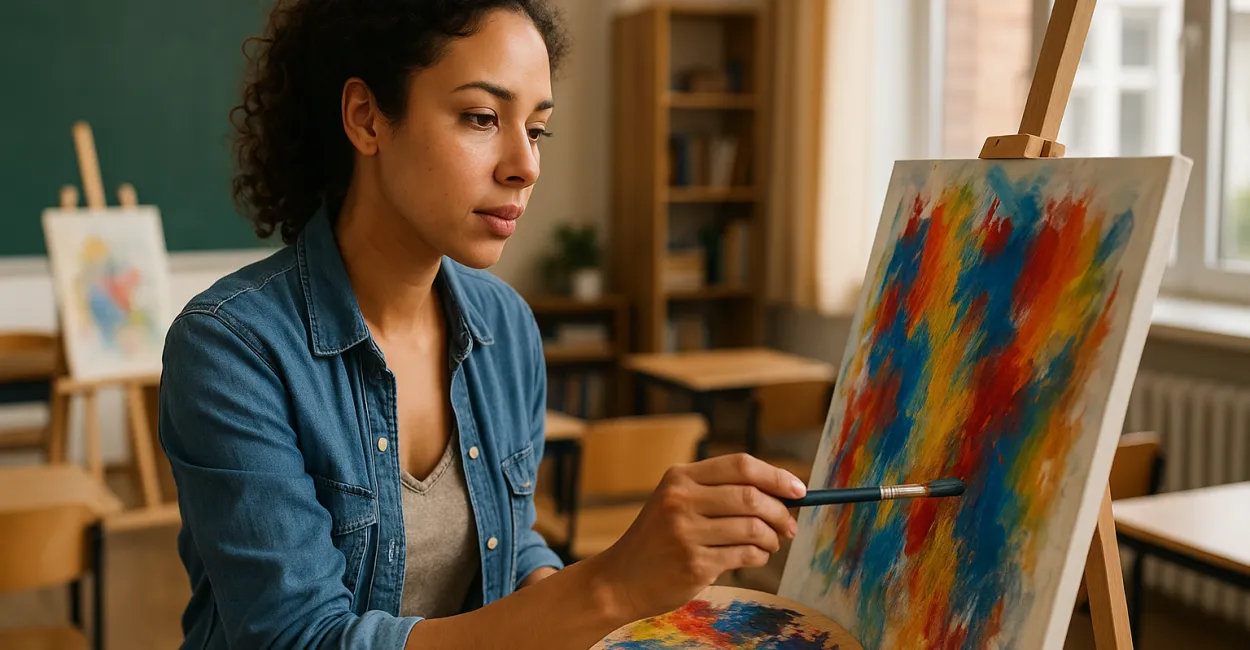
Art is neither a social ornament nor a luxury for calmer times. It organizes emotions, gives shape to collective memory, and changes how a community thinks, learns, and understands itself.

In education, its impact goes beyond sensitivity: it builds knowledge, broadens students’ perspectives, strengthens expression, and creates room for critical thinking. Art connects schools, culture, civic life, and emotional health all at once. Read on to learn what art looks like in practice, why it matters so much, and how it shows up in everyday life, both inside and outside the classroom.
What You Need to Know
- Art is a symbolic language that transforms human experience into form, image, sound, movement, or words.
- In education, it develops perception, cultural awareness, coordination, listening, and argumentation.
- Art’s value lies not only in the finished product, but also in the process of creating, interpreting, and sharing.
- Art projects work best when they connect with real-world contexts rather than becoming decorative activities.
- Arts education helps students become more expressive, attentive, and able to read the nuances of the world around them.
Art, Education, and Society: Why These Three Fields Come Together
Technically speaking, art is a form of symbolic production that uses mediums such as drawing, painting, music, dance, theater, literature, film, and visual arts to communicate meaning. Put simply, it is a human way of turning lived experience into an expression that can be shared.
This may sound simple, but it changes everything. When a school treats art as a peripheral subject, it loses a tool for understanding the world. When it treats art as central to learning, it makes room for imagination, interpretation, and taking a stand. That is why art plays such a prominent role in discussions about curriculum, inclusion, and well-rounded development.
What sets art apart from a merely decorative activity is its ability to create meaning, invite interpretation, and reshape the experience of both the creator and the observer.
This understanding aligns with educational and cultural guidelines championed by international organizations. UNESCO, for example, provides documents on arts education and culture that emphasize the connection between expression, learning, and social participation.
Where art makes a real difference
- When it helps students name emotions they had not yet found a way to explain.
- When it connects classroom content with local culture, place, and identity.
- When it makes room for interpretation rather than expecting a single right answer.
Artistic Mediums and What Each One Develops
Not every art form does the same work. Painting builds observation and visual composition skills. Music develops rhythm, memory, and listening. Theater builds stage presence, improvisation, and an ability to read context. Dance brings together the body, space, and intention. Literature expands vocabulary, imagination, and narrative comprehension.
In practice, these mediums constantly overlap. A school project might start with reading a poem, move on to designing a set, and end with a performance. This kind of integration often yields more than disconnected, standalone classes because students see the relationship between what they learn and what they create.
On the official website of Brazil’s Ministry of Culture, you can follow policies and initiatives that show how culture and education go hand in hand in Brazil. This matters because arts education does not happen in a vacuum: it depends on access, context, and continuity.
What each medium commonly develops
| Medium | Common areas of development | Practical uses |
|---|---|---|
| Visual arts | Observation, composition, spatial awareness | Drawing, painting, photography, collage |
| Music | Listening, rhythm, memory, attention | Singing, percussion, sound creation |
| Theater | Expression, improvisation, empathy | Acting, dramatic readings, theater games |
| Dance | Coordination, body awareness, rhythm | Movement, choreography, physical exploration |
| Literature | Vocabulary, interpretation, imagination | Poems, short stories, essays, novels |
Why Art Strengthens Learning at School

Anyone who works in education knows that not every student learns the same way. Some learn best by listening; others by writing; many by doing. That is where art comes in: it offers multiple ways to engage with content, increasing the chances of genuine involvement.
The most common mistake is to think that art activities are just a way to “give the class a break.” That misses the point. A good art project requires attention, decision-making, revision, and critical thinking. In other words, it develops cognitive and social-emotional skills at the same time.
At school, art works when it stops being a break between lessons and becomes a tool for developing thought.
A common example
An elementary school class was assigned to create posters about conserving water. At first, the assignment seemed simple. But when the teacher asked each group to explain its choices of colors, fonts, and images, the activity took on a new dimension. Students began defending their ideas, comparing arguments, and revising their work. The final posters were better, but the real gain was something else: students learned to justify their decisions.
This kind of experience is common in schools. Sometimes, the difference between a forgettable lesson and a memorable one comes down to how the teacher guides the process, not the materials used.
Expression, Identity, and Emotional Health in the Same Process
Art is also valuable because it helps people understand themselves. Children and teenagers often find a safe space to talk about themselves through drawing, music, or theater without needing a prepared speech. This does not replace psychological support when it is needed, but it does provide a valid channel for expression.
There is, however, an important distinction: art is not therapy by definition. It may have therapeutic effects, but it does not automatically take the place of professional care. This nuance matters because it avoids romanticizing art and protects its use in education.
Research and reports on culture and well-being from universities and research centers have highlighted the role of cultural participation in quality of life. A good place to start is Harvard University, which regularly publishes research and studies on health, education, and behavior that can help explain these connections.
When art is most helpful
- When the environment allows for trial, error, and revision without humiliation.
- When students create original work rather than produce disguised copies.
- When students see a connection between what they create and their own lives.
Culture as a Foundation: Museums, Heritage, and Place
Talking about art without talking about culture makes the subject less rich. Museums, cultural centers, community festivals, graffiti, documentary photography, and intangible heritage show that artistic production does not exist only in galleries. It also belongs on the street, in the neighborhood, at school, and in family memories.
In Brazil, this is clear in the strength of cultural expressions such as maracatu, samba, cordel literature, independent films from low-income communities, and urban visual arts. These worlds are not mere accessories to the country; they help explain who Brazilians are. For data on cultural participation and consumer habits, consult the IBGE, Brazil’s national statistics agency, which publishes social research and national statistics.
Not every cultural space has the same impact. A museum with a good guide can deeply broaden students’ horizons; a rushed visit without conversation or context usually accomplishes little. The difference lies in the educational framing and interpretation.
How to Teach Art Without Letting It Become a Hollow Activity
Weak art projects tend to follow a clear pattern: they ask students to make something but offer no examples; ask for creativity but do not explain the goal; and ask for participation but do not listen. The result is often a pretty display and shallow learning.
Better projects follow a different approach. First, they introduce examples. Then, they encourage observation. Next, they allow for experimentation and revision. Only then do students share their work. This process works in schools, arts workshops, and community projects.
- Choose a topic that connects with the group’s lives.
- Show real works, artists, or cultural expressions related to the topic.
- Invite students to create within clear guidelines that leave room for originality.
- Include an opportunity to speak, read, or present.
- End with reflection on the process, not just the final product.
This approach works well when there is time to follow the process. It falls short when the goal is simply to rush something out by the end of class. In those cases, the work may look polished, but the learning remains shallow.
The Value of Art in Civic Development
People who have meaningful exposure to art tend to be better at interpreting symbols, narratives, and competing meanings. This matters when voting, making arguments, consuming media, recognizing manipulation, and understanding cultural diversity. In a diverse country, this ability is not a minor detail; it is a civic skill.
Arts education also challenges the idea that knowledge only counts when it can be reduced to a number. Not everything that matters fits into a multiple-choice test. Aesthetic sensitivity, the ability to interpret, and creative authorship are tangible dimensions of human development.
Art does not replace other fields of knowledge, but it deepens our ability to learn, interpret more precisely, and communicate with greater intention.
Next Steps for Bringing Art Into Everyday Life
If you want to take the subject seriously, the best approach is to start small and stay consistent. Look at what is already nearby: a museum, a library, a theater group, a local artist, a traditional festival, or a digital collection. From there, connect the experience with reading, creating, and conversation.
For schools, the next step is both simple and demanding: include art as a way of thinking, not as a way to fill the schedule. Families can encourage visits, listening, and exposure to different forms of creative work. If you want to explore the subject further, a good next step is to compare real art projects, assess how they are presented, and see whether they leave room for genuine original work.
Frequently Asked Questions
What is art, in simple terms?
Art is a form of symbolic expression that transforms experiences, ideas, and emotions into visual, auditory, physical, literary, or performance-based language. It communicates meaning and invites interpretation; it is about more than beauty.
What is the difference between art and entertainment?
Entertainment is primarily meant to amuse and hold people’s attention. Art can be entertaining, but it can also spark reflection, discomfort, memory, and social criticism. Not all art is pleasant, and that is part of its purpose.
Why is art important in education?
Because it develops perception, cultural awareness, listening, creativity, and the ability to express ideas. It also increases student engagement when learning requires interpretation and original work.
Does art help with emotional development?
Yes, because it offers ways to express things that may not come up in direct conversation. Children, teens, and adults can work through feelings by creating, reading, and experiencing art. This does not replace professional support when it is needed.
Does every art project need to be assessed?
Yes, but assessment should consider the process, participation, engagement with examples, and ability to revise the work. Judging only the final result often limits learning.
How can I start studying art today?
Start by looking at works of art, visiting virtual museums, reading about artists, and comparing different mediums. Then try making something short: a drawing, piece of writing, photo, scene, or composition. Learning becomes more powerful when observation and practice go hand in hand.
Artigos Relacionados
 Distance Learning: 12 Essential Tips to Get the Most Out of Online Education
 Librarian: An Essential Role in Modern Society
 Education: The Essential Role Parents Play in Child Development
 Bilingual Education: Is It Worth Investing in International Education?
 Education and Artificial Intelligence: Transforming Learning in the 21st Century
 The Essential Journey to Sustainable Career Growth
